

The debt of the province of Buenos Aires with the #TransWorkQuota law
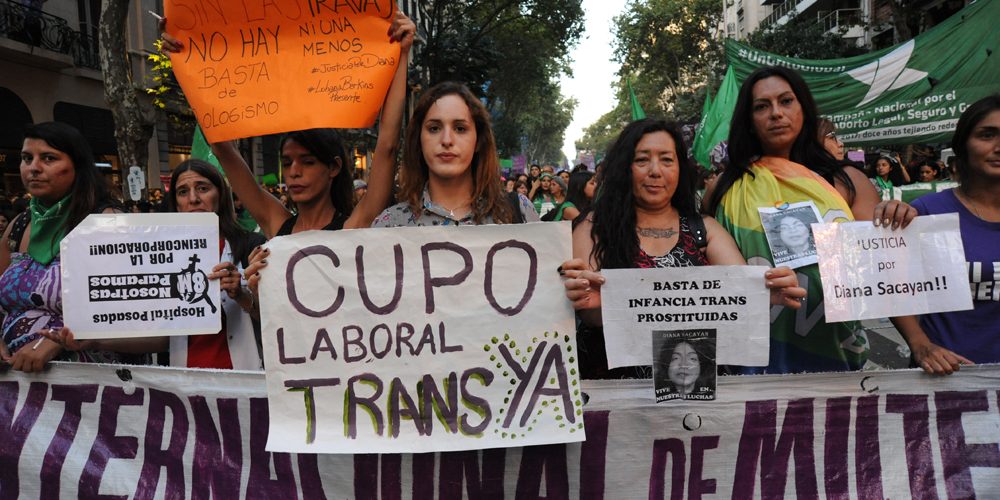
Thirty-one months after the quota was approved, the Buenos Aires provincial government still hasn't signed the implementing decree to put it into effect. "Every day that passes without the law being enforced is another night that our female colleagues take to the streets, exposed to violence," said Sasha Sacayán, brother of Diana Sacayán and an activist.

Share

By Anita Aliberti. The story of the trans quota law in the province of Buenos Aires is a story of endless waiting. Thirty months after its approval, it remains unimplemented because the Buenos Aires provincial government has not signed the implementing decree to put it into effect. “Every day that passes without the law being enforced is another night that our sisters take to the streets, exposed to violence and death,” Sasha Sacayán, brother of trans activist Diana Sacayán and coordinator of the organization Anti-Discrimination Liberation Movement (MAL), told Presentes. Law 14.783 was passed on September 17, 2015, a month before its creator, trans activist Diana Sacayán, was brutally murdered. The law is groundbreaking worldwide, as it mandates that the provincial government employ at least 1% trans and gender-diverse people in public administration. “Why hasn’t Governor María Eugenia Vidal signed the regulations?” “We can’t say because we’ve never had an effective response on this issue,” Karina Nazábal, former provincial deputy and drafter of the law, told Presentes. “We sense that, within the framework of a conservative government, there is a refusal to end these binary systems of woman-man, worker-employer, poor-rich: we believe that this is the challenge the law poses to this system ,” Nazábal added.
[READ ALSO: #TransWorkQuota What's happening with the law in the province of Buenos Aires?]
“Regulation is urgent.”
According to the report "The Butterfly Revolution" —created by the Gender and Sexual Diversity Program of the Public Prosecutor's Office of the City of Buenos Aires and the Mocha Celis High School—70% of the trans and travesti population lives off prostitution from the moment they leave home: before turning 18, when they are still minors. "The need for the governor to sign this regulation is so urgent that only those who live and suffer through prostitution as their only option can truly understand it," said Nazábal.
"The debate surrounding this law challenges us more than ever because we are currently going through the trial for the transphobic murder of Diana Sacayán," Nazábal said. "Diana's story is once again making headlines: with her own life, with her own body, and in this case, with her own death, where the concept of transphobic murder will be considered in a trial for the first time in Argentina." "Doing justice for Diana is continuing her legacy," said her brother.
[READ ALSO: #Argentina: progress and shortcomings of the trans employment quota]
A national campaign
Teacher and trans activist Quimey Ramos said: “A national campaign for implementation is necessary. When the law was passed, many organizations decided to say they were already beginning to comply with the quota.” Because it was not regulated, the hiring process was not formalized, there was no open competition, and no calls were made for resumes. This allowed jobs to be taken with very precarious contracts, with very few job security guarantees, and also made it impossible to properly monitor this group.he added.
A social transvesticide
Florencia Guimaraes is 36 and identifies as a survivor of prostitution. Along with her acquaintances, she keeps a kind of informal tally of the number of trans women who die each day. The figure is alarming: she says that so far this year , 30 trans and travesti people have been killed. “We’re not just talking about hate crimes, but about a social transvesticide : those who die in hospitals, in the worst conditions, due to the negligence of the state and a society that normalizes the idea that the role of trans women is within the prostitution system,” she told Presentes. “Every time one of our sisters dies, a little bit of us all dies,” she added.
“ Trans women have the right to live without fear of being taken to a police station and raped, of being forced into a car and not knowing where you’ll end up. We have the right to go to work knowing that we won’t be killed that same day,” Guimaraes said.
[READ ALSO: Transgender employment quota regulated in Resistencia: “It is a historical reparation”]
“They want to make us disappear”
Valentina Pereyra is a leader of the Association of Transvestites, Transsexuals, and Transgender People (ATTTA) in La Plata. Like Florencia, she searches the news for the names of her deceased comrades. “We don't find out about many of them because they die as unidentified or because they are registered with their former name, not their self-identified name,” she said. “Despite our attempts to work with the Secretary of Human Rights, Santiago Cantón, all we've received from this government is imprisonment and exclusion, raids, illegal searches, and persecution of trans migrant comrades. This administration wants to make us disappear,” she told Presentes.
Since the law's enactment, the provincial government has convened the LGBTI organizations that championed it to discuss its implementation. However, they haven't heard anything since last year. Presentes tried to contact the Secretary of Human Rights, Santiago Cantón, and his press office said that since there were no further developments, he had nothing to say.
"Having a formal job changes your life."
“It’s incredible how much access to formal employment changes your life,” Ivana Gutiérrez told Presentes. “You gain access to rights you didn’t even know existed .” Ivana is a member of Conurbanxs por la Diversidad (Conurbanxs for Diversity) and worked for three years in the Undersecretariat of Employment and Social Economy in Morón, thanks to a social employment program promoted by the municipality. She reports that in 2016, when Ramiro Tagliaferro of the Pro party took office as mayor, a pattern of harassment began. “Since they couldn’t afford to fire me, they started using violence against me to make me give up and resign,” she said. Then one day they left her a sign that sounded like a threat: “Repentant macho, now it’s your turn.” She reported it to her boss, and when she received no response, she went to the Center for Living Without Violence and initiated legal action. Now she works for the Public Defender’s Office, one of the state agencies that adopted the Quota Law a year and a half ago.
[READ ALSO: Transgender employment quota approved in Río Grande, Tierra del Fuego]
The municipalities that adhered to the law
“The law has taken hold on its own, and many municipalities in the province have already adopted it. Not implementing it is not only denying a person the right to work, but also denying the possibility of providing employment to those who do want to work,” said Saay Sacayán.
So far, the municipalities of Avellaneda, Lanús, Morón, Almirante Brown, Merlo, Tres de Febrero, and San Miguel have adopted the trans employment quota law. It has also been approved in the towns of Azul, Chivilcoy, and Campana. Bills have been introduced in Lomas de Zamora, Quilmes, Hurlingham, La Matanza, Esteban Echeverría, Moreno, Florencio Varela, and Ituzaingó, but have not yet been approved. In the city of La Plata, an emergency law regarding the quota was passed. In Mar del Plata, an unprecedented resolution promoted by the Lohana Berkins free chair guaranteed 1% of the non-teaching positions at the National University of Mar del Plata to trans and transvestite people: in December they incorporated two trans workers.
[READ ALSO: The trans job quota incorporated the first trans worker in the country in Venado Tuerto]
“Being a trans person is not a disability; you can’t be dependent on others for life. Autonomy comes when a trans person can choose a job. That’s what Diana envisioned, and it’s the path she showed us. If Diana were here, she would be fighting for a national law today,” said Sasha.
We are present
We are committed to journalism that delves into the territories and conducts thorough investigations, combined with new technologies and narrative formats. We want the protagonists, their stories, and their struggles to be present.
SUPPORT US

FOLLOW US
Related notes

We are present
This and other stories are not usually on the media agenda. Together we can bring them to light.