

#DianaSacayánTrial: A witness testified about the night of the transvesticide
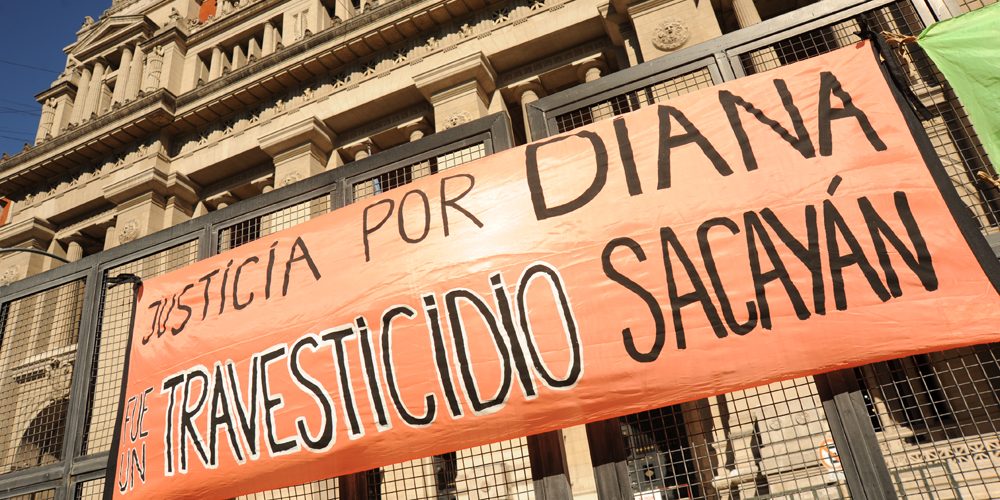
After last Monday's suspension due to the impossibility of transferring the accused from prison, today was the fifth hearing of the trial for the transvesticide of Diana Sacayán, the Argentine human rights defender savagely murdered in October 2015.

Share

By Ana Fornaro and Maru Ludueña Photo: Ariel Gutraich After last Monday's suspension due to the impossibility of transporting the accused from prison, today marked the fifth hearing in the trial for the transphobic murder of Diana Sacayán , the Argentine human rights defender brutally killed in October 2015. Rain forced the cancellation of activities organized by LGBTQ+ activists in Lavalle Square, across from the courthouse, since the start of the trial. These activities were intended to support family and friends in this historic process, in which the justice system, for the first time, is using the term "transphobic murder." At 12:30 p.m., the courtroom of the Oral Criminal Court No. 4 of the City of Buenos Aires—comprised of judges Adolfo Calvete, Ivana Bloch, and Julio Báez—was nearly full to hear the five summoned witnesses. Ultimately, only three appeared. Two members of the Scientific Police, who were responsible for the DNA analysis, were also absent.
[READ ALSO: #DianaSacayánTrial: the fourth hearing focused on who the accused is]
The first to testify was MR, the partner of the grandmother of the accused, David Gabriel Marino, and one of the people responsible for his upbringing. Marino's lawyer, Lucas Tassara, called him to recount what Marino was like during his childhood and adolescence. At 78 years old, MR had great difficulty speaking and understanding the questions he was asked, but he said—several times—that he had known Marino "since he was little" and that he had always been close to him. First living with him—until the accused was 18 or 20 years old—and then visiting him and his mother. He also said that Marino had finished high school as a good student. And that he was aware of Marino's problems with drugs, but that after his stay at the former Cenareso rehabilitation center, "he did well." MR's testimony was brief and gave way to the two witnesses for the prosecution, represented by lawyer Luciana Sánchez. For this, the accused requested not to be present in the courtroom, thus avoiding a confrontation with these two people. He listened to their testimonies from the adjacent room.A witness to the night of the crime
The first to speak was CM, a neighbor from the Flores building where Diana Sacayán lived and where she was murdered between Saturday, October 10th, and Sunday, October 11th. According to his written statement—which he ratified orally today—CM, who said he didn't know Diana or Marino by name, returned home and when he opened the front door, he saw two people inside who were "hiding." As soon as the door opened, they left the building. "It was Saturday. I think it was 2 a.m. I was coming back from an event. I arrived after my wife and children. I opened the door, and just then a person I didn't know came out. I was going in, and I held the door open for him to leave. There was always someone from security, but not that night. I don't remember the people's faces. I only remember that he had red eyes and that he was hiding next to the security desk chair. He heard the door and came out."[READ ALSO: #DianaSacayánTrial: the autopsy showed that she was murdered with ferocity]
When CM's statement in court on October 26, 2015, was read, he consistently referred to two people and gave the time as 4:00 AM. "Were there two people?" "Yes, I said there were two at the time, there were two. They were both together. I don't remember anything because it was just a second." CM also stated that they were never able to create a composite sketch of the individuals because he didn't have enough details. He also said he couldn't identify anyone in the lineup.The witness who met Marino at a nightclub
The last to testify was CO, a professional makeup artist who, for a long time, dedicated himself to making bodypainting in nightclubs in Buenos Aires. According to her account, one of those nights—she doesn't remember when—she met Marino and gave him her card. He called her. And then they saw each other “at most five times.” “Were you in a relationship?” asked lawyer Sánchez. “No, he came up for a drink once, and I also ran into him on the street in Once. I think he was selling alfajores.” “And why didn't you see him again?” “I don't know.” “Did you see him on the night of Saturday, October 10, 2015?” “No, I hadn't seen him for about a year at that time.” “When was the last time you saw him?” “I think it was when they summoned me here that year.” “Did he ever ask you for money?” “Yes, once, like everyone does.” At this hearing, the representatives of the Public Prosecutor's Office – Ariel Yapur, representing the General Prosecutor's Office No. 5 before the Oral Criminal Courts, and Mariela Labozzetta, representing the Specialized Prosecutor's Unit for Violence against Women and LGBTIQ+ People (UFEM) – and the plaintiff, the National Institute against Discrimination, Racism and Xenophobia (INADI), represented by Juan Kassargian, did not ask any questions of the witnesses. It was agreed with the Court that the hearing schedule would continue as follows: May 2 at 9:00 a.m.; May 7; May 14; and May 21.We are present
We are committed to journalism that delves into the territories and conducts thorough investigations, combined with new technologies and narrative formats. We want the protagonists, their stories, and their struggles to be present.
SUPPORT US

FOLLOW US
Related notes


We are present
This and other stories are not usually on the media agenda. Together we can bring them to light.