

#DianaSacayánTrial: the fourth hearing focused on who the accused is
By María Eugenia Ludueña and Ana Fornaro. Photos: Ariel Gutraich. The fourth hearing in the trial for the transphobic murder of Diana Sacayán began at 2:30 p.m. because there wasn't a large, available courtroom in the Buenos Aires Palace of Justice. It's a historic trial because for the first time…

Share

By María Eugenia Ludueña and Ana Fornaro. Photos: Ariel Gutraich. The fourth hearing in the trial for the transphobic murder of Diana Sacayán began at 2:30 p.m. because there wasn't a large, unoccupied courtroom available at the Palace of Justice in Buenos Aires. It's a historic trial because, for the first time, the word "transphobic murder" is being used in legal terms, with strong public support. Outside, as has been the case since the first day, activism is in full swing thanks to an open mic, signs, artists, a street fair, and numerous expressions of support for Diana's family, disrupting the stiff, homogenous atmosphere of Lavalle Square, usually filled with suits and legal documents.
There are always at least 50 people present at the hearings, including the public and the members of the Criminal Court No. 4 of the City of Buenos Aires – Adolfo Calvete, Ivana Bloch and Julio Báez –; the representatives of the Public Prosecutor's Office – Ariel Yapur representing the General Prosecutor's Office No. 5 before the Criminal Courts and Mariela Labozzetta for the Specialized Prosecutor's Unit for Violence against Women and LGBTIQ+ people (UFEM); the plaintiffs of the Sacayán family represented by Luciana Sánchez; the plaintiffs of the National Institute against Discrimination, Racism and Xenophobia (INADI), represented by Juan Kassargian, the defense team, headed by Lucas Tassara; the accused David Gabriel Marino; the court employees and the police.[NOW] Sasha Sacayán, Diana's brother, before entering the fourth hearing at the Buenos Aires courts for the transphobic murder of the human rights defender. pic.twitter.com/gh0SjEIdt6
— Presentes Agency (@PresentesLGBT) April 9, 2018
There are about 30 seats for the public, and each hearing typically maintains certain seating categories: in the first row, Say Sacayán, Diana's brother and a plaintiff, a trans man from Laferrere who, in addition to being one of the main driving forces behind the trial, is the coordinator of the Anti-Discrimination Liberation Movement (MAL), which Diana founded. In the second row are Diana's eyes, mouth, hair, and gestures, mirrored in those of the Sacayán family. Many women and some men sit there every week wearing t-shirts demanding justice. In the third and final row, more activists, representatives from various institutions, and a handful of journalists.[NOW] #JusticeForDianaSacayan Luciana Sánchez, the family's lawyer, explains how the trial is progressing before entering the fourth hearing for the transphobic murder. pic.twitter.com/rTJxAVIBTI
— Presentes Agency (@PresentesLGBT) April 9, 2018
The accused, smiling
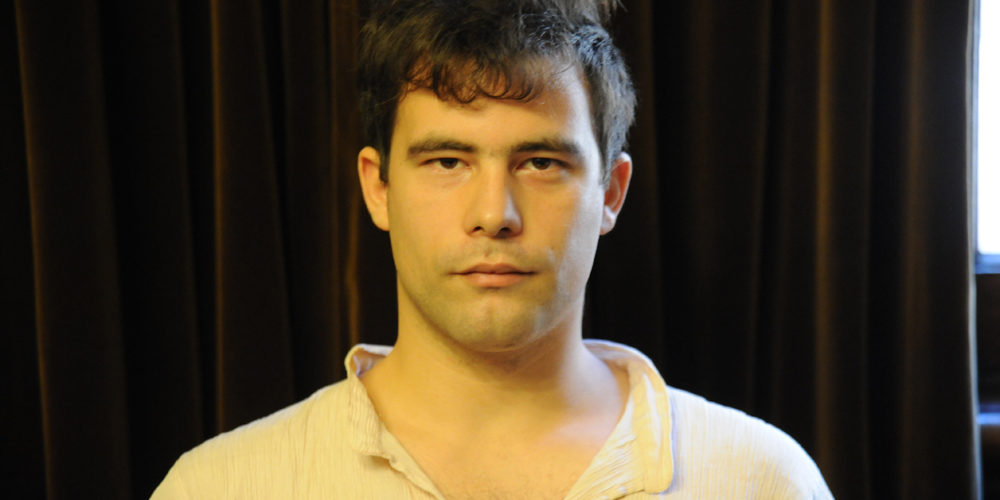
Gabriel David Marino, the 25-year-old accused of the transvesticide, was present during the testimony of the two witnesses throughout the two-hour hearing. Unlike the defiant gaze of the first day, and the yawns he displayed in the morning when autopsy photos were shown, his demeanor at this hearing was one of quiet humor. At one point, he was close to laughter when a witness who knew him recounted how he had thrown his cell phone in the toilet. At another, the witness looked at Marino conspiratorially, and the judge brought him back to reality. “Can you tell me what you’re looking at?” she snapped.The first witness was an inspector who participated in the raid and arrest operation of Marino at his family home in Morón. His statement was brief, barely ten minutes, in which he confirmed that some articles of clothing were seized during the operation, including a striped sweatshirt that had also been mentioned in other hearings. “I met Marino going into an internet café at the corner of Artigas and Yerbal streets in 2015.” This is how the second witness, MD, a man over 60 years old who said he had been an accountant for 32 years, began his testimony. His testimony was lengthy, lasting almost an hour and a half, and initially exasperated prosecutor Ariel Yapur. The witness recounted that on the day they met (according to the witness, between April and June of 2015), “Marino was very friendly and approachable, polite, and well-spoken.” He was on the corner with Félix Ruiz Díaz, who is also involved in this case (he is being investigated for the same events). "Marino told me about his addiction problems; he had been kicked out of his house, he wanted to work with me, he asked me for a job. I got the impression that he needed to talk to someone. I encouraged him to go to Cenareso (formerly the National Center for Social Recovery)."— Presentes Agency (@PresentesLGBT) April 9, 2018
[NOW] From the courts in Buenos Aires, actress and trans activist @yodivinadaniela explains why it's important to demand justice for the transphobic murder of Diana Sacayán. pic.twitter.com/XPvmxt3Pa6


The Fairly OddFather
Marino was at the Cenareso rehabilitation center, and according to other witnesses, he met Diana there. “When he was hospitalized, I would bring him cigarettes every day. They let him go outside with me. He called me The Magic Godfather.” “Why did you help him?” Prosecutor Yapur asked. “Because of my beliefs. I’m a believer, even if you aren’t.” Later, the prosecutor asked him how he learned of Diana’s death. “On the internet,” he replied. He recounted that days later he visited Marino’s mother. “She was sewing a torn pair of jeans; it was a cut made with scissors. Marino’s mother told me that he had gotten into a fight with Sacayán and had been injured,” he said. This is the first time in the trial that someone has said Marino confessed to the crime, because until now the accused has not spoken. When questioned about the relationship between Marino and Diana, he said, “She told me she was going to Sacayán’s house to use drugs.” It is also the first time that "Sacayán" has been spoken of in this way during the trial; from a distant place.[READ ALSO: #DianaSacayán: This is how the first day of the trial for transvesticide was experienced]
Until now, as in any trial, the testimonies had focused on Diana, the victim. Those who testified included direct witnesses to forensic examinations (such as the doctor who performed the autopsy) and operational procedures (at the crime scene, during the arrest), as well as people who knew Diana (her brother, friends, fellow activists). Yesterday, signaling that the trial is entering a new phase, someone testified for the first time, revealing Marino's identity. In another part of the testimony, the witness recounted that someone—whom the witness assumed was Marino—rang his doorbell at three in the morning on October 11, the date the autopsy determined Diana was murdered. But the witness said he didn't answer. "The next day I went to Cenareso and found out that Marino had checked himself back in," he said. Prosecutor Labozetta, from the UFEM (Specialized Unit for Violence Against Women), asked him if he had spoken with Marino about what happened the night the doorbell rang. The witness said no, but recounted that when he went to Cenareso, Marino told him that he had had “a fight over the substance”.“Marino was violent and capricious”
In his statement, the witness repeatedly mentioned gifts and favors Marino requested: sometimes money, sometimes clothes, which—according to the witness—Marino asked for for his mother, who had “a baby” and “couldn’t even afford milk,” although at another point he said the mother was a chef. “Marino was known for his extortion, his insolent demands, like when he asked me (referring to the period of detention) for name-brand shampoo and menthol cigarettes, not acknowledging his situation.” The plaintiff’s lawyer, Luciana Sánchez, asked him how much he spent on gifts for Marino and how much money he gave him: 500 pesos a week, he estimated. He said Marino only came to his house once. He also said that he was the one who picked up Marino's addiction medication from Cenareso and took it to his mother's house ("she didn't have enough to eat, I often gave her groceries"). He recounted situations related to Marino's addiction, including one in which the young man asked him, during one of his special outings while at Cenareso, to accompany him on the bus to buy drugs. The witness said he waited for him at the bar across the street. The judge asked the witness why he didn't refuse to accompany him in those situations: "I don't use drugs, and I never have. But Marino was violent and capricious." Later in his testimony, he said that Marino also had fits of rage. More than once, the witness did not answer the questions clearly, and the court, the defense, and the prosecution had to rephrase the question. At times, he mixed up information, sometimes he was defensive, or he recounted situations from his personal life: "I had a stroke, my family tried to take everything from me, they took my apartment."[#DianaSacayánTrial: the autopsy showed that she was murdered with ferocity]
Judge Báez asked him why he was so friendly with Marino. The witness replied: "Out of affection. If Marino hadn't had that addiction problem, I could have married him in a same-sex marriage.""How many Marines are out there?"
At the end of the hearing, Gabriela Mansilla, Lulú's mother—Lulú being the first trans girl to legally change her gender identity without a court battle at the age of six—and head of the organization Infancias Libres (Free Childhoods), left the courtroom deeply moved. “There is so much outrage. Diana's death is infuriating. And to be here, to see the accused laughing, with the entire Sacayán family present, is awful. As if the lives of trans women don't matter. I have a trans daughter, and right now I'm going to a meeting where six trans girls are waiting for me. I'm going to see them knowing that one day they could be Diana. How many Dianas are there? And how many Marinos are out there?” she said as she left the courthouse, on her way to Lavalle Square.Many organizations and individuals were waiting there, including students from the Mocha Celis Popular High School. They were the first to speak at the closing of the event. The floor was passed from activist to activist. It was half an hour of powerful, organized, and collaborative discourse surrounding the trial for the transphobic murder and its historical significance. It is a trial that can change history because, as Luciana Sánchez explained, it seeks not only a conviction but also reparations and public policies for prevention. Because, as Say Sacayán said, "this is not just about Diana, but about the justice system addressing the deaths of trans women." The first fifteen minutes of this hearing were spent dealing with scheduling problems and trying to coordinate the calendars of the court, the courtroom, other courts that operate in the same room, the prosecution, and the defense. They have a full schedule of hearings that have also been waiting for a while, and coordinating them is difficult because in the Argentine justice system, you have to squeeze in a few slots. Finally, the dates for the next four hearings were agreed upon: April 16 and 20 (witness statements), May 7 and 14 (arguments).[NOW] Higui de Jesús came to the courthouse to demand #JusticeForDianaSacayan and to support the family and activists. Higui knows what sexist justice is because she experienced it firsthand. pic.twitter.com/pvjzAjCAwi
— Presentes Agency (@PresentesLGBT) April 9, 2018
We are present
We are committed to journalism that delves into the territories and conducts thorough investigations, combined with new technologies and narrative formats. We want the protagonists, their stories, and their struggles to be present.
SUPPORT US

FOLLOW US
Related notes


We are present
This and other stories are not usually on the media agenda. Together we can bring them to light.