

#DianaSacayánTrial: the autopsy showed that she was murdered with ferocity
By Ana Fornaro and María Eugenia Ludueña. Diana Sacayán was brutally murdered in her own home, while defenseless from the severe beating she had received. The trans activist and human rights defender was bound, gagged, attacked in numerous ways, and fatally stabbed. This is what she told…

Share

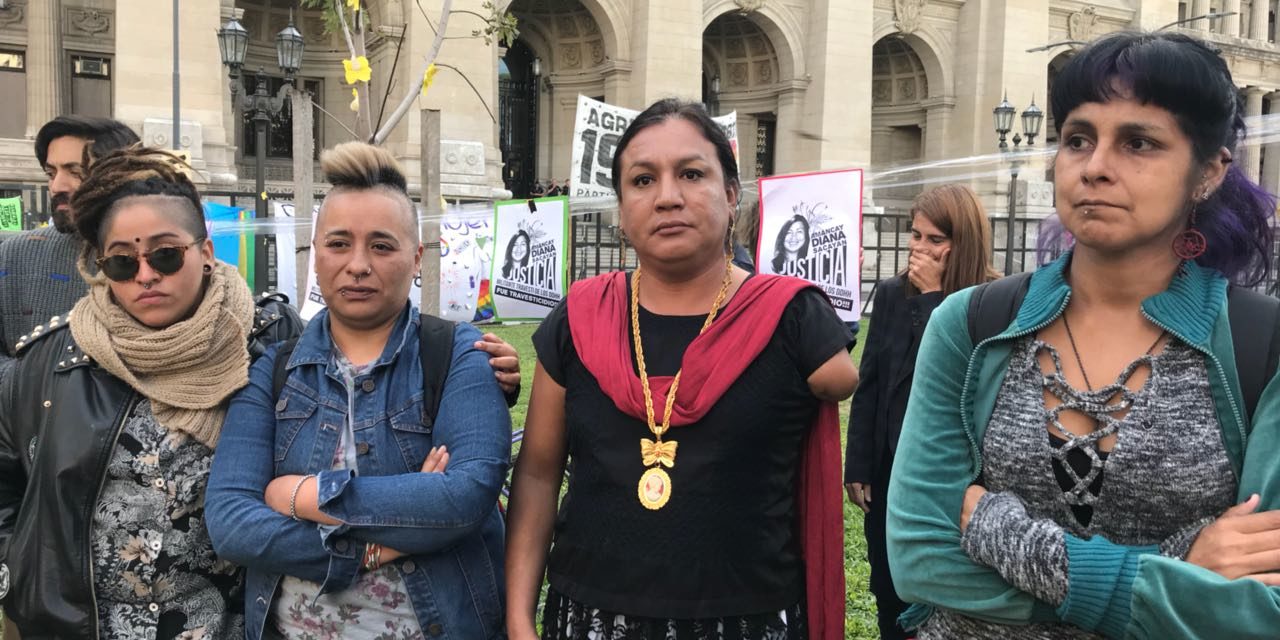
By Ana Fornaro and María Eugenia Ludueña. Diana Sacayán was brutally murdered in her own home, while defenseless from the severe beating she had received. The trans activist and human rights defender was bound, gagged, attacked in numerous ways, and fatally stabbed. This was recounted yesterday by Roberto Cohen, the first of the seven witnesses in the hearing, in one of the most harrowing passages of the trial so far. Some people left the courtroom during the projection of the autopsy images, including some family members. Friends of Diana and the Muxe anthropologist Amaranta Gómez Regalado , who gave a masterclass before the Oral Criminal Court No. 4, . Photo: Ariel Gutraich. At the beginning of this third hearing, which lasted six hours—the longest to date—the court had warned: the autopsy images could be disturbing. Cohen sat in the witness chair and apologized to those present. Using the language that bodies use to tell forensic science what happened, Diana's body spoke. "I met Diana Sacayán on October 14, 2015, at 7:00 a.m., on the autopsy table," the forensic pathologist said. Diana was his 14,806th autopsy, a body 1.72 meters tall and weighing 95 kilos, with 27 wounds, 13 of them stab wounds, two of them fatal. Cohen, who has performed more than 16,000 autopsies at the Judicial Morgue—including those of Santiago Maldonado and Ángeles Rawson—supported his explanation with a presentation of photographs displayed on a television screen.
[NOW] #JUSTICEFORDIANASACAYAN Artistic activities and an open radio broadcast have already begun in front of the courthouse while the third hearing of the oral trial for the transphobic murder of the human rights activist is underway. pic.twitter.com/zsm8Qpah1Z
— Presentes Agency (@PresentesLGBT) March 26, 2018
The impact of the images
The images showed Diana as no one would have wanted to see her, or anyone else for that matter. Her face was bruised and swollen, and she had wounds on her head, face, chest, arms, back, torso, and buttocks. “Multiple injuries,” the forensic expert said. He categorized the injuries into three types: abrasions (from blows or impacts against hard objects), injuries from restraints, and injuries from a bladed weapon (pointed or sharp objects). “All the injuries were inflicted while she was alive,” Cohen explained. He described how the blows left the victim defenseless. And that the fatal injuries, two deep wounds, caused internal bleeding and were inflicted with a blade that must have been 12 to 15 centimeters long. “She survived for 10 minutes after those injuries,” Cohen said. And he established a sequence of events: she was attacked and beaten, then bound, and then stabbed multiple times. As the images played on the television, some people in the room covered their mouths. Others closed their eyes, some dabbed away tears with tissues. The accused, Gabriel Marino, 25, put his hands inside his red sweatshirt and leaned back in his chair. Gone was the haughty, defiant look he'd had the first day, when he'd smiled at the photographers. Every now and then he looked down, every now and then he closed his eyes. At the worst moments, he seemed to doze off. "It could be one or more weapons. It could be one or more people," the forensic expert responded to those questions.Viciousness and multiple injuries
“Have you ever performed an autopsy on a trans woman?” asked Mariela Labozzetta, head of the Specialized Prosecutor's Office for Violence Against Women and LGBT People, which brought this case to trial with explicit mention of the term “transvesticide.” “Many times,” the forensic pathologist replied. “Could you mention any specifics?” “The multiple injuries. But that's something I also saw in the autopsies of Ángeles Rawson and Wanda Taddei.” The family's lawyer, Luciana Sánchez, asked about how the court records the anatomical maps of trans people. The doctor explained that these maps are based on the Istanbul and Minnesota protocols. “But is there a specific way to record this autopsy because it involves a trans person?” “No, we use the female gender.” The last question posed to the forensic expert was by one of the judges, Julio Cesar Báez. He wanted to know if Cohen considered the multiple injuries related to the ferocity of the crime. "If you call the multiple injuries ferocity, then I must say yes." After the forensic expert finished his testimony, the accused asked to leave to go to the bathroom. "He's feeling unwell," said his lawyer, Lucas Tassara, and requested that he be excused from being present. The court granted his request. Someone in the courtroom murmured, "After what he did, he'll feel bad for the rest of his life."
The Metropolitan Police operation against Diana The second witness was an activist and friend of Diana's, with whom she shared many activist activities. One of the most striking moments of her testimony was when she recalled a Metropolitan Police operation that ended with Diana handcuffed and trampled. That day, she and Diana were with a group of transvestites and trans people in Buenos Aires, heading to La Plata, where the issue of a trans employment quota was being discussed—a law Diana had been one of the driving forces behind. The friend recounted that they were at a bus stop on 9 de Julio Avenue, near the Ministry of Health, waiting for the bus. “We encountered a sexist man who insulted Diana. There was an incident, the Metropolitan Police intervened, and we were repressed. Diana was…” they tied up They grabbed her hands, threw her to the ground face down, mocked her, and stepped on her wrists. They wouldn't let her sit down. Diana explained that she worked in human rights defense at INADI (National Institute Against Discrimination, Xenophobia and Racism). The police told her that they were the authority. She and a colleague from INADI were arrested. “I had never before been caught in the crossfire with that level of violence.” Diana worked with this friend at the health clinic in the San Justo Polyclinic. “Although that clinic is still open today, many other projects were left unfinished without her; she was the one who forged them, and now she's gone. And with Diana dead, there's no one left to get you out of the police station like she used to.” Among the testimonies were also two very brief statements from witnesses, a cousin and a nephew-in-law of the accused, who briefly recalled the operation in which the police went to Marino's parents' house and took a toothbrush, a comb, and some sneakers.[NOW] @vale_licciardi is also saying #JusticeForDianaSacayan at the courthouse, while the third hearing for the transphobic murder of the human rights activist is underway. pic.twitter.com/imAnZDKqKJ
— Presentes Agency (@PresentesLGBT) March 26, 2018
For the first time, the justice system speaks the language of transvestites.
Amaranta Gómez Regalado – activist muxe The internationally renowned anthropologist had been summoned as an expert witness by the family's legal team. Her testimony before the court was a masterclass, aimed at a broad audience, on gender identity, politics, culture, and violence, framed within the regional context. Her presentation offered a kind of cultural interpretation of the reality experienced by trans people in Latin America, highlighting both commonalities and differences, and explained to the court. It lasted approximately two hours, and hopefully one day it will be recorded in the annals of history. She began by introducing herself to the judges: “I am 40 years old, I come from the Isthmus of Tehuantepec, in Oaxaca, I am of Zapotec descent, and I am an anthropologist from the University of Veracruz. I have been an activist for human rights, the rights of trans and Indigenous people, and sexual health for over 22 years. This is my sixth visit to Argentina.”[READ MORE: The muxes, a millennia-old transgender identity «]
In July 2016, Amaranta was invited by the Supreme Court of Justice of Argentina to speak about globalization, diversity, and gender at the "Diversity and Access to Justice" conference, chaired by Supreme Court Vice President Elena Highton de Nolasco. Her activism had many points of convergence with Diana's. Both worked at ILGA-LAC for Latin America and the Caribbean. They traveled together to Sweden, Brazil, Mexico, and Guatemala. "Diana was the leading voice in calming certain situations. She had a great capacity for negotiation," Amaranta said. Guided by questions from Luciana Sánchez, the plaintiff's lawyer, Amaranta first addressed the basic concepts. She spoke of cisgender as a hegemonic category and of gender binarism. “From the schizophrenic Spanish, where it seems there is no third space, which does exist in the Zapotec language. In the Isthmus of Tehuantepec, articles like 'tique' don't refer to masculine or feminine. We must assume that a third space exists, without confining it,” she said. She spoke about trans identity: “A new category. From my point of view, and based on the work that has been done, it is a political category that allows us to make visible the needs of the transvestite, transgender, and transsexual population. To navigate genders. To play with biology, which is not content with having been born female or male.” “Are trans identities hegemonic in Latin America?” Sánchez asked. “No. But in many populations and places, they existed before the LGBT movement. In Mexico, in Canada, in Panama, in Polynesia, in Fiji, the Navajo in the United States,” she exemplified. “They pre-existed the colonial process and are linked to Indigenous identity.”“The challenge lies in changing the cultural mindset.”
Amaranta recalled hearing the word “transvestite” for the first time in Buenos Aires. She was at the home of her friend, the philosopher Josefina Fernández, when she heard it from Lohana Berkins. “A transvestite body is a form of citizenship. But most Latin American countries don't recognize this,” she told the court. “There has been progress here, and it has taken a lot of work. But no matter how much legislation exists, the challenge lies in changing the cultural mindset, because the transvestite body breaks down binary barriers; it is neither female nor male, it is something else, it is self-constructed.” Before the judges, the Muxe activist recalled the chain of exclusions and rejections that trans people have faced since childhood—in their families, at school, and in accessing employment. “There is no full recognition of the intellectual capacity of trans people, as if they all had to be hairdressers or dancers or dedicate themselves to sex work.” She also spoke of the denial of love: “It seems as if transvestites don't have love.” On the denial of the deaths: “That’s how far the trans identity can be made invisible.” The anthropologist spoke of the deaths as “the final destiny of trans people.” She emphasized the brutality of these crimes. She analyzed them, as Judith Butler does, from a double denial by the perpetrator: the denial of the trans body and the denial of the desire for that body.Lives and deaths without statistics
She shared data: the average life expectancy for transgender people is 32 to 40 years. However, there are no official statistics on this population. “The data is being pushed by civil society organizations.” She emphasized the context of poverty, violence, and neglect that characterizes the lives of many transgender people. She spoke of the horizon of possibilities that even a small step forward can open up. On the power of activism, but also on its fragility: “In all of Latin America, we don't even reach 30. And that line of leadership is sometimes abruptly cut short. Diana's murder,” she recounted, “had a profound impact, not only in Argentina. It left a void, a collective sense of abandonment. And a lesson learned: ‘As trans people and human rights defenders, we are more vulnerable, because when you move from the private to the public sphere, you face persecution, aggression, and intimidation. You become a social spokesperson, you are challenging the State. It's not a cis person taking the microphone, it's a trans woman whose body you don't understand. As if a trans woman didn't have the right to imagine the world differently.’” “Trans people end up not being recognized as subjects of rights. Their crimes go unpunished. How many people across Latin America can build a network so that the case is now in court?” She made an appeal to the judges: “The justice system should also pave the way and name trans people.” Photo: Ariel Gutraich
“With Diana's murder, street violence entered the home.
Following the lengthy testimony of expert witness Amaranta Gómez Regalado, two more of Diana's lifelong friends testified. Both were transgender women and both part of the human rights activist's inner circle. They had briefly met the accused, but under the name "Lautaro." Diana had introduced him as her boyfriend weeks before her murder and told them she had met him at CENARESO (National Center for Social Re-education). The testimonies of Diana's friends highlighted her freshness and spontaneity, as well as her leadership qualities. "She was our role model, she always had been, ever since we were girls," said the first, who spoke of the irreparable wound her death caused. Since her friend's murder, fear has kept her from ever setting foot in Buenos Aires again. Yesterday, she told the court that she became depressed and stopped doing all the activities she had enjoyed before. Now, she says, she only sees her family and practically never leaves her house. “What I felt then, and still feel, is: if they did this to her, a public figure, a human rights defender, what hope is there for us, the anonymous ones?” She added: “My trans friends are constantly being killed in the streets. They are very vulnerable, but this time, with Diana, the violence of the street spilled into her home.”“We live exposed to discrimination and violence.”
The last to testify was another friend and fellow activist of Diana's. They met when they were both students at School 84 in Laferrere. They came out as trans together. “We would take refuge in the school kitchen because we were constantly harassed and ridiculed during recess, and that's where we planned and knitted. We were about 19 years old. She was always a fighter. Later, we participated in the same organizations and projects. Diana always wanted to continue studying and pursue a political career,” she said. When she learned of Diana's murder, she was in shock. “I went straight to the prosecutor's office to give my statement. For a long time, for many months, I couldn't sleep. I was afraid. They had already tried to kill me at my doorstep, and it was very difficult for the judges to listen to me. We also have rights and guarantees. We live exposed to discrimination and violence.” At five in the afternoon, artistic and activist activities continued in the plaza in front of the courthouse to accompany the hearing. It was there that activists Amaranta Gómez Regalado, Flor Guimaraes, Romina Pereyra, and Say Sacayán concluded the day's events and told the public about the hearing. “It was a very hard day for us. It was very hard to see everything they did to Diana, which is what they repeatedly do to all our comrades, and it's something the justice system has never addressed. Our obligation and our responsibility is to take up this case as Diana would have,” said Say, emotional, his voice breaking. For her part, Amaranta Gómez Regalado spoke about her relationship with Diana and emphasized the unprecedented and historic nature of this trial, where Argentina, once again, is leading the way on issues of diversity. “This is the first time the justice system and the media have spoken about transphobic murder. Forcing institutions to use our language is a huge step: be proud of that.”We are present
We are committed to journalism that delves into the territories and conducts thorough investigations, combined with new technologies and narrative formats. We want the protagonists, their stories, and their struggles to be present.
SUPPORT US

FOLLOW US
Related notes
We are present
This and other stories are not usually on the media agenda. Together we can bring them to light.