

AstroMostra, the astrologer and writer who interprets the sky through a queer lens
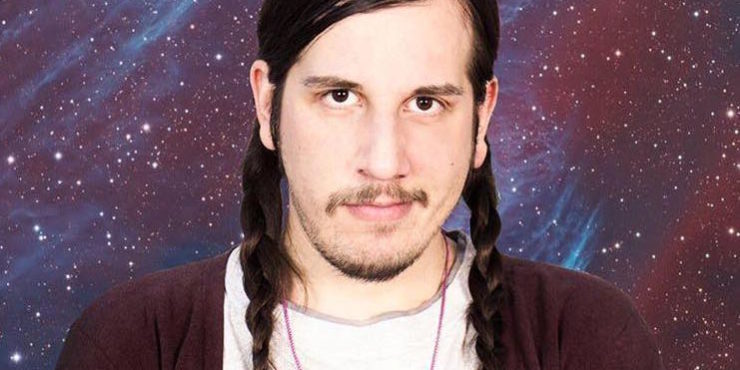
By Lucas Gutiérrez Photo: Lau Castro Gael Policano Rossi is a writer, playwright, actor, astrologer, and always more. Originally from southern Argentina, this self-taught astrologer began talking about the zodiac and planets on Radio Nacional Rock's program 'Villa Cariño'. It was there that “AstroMostra” was born, when a listener combined the 'mostra' (a play on words combining "mostra," meaning "most" or "most" in Gael's name) on air…

Share

By Lucas Gutiérrez Photo: Lau Castro Gael Policano Rossi is a writer, playwright, actor, astrologer, and always more. Originally from southern Argentina, this self-taught astrologer began discussing the zodiac and planets on Radio Nacional Rock's program 'Villa Cariño'. It was there that “AstroMostra” was born, when a listener combined Gael's "mostra" (a play on words combining "mostra," meaning "extreme") with his interpretation of the sky and planets. Today, he has a queer-centric astrology segment on Franco Torchia's program, "No se puede vivir del amor" (You Can't Live on Love), on Radio de la Ciudad. He can also be found reading at events and has titles listed in the catalogs of various publishers. Under the 'De Parado' imprint, he published 'Gualicho', his first novel, and has just released his "Amuleto" (Amulet) planner for this astrological year. Multifaceted and omnipresent on social media, Gael engages with the twelve signs of the zodiac in diverse ways.
– How did you get into astrology?
– When I was 17, I moved to Buenos Aires on my own and started working at a call center where, for a few dollars, you could talk to 'psychics via SMS.' We had to have interesting conversations, and suddenly, in the reading material they gave us, I came across grupovenus.com and started reading about it. My boss would say, "And to think there used to be real witches," and I'd think to myself, "You don't know it, but you have a witch undercover." I've always been very witchy, but it was hard for me to come out of the closet. My approach was a very disorganized kind of knowledge, mainly linked to the democratization of knowledge through the internet. I've always been self-taught. My teachers are Liz Greene and Howard Sasportas because you can read everything and have a lot of knowledge all mixed up together, but you need someone to come and bake the cake for you.– How does astrology influence our gender identity?
Medieval astrology only considered Mercury, Mars, Jupiter, Venus, Saturn, the Sun, and the Moon, and that was it. They were categorized as masculine and feminine. With the discovery, through optics, of Uranus and Neptune, the concept of hermaphroditism and hybridity began to emerge! Suddenly, one could be "both man and woman." For example, Neptune wasn't assigned either gender, but medieval tradition retained things like "Mars = masculine." But this was just a category, not even related to genitalia or gender representation. So when I say "masculine," a series of things will come to mind. A woman can be very Martian, and that doesn't mean she's masculinized; at most, she might be "Martian." She might be hurried, angry, and that can't be an exclusively masculine trait. That's a question I have to ask myself as an astrologer. It all depends on me and how I read your chart, how I ask myself these questions. Astrology is the astrologer. Astrology cannot yet escape some of these limitations; it has not examined itself through a post-gender lens. The birth chart can guide you toward personal fulfillment but cannot impose anything on you.– You are a poet, actor, playwright, writer and more, in which of these spaces do you feel most comfortable?
– If I leave one discipline and explore another, it's because of a restlessness, a little itch in my gut; comfort isn't my goal. Right now, what interests me is writing. I write for the internet, I write poetry, and I spent four years researching dramaturgy at the Metropolitan School of Dramatic Arts (EMAD) and the National University of the Arts (UNA). Now I'm finishing my postgraduate thesis on, so to speak, dissident dramaturgy. I work on problems that dramaturgy already explores on stage but not in writing, so I take those "oddballs" and analyze them. I have writing problems and I'm somewhat dyslexic, but my dream is to be at home writing, selling my little books, and doing my own thing.– Since 2013 you have been working on a series of autobiographical presentations, what are they like?
– I have a tradition of immersing myself in documentary filmmaking. Since 2013, I've been working on my biography, heavily inspired by the work of Sophie Calle and a rather post-identity artist named Miguel Bonneville. I met them in 2012, and since then I've been doing three autofictional or documentary lectures—I'm not quite sure—where I basically tell my life story. I do this by projecting and talking about screenshots, what's happening on my desktop, the identities we have online, love, politics, and sexuality on the internet. They're not lighthearted viewings; I'm completely blown away. I work on the I extimateInstead of the intimate. The first, “Amor Brujo,” is an intimate diary of an internet obsession. I expose all the steps of a stalking In 2012. In the second piece, “Despicable Person,” I work with all the hateful comments from the presidential campaigns of Cristina Fernández de Kirchner and Daniel Scioli. I take the hate from the internet, that political hate from the summer when prosecutor Alberto Nisman died, and compare it to my family, as if Cristina were my mother. I work with repulsion, with what is repulsive, to see if you can handle it. The third piece doesn't have a name; it's the emoji of a baby bottle. Initially, it was the first piece, but it took me 30 years to create it. It's almost two and a half years of research and screenshots of basically all the gay men in Buenos Aires and Argentina. It's about sexuality on the internet, sexuality as a public matter. It's very complex to see and formulate the questions because I don't have the answers. This year I'm going to Mexico with this work to give a workshop on autofiction.– What was your life like before you came to live in Buenos Aires?
I went to the only arts school in Río Gallegos (Santa Cruz province). In the mornings it was a high school with an art focus, and in the afternoons we went to the workshop, which was the old vocational school for fine arts teachers. We had sculpture, printmaking, drawing, and painting; it was a huge school and mixed people of all ages. I went to a club called El Divino. I had a boyfriend when I was 15, and that was it. I was a bit of a flirt, a real loose woman. There wasn't a gay scene in Río Grande, but I created my own. I bought a lot of things online back then and paid cash on delivery. Music from a label called Índice Virgen, Sakura Cardcaptor and Evangelion manga, books from the publisher Tematika, which introduced me to the existentialists—that was my little world. In 2005, a year after the Cromañón tragedy, I came to Buenos Aires. They were closing everything down, and I even got to see some basement bars. The first night I went to see Muscari's 'Shangay' at the Maipo. The next day I went to see 'Belleza y Felicidad' and when I walked in I saw Lara from the band 'Qué Out' and I said, "I can't believe it, this is my place in the world." You can follow Astromostra's advice and predictions on their Blog. In Twitter and FacebookOn the radio on Monday afternoons at Radio Viaduct and at night in his column on the program 'You can't live on love' ]]>We are present
We are committed to journalism that delves into the territories and conducts thorough investigations, combined with new technologies and narrative formats. We want the protagonists, their stories, and their struggles to be present.
SUPPORT US

FOLLOW US
Related notes
We are present
This and other stories are not usually on the media agenda. Together we can bring them to light.