

Crossed Lives: A photographic project about Mexican trans women at the Hotel Gondolin
By Ceci Estalles* “I want people who don’t know about art to understand what I do,” says the Chinese artist and activist Ai Weiwei, and I can’t help but connect those words with what we experienced last Monday at the Hotel Gondolin. The Hotel Gondolin is a hotel reclaimed by trans women, self-managed…

Share

By Ceci Estalles* “I want people who don’t know about art to understand what I do,” says Chinese artist and activist Ai Weiwei, and I can’t help but link those words with what we experienced last Monday at the Gondolin Hotel.
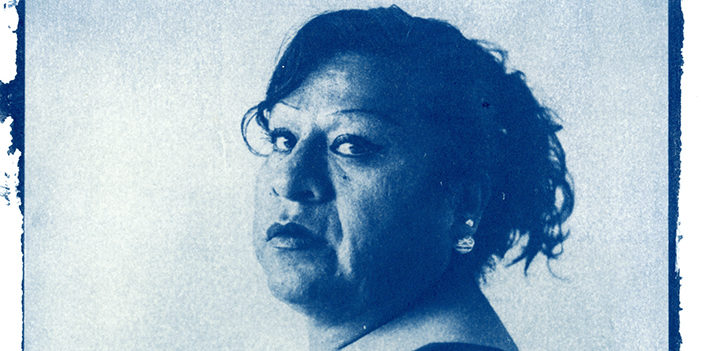
 It was the first time her work had moved away from the formality of the art scene or academia, returning to the intimacy of the collective to speak the same language amidst laughter and shared understanding, paradoxically, within a house painted blue. “One of the goals of my work is to move beyond the self-referential world of photography, art, or academia, and reach diverse audiences from different social classes and/or educational backgrounds. The complexity of the subject matter requires a still-complex exploration to construct the project with multiple layers of interpretation that allow for a democratic understanding,” said Giulia.
 Shared bodies
“Casa Azul” depicts the process of identity construction and the practices of individuals whose bodies are considered doubly abject due to both their identity and their incarceration. Forced to wear blue, the detainees named the prison “Casa Azul,” evoking the imprisonment of their own bodies. In a men's prison, women's clothing is prohibited, but through bribery, the inmates obtain it, transforming it into a weapon of resistance against an environment that imposes masculinity upon them.
 Shared bodies
  “Casa Azul” highlights the eternal binary struggle these individuals face daily to be who they identify as: women. It was an honor and deeply moving to share this experience with so many women who lack rigid structures, sharing not only the same process of personal transition but also the struggle for societal acceptance. I found it beautiful that the life stories of five detained Mexican women could resonate with so many trans women in Argentina. I'm sure Alejandra, Martina, Gabi, Frida, and América would be happy to know they were present at the Hotel Gondolín.
Part of Casa Azul can be visited in the collective exhibition “Draft of an Intervened Body” at Arte x Arte until April 6th. Lavalleja 1062 Tue to Fri from 1:30 pm to 8 pm. Sat from 1:30 pm to 4 pm.
*Photographer and activist. She is one of the members of the Trans Memory Archive project.]]>
“Casa Azul” highlights the eternal binary struggle these individuals face daily to be who they identify as: women. It was an honor and deeply moving to share this experience with so many women who lack rigid structures, sharing not only the same process of personal transition but also the struggle for societal acceptance. I found it beautiful that the life stories of five detained Mexican women could resonate with so many trans women in Argentina. I'm sure Alejandra, Martina, Gabi, Frida, and América would be happy to know they were present at the Hotel Gondolín.
Part of Casa Azul can be visited in the collective exhibition “Draft of an Intervened Body” at Arte x Arte until April 6th. Lavalleja 1062 Tue to Fri from 1:30 pm to 8 pm. Sat from 1:30 pm to 4 pm.
*Photographer and activist. She is one of the members of the Trans Memory Archive project.]]>
We are present
We are committed to journalism that delves into the territories and conducts thorough investigations, combined with new technologies and narrative formats. We want the protagonists, their stories, and their struggles to be present.
SUPPORT US

FOLLOW US
Related notes


We are present
This and other stories are not usually on the media agenda. Together we can bring them to light.