

#DianaSacayán: "Diana gave everything for her family and her community"
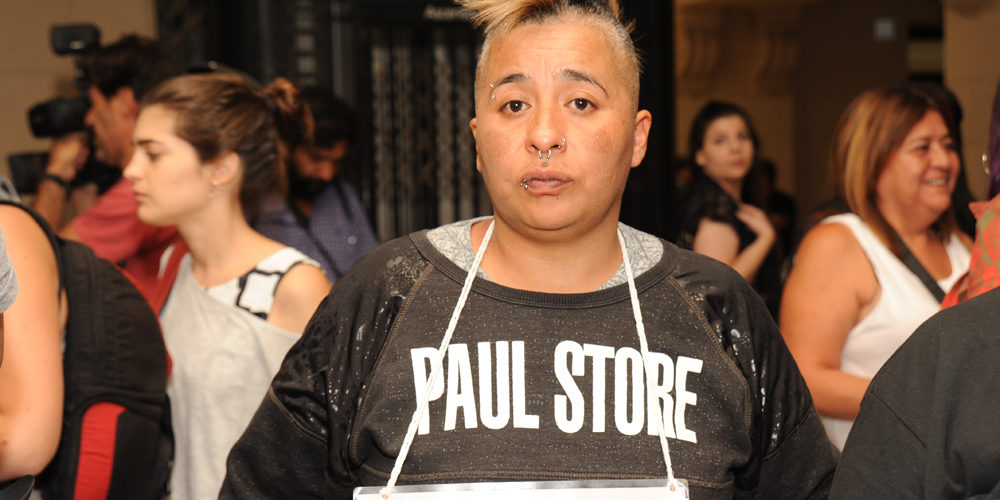
Today was the second hearing of the public trial for the transvesticide of Diana Sacayán, murdered in October 2015. As on Monday, there were two parallel events: one outside the Palace of Justice in the City of Buenos Aires, where diversity activists, artists and members of the public accompanied the family and showed their support for the trial from 9 a.m., and another inside, where the hearing took place, starting after 11 a.m. and ending at 5 p.m.

Share

By Ana Fornaro and María Eugenia Ludueña _ Photos: Ariel Gutraich [Chronicle in progress] Today was the second hearing of the public trial for the transphobic murder of Diana Sacayán, killed in October 2015. As on Monday , there were two parallel events: one outside the Palace of Justice in Buenos Aires, where LGBTQ+ activists, artists, and members of the public accompanied the family and showed their support for the trial from 9 a.m. The other took place inside, where the hearing began after 11 a.m. and ended minutes before 5 p.m.
From the beginning it was known that it was going to be a long and crucial day: of the 13 witnesses expected, 10 testified, among them Diana's brother, Sasha Sacayán, activist and current coordinator of the organization Anti-Discrimination Liberation Movement (MAL), one of Diana's many legacies.[NOW] #Argentina We are outside the courthouse awaiting the second hearing in the trial for the transphobic murder of Diana Sacayán. #JusticeForDiana #ItWasATrphobicMurder pic.twitter.com/4cyrJdJTud
— Presentes Agency (@PresentesLGBT) March 19, 2018
In addition to the Oral Criminal Court No. 4 – made up of Adolfo Calvete, Ivana Bloch and Julio Cesar Báez – the representative of the Public Prosecutor's Office, Ariel Yapur, was present in the room; representatives of the Argentine Institute against Discrimination (INADI), with the complaint headed by Juan Kassargian, lawyer of the organization where Diana worked; and Luciana Sánchez, lawyer of the Sacayán family.[NOW] #Argentina #JusticeForDiana With open radio and music, the vigil continues in front of the Buenos Aires City courts. #ItWasATrusesicide pic.twitter.com/oETHGfMBZV
— Presentes Agency (@PresentesLGBT) March 19, 2018
 The judges of the Oral Criminal Court No. 4, in the courtroom on the sixth floor, Courts
Facing them was David Gabriel Marino, the only person accused of "triple aggravated homicide due to gender-based violence motivated by hatred of gender identity, with premeditation and robbery," alongside Lucas Tassara, his lawyer. The courtroom was overflowing with people, including Diana's large family, activists, and journalists. Some people were unable to enter.
The judges of the Oral Criminal Court No. 4, in the courtroom on the sixth floor, Courts
Facing them was David Gabriel Marino, the only person accused of "triple aggravated homicide due to gender-based violence motivated by hatred of gender identity, with premeditation and robbery," alongside Lucas Tassara, his lawyer. The courtroom was overflowing with people, including Diana's large family, activists, and journalists. Some people were unable to enter.
The accused refused to testify
Marino entered with his head down, dressed in jeans and brand-name sneakers, wearing a cream-colored wool jacket. He sat next to his lawyers and kept his eyes half-closed, with the same undefined expression as at the previous hearing. As he nervously clasped his hands, Diana's family members stared at him from their seats. Gabriel David Marino (right) with his lawyer Lucas Tassara, public defender
To begin the hearing, Marino was required to give a statement, something his lawyer objected to. He requested that the questioning be postponed, but the court denied the request, arguing that the accused could refuse to testify if he wished, or could do so at a time of his choosing. Therefore, he was obligated to answer the standard questions posed by the judges to any accused person. Thus, those in the courtroom learned that Marino was born in 1992 in Parque Patricios. That before being charged and placed in pretrial detention, he worked as an accountant's assistant. That he had a history of drug problems and was currently in treatment. He began studying law in prison and is currently enrolled in the Common Basic Cycle (CBC). Marino answered quickly, almost without modulating his voice, and finally said that he would not give a statement because he did not know "all the evidence against me," repeating his lawyer's argument. After finishing his answers to the judges, he stood up from his chair and, before Sasha, the first witness, entered, he had to leave the courtroom. This was at the request of the family's lawyer, so that Diana's brother could speak in peace.
Gabriel David Marino (right) with his lawyer Lucas Tassara, public defender
To begin the hearing, Marino was required to give a statement, something his lawyer objected to. He requested that the questioning be postponed, but the court denied the request, arguing that the accused could refuse to testify if he wished, or could do so at a time of his choosing. Therefore, he was obligated to answer the standard questions posed by the judges to any accused person. Thus, those in the courtroom learned that Marino was born in 1992 in Parque Patricios. That before being charged and placed in pretrial detention, he worked as an accountant's assistant. That he had a history of drug problems and was currently in treatment. He began studying law in prison and is currently enrolled in the Common Basic Cycle (CBC). Marino answered quickly, almost without modulating his voice, and finally said that he would not give a statement because he did not know "all the evidence against me," repeating his lawyer's argument. After finishing his answers to the judges, he stood up from his chair and, before Sasha, the first witness, entered, he had to leave the courtroom. This was at the request of the family's lawyer, so that Diana's brother could speak in peace.
“Diana gave everything for her family and community”
“I’d like to tell you who Diana was and what her activism was,” Sasha said after introducing herself. Her statement, answering questions from lawyer Sánchez, was the longest of all, lasting an hour and a half. She began with her family’s origins: 17 children of a migrant mother from Tucumán, who settled in Laferrere, in the greater Buenos Aires area, living in precarious conditions and making many sacrifices. From a very young age, Diana established bonds with her neighbors, transformed her neighborhood into a community, and helped her trans and travesti friends, all of whom were involved in prostitution, as she herself had been for so long. “She was very affectionate with all of us and was a role model for trans women. She gave everything for her family and her community. Her first victory was achieving the Repeal of the Buenos Aires Province Code of Misdemeanors which prohibited transvestite identities. She clashed with the police many times and was persecuted. She made some 23 complaints against police officers because of their links to sexual exploitation. Recently, she had asked for protection because she had been assaulted. They didn't give it to her.” Diana was also one of the driving forces behind the Gender Identity Law and campaigned for a trans employment quota in the province of Buenos Aires, which has yet to be implemented. Diana was murdered a month after the law was passed, while she was already working in the Diversity Department of INADI (National Institute Against Discrimination, Xenophobia and Racism). “This law is fundamental because, according to research, 98% of trans and gender-diverse people do not have access to formal employment and are forced into prostitution. They had a life expectancy of 32 years, which has now increased to 40. Through activism, we have managed to gain 8 years of life. We denounce this cycle of violence suffered by trans and gender-diverse people from childhood as social transvesticide, and when they are murdered, these must be called what they are: transvesticides, which are hate crimes, because they are committed with cruelty. Diana died from the third stab wound, but she received more than 20. She was gagged and then finished off.” Diana's family heard these words, and several of them were already in tears. At the end of their testimony, and after answering some questions from Marino's defense—related to how they had identified the accused—Judge Báez asked: "Were there any changes at MAL after her murder? Was anyone able to replace Diana?" "No. Transvestite and trans people have an average life expectancy of 35 years. With the living conditions they face, it's very difficult for our comrades to imagine life without Diana. Since her murder, we've lost five more comrades. Among them was Lohana Berkins." It took Diana twenty years to become the activist she was. It's difficult to build leadership when life expectancy is so short, when your comrades are dying.Sasha said.
The first police officer at the crime scene
After his statement, there was a brief pause, and the remaining nine witnesses testified. The hearing continued with the testimony of Martín Ariel Maldonado, who is now a deputy commissioner and at the time of the crime was head of the Judicial Investigations Unit of the 38th Police Station in Buenos Aires. Maldonado provided testimony about the crime scene. "The patrol car was dispatched after learning of a violent incident, and the superiors assisted at the scene. That's how I arrived at the apartment. I observed the scene to report back to the court." "What did you find?" Prosecutor Yapur asked. "The apartment door was ajar. It was a normal apartment, but the bedroom was completely ransacked. You couldn't get in, but you could see a mattress, which took up almost the entire room, and underneath it, a body, although it wasn't fully visible. There were bloodstains on the floor and walls," Maldonado recounted. He recalled entering the apartment with his colleague from the mobile unit, and that behind them, in turn and successively, the prosecutor's office, the forensics divisions, the trace evidence service, the laboratory personnel, and the medical examiners arrived. He recounted that there was a PC in the living room, turned on, "with chats open."“His absence had a significant impact on the LGBT community.”
P. rented Diana the apartment on Rivadavia Street where she was killed. He was also the one who received a call from the building manager saying that he hadn't seen Diana for a few days and had noticed that the apartment door was unlocked, leaning against the frame. P. described to the court how that day, he was the one who pushed open the front door and found the apartment in disarray, "a lot of things broken." The bedroom door was closed. "I banged on it, opened it, it was chaos. A mattress was taking up the whole room and seemed to be covering something underneath. The furniture was out of place, all over the place. The bed frame was against the wall. There were bloodstains and broken glass everywhere. It was like they had made a pile of things." As he approached the mattress, he said he could make out Diana's feet. He then decided to go outside and call 911. He also remembered knocking on his neighbors' door and being refused the use of the phone. She also spoke of Diana's activism: after all, the streets, the plazas, and the marches were their meeting places, what united them and where they had met, far beyond their relationship based on the rent, which Diana paid "when she could, but it was never a problem." P. also recounted that Diana had done electrical and painting repairs in the apartment. P. knew that Diana had suffered previous attacks. "I found her one day in Constitución, getting out of a police car. They had taken her while she was waiting for the bus to go to the hearing on the Trans Employment Quota Law. Diana gave me the MAL flag. The previous year she had experienced violence at the hands of the police." Her testimony highlighted Diana's role as a human rights defender: "After her death, I was in shock for a year. Her absence had a huge impact on the LGBT community. We miss her political clarity, her concrete way of pursuing goals. And now we say: Call me when you get home, out of fear, because we continue to see these hate crimes that terrify us."The building's security guard
Leonardo Gabriel Vázquez, the next witness, was on duty at the building where Diana lived. He testified that he last saw Diana on Saturday, October 11, when she went downstairs to open the door for two men, at 8:30 p.m. and again at 10:30 p.m., but that he never saw them leave. Vázquez indicated that one of those men, the last to arrive, was "the gentleman," he said, referring to the defendant sitting a few feet away, Gabriel David Marino. "He was well-dressed; I had seen him a couple of times before. Diana greeted the gentleman with a kiss on the mouth."The neighbor downstairs
Mariano Gabriel Martínez knew Diana “from the building's hallways. She lived on the floor below, right under his apartment.” In his statement, the fifth witness of the day recounted that in the early hours of Sunday morning, he was asleep when “a loud, sharp bang woke him up. I checked the time on the TV converter box: it was 3 a.m.” The downstairs neighbor said that the next morning, “I asked Gabi, the security guard, if he had heard anything, but he said no.” Marino's arrest Commissioner Ricardo Juri, head of operations for the Federal Police Homicide Division at the time of the crime, recounted how the lead that led to Marino's identification was consolidated, in conjunction with prosecutor Di Lello's office. According to the witness, investigators began to identify the accused based on testimonies indicating his relationship with Diana. However, Diana's circle knew him by a different name. That's why "the name David didn't come up in the statements." It wasn't until security camera footage from the area (showing two men leaving the apartment), wiretaps, analysis of Facebook profiles, call records, and data from Cenareso (the National Network Hospital specializing in Mental Health and Addictions, where Diana and Marino met) that they were able to locate him. The following witnesses were a couple who witnessed, at the request of the police, the operation to arrest Marino and the raid on his house in Ituzaingó, from where the investigators took the toothbrush, a jacket and a sweater.Witnesses who were passing by
Denis Rivero and Jean Paul Delacroix were walking near Plaza Flores when the police stopped them to witness the homicide investigation at Diana's apartment. The friends gave two compelling testimonies to the court yesterday. “As soon as I walked in, I saw a mess. The door was broken on the inside. In the living room, there was a bloody knife on the end, under a table. It was a large knife, like a kitchen knife, a utility knife. There was also a purse lying on the table, things scattered on the floor. But I especially remember the knife: those are things you don't forget. In the bedroom, the bed frame was overturned, the walls stained with blood. They lifted the mattress and found the body. It was bound hand and foot, surrounded by blood. It had at least five very obvious wounds, including a stab wound above the navel,” one of them said. They also recalled that the police collected several used condoms in the bathroom and trash from the kitchen that day. With these statements, a long hearing with consistent testimonies concluded around 5:00 p.m. The next hearing will be on Monday, March 26, when another long list of witnesses—thirteen people—is expected. Meanwhile, outside in the plaza in front of the courthouse, activism continued throughout the afternoon, calling for support for the demand for justice on March 26, at the third hearing of the trial.[NOW] #JusticeForDiana Gabriela Mansilla is the mother of Luana, the first trans girl to obtain her national identity document, and an activist for the rights of trans children in #Argentina #ItWasATrusecide pic.twitter.com/ZNQ238Qxzx
— Presentes Agency (@PresentesLGBT) March 19, 2018
]]>#Argentina The second hearing in the trial for the transphobic murder of #DianaSacayan . Ten witnesses testified today: her brother Say, neighbors, and police officers who participated in the investigation. The full report will be available on our website shortly: https://t.co/uLclizZKOx #JusticeForDiana pic.twitter.com/hFSgVXl5IT
— Presentes Agency (@PresentesLGBT) March 19, 2018
We are present
We are committed to journalism that delves into the territories and conducts thorough investigations, combined with new technologies and narrative formats. We want the protagonists, their stories, and their struggles to be present.
SUPPORT US

FOLLOW US
Related notes


We are present
This and other stories are not usually on the media agenda. Together we can bring them to light.