

#DianaSacayán: This is how the first day of the trial for transvesticide was experienced
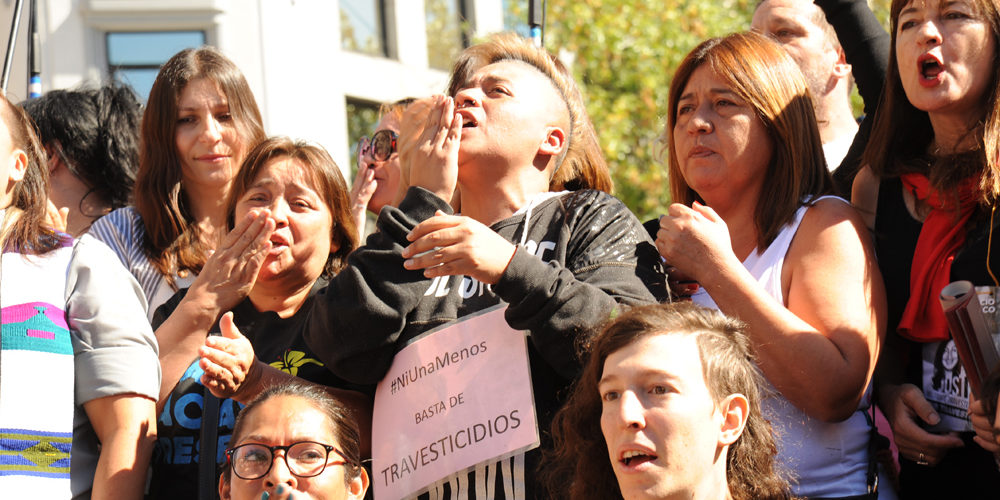
By María Eugenia Ludueña and Ana Fornaro Photos: Ariel Gutraich Starting at 8 a.m., activists and members of the public alike began arriving at the corner of Lavalle and Talcahuano streets. The Justice for Diana Commission had called for people to support the public trial by showing their presence and voices. And there they were…

Share

By María Eugenia Ludueña and Ana Fornaro
Photos: Ariel Gutraich
Starting at 8 a.m., activists and ordinary people alike began arriving at the corner of Lavalle and Talcahuano streets. The Justice for Diana Commission had called for people to support the public trial by showing their presence and voices. Various political, social, and cultural organizations were there, with their signs and slogans. The Justice for Diana slogan was strongly echoed by others demanding: "Stop transphobic murders" and "Trans job quotas." The enthusiastic and emotional atmosphere in the street was quite different from the one inside the courtroom.
#DianaSacayan “This is a trial eagerly awaited by the community, activists, organizations, and all of society. If there is an exemplary sentence, it will mark a turning point in access to justice for transvestites and trans people,” says Dario Arias of @ConurbaDiversos pic.twitter.com/7BC7tOdVmJ
— Presentes Agency (@PresentesLGBT) March 12, 2018
At the open-air radio broadcast set up in the plaza, activists and members of the trans community remembered Diana and made various demands: the most repeated was for job placement so that prostitution is not the only option for survival. They addressed politicians, and in particular the governor of the Province of Buenos Aires, María Eugenia Vidal, who has not implemented the Trans Employment Quota Law, championed by Diana. Meanwhile, on the sixth floor of the courthouse, the hearing was beginning.

[NOW] #DianaSacayan #trial “The trans population has a life expectancy from the Middle Ages. It is a disgrace to this society that they continue killing us and leaving us to die. We need jobs and the trans employment quota must be implemented now,” says a spokesperson from the courthouse. pic.twitter.com/dkEDdjb3T9
— Presentes Agency (@PresentesLGBT) March 12, 2018
The courtroom was far too small for a trial of this magnitude, given its social and legal significance. Many people were left outside. David Marino was among the first to take his place in the dock, heavily guarded by police. The courtroom was then opened to journalists, followed by the family.

 The Sacayán family filled a large part of the courtroom—siblings, aunts, nephews, and nieces. Each and every one of them bore something in their features that deeply reminded them of Diana: their eyes, their mouths, their hair. Several of the women in the family also wore t-shirts with a yellow flower, the amancay, and the slogan "Justice for Diana Sacayán." The photographers had only a few minutes to take pictures. Marino stared at them, fixed and defiant. The president of the Oral Criminal Court No. 4—comprised of Adolfo Calvete, Ivana Bloch, and Julio Cesar Báez—began the trial: "Mr. Marino, you must pay close attention to what is said here." What was said in this first hearing was brief, painful, and powerful. It lasted half an hour. Basically, parts of the indictment were read, which included the prosecution's and plaintiff's charges: "triple aggravated homicide due to having been carried out with gender violence motivated by hatred of gender identity and with treachery and robbery."
 As the prosecution's and the plaintiff's accusations were read aloud, the courtroom was filled with graphic images of Diana's final moments: multiple stab wounds, 27 injuries, 13 of them inflicted with a bladed weapon—a knife, scissors, a hammer. Bound and gagged. "She tried to defend herself." Injuries to her skull and jaw. "Murdered with extreme violence." And the theft of the 20,000 pesos she had been carrying. While these excerpts were read, Diana's family remained silent. Marino kept his gaze fixed on the courtroom floor, his eyes sharp and piercing. One of her nieces wiped away tears.
 The head of the UFEM (Specialized Prosecutor's Unit for Violence against Women and LGBTI People), Mariela Labozetta, and the National Criminal Court of Instruction No. 4, headed by Matías Di Lello, determined that it was a transphobic hate crime. This makes the trial crucial: never before in the justice system has an investigation been brought to trial as a hate crime based on gender identity, an aggravating circumstance considered in section 4 of article 80 of the Penal Code. The prosecution also alleges gender-based violence, an aggravating factor that constitutes femicide. In their indictment, the prosecutors stated that Diana was violently murdered for being a "trans woman and for her status as a member of the Sexual Diversity Program of INADI (National Institute Against Discrimination, Xenophobia and Racism), a driving force in the fight for the rights of trans people, secretary of the International Lesbian, Gay and Bisexual Association of Latin America and the Caribbean (ILGA-LAC), and leader of the Anti-Discrimination Liberation Movement (MAL)." The family's legal action, led by Diana's brother Say Sacayán and represented by lawyer Luciana Sánchez, also shared this view. The other legal action, brought by INADI (National Institute Against Discrimination, Racism and Xenophobia), was also handled by Juan Kassargian, the organization's lawyer. [caption id="attachment_9893" align="aligncenter" width="818"]
 Gabriel David Marino, charged with the transvesticide, is 25 years old and is in pretrial detention. Marino knew Sacayán. And he had an accomplice. But the investigation into him continues and he is not part of this trial. Ariel Yapur, representing the Public Prosecutor's Office, requested that a fragment of the case file be read, which indicates that Marino had known Diana for a month before killing her, as well as her friends and her mother. After the reading, the presiding judge adjourned the session. The next hearing will be on Monday, March 19, when the 13 witnesses summoned by the court will testify, including Say, Diana's brother. "Today's hearing made the accusation clear: that this was a hate crime, a transphobic murder, and a femicide," lawyer Luciana Sánchez told Presentes.
In the plaza, a crowd listened to the words of those who had participated in the hearing. “It is an enormous, historic responsibility, and a challenge. Unlike other cases where the justice system has mistreated the LGBTI community, here there is a group of people from the legal community working hard: the UFEM (Specialized Unit for Violence Against Women), the Directorate of Guidance, Support and Protection for Victims (DOVIC), public institutions that today made us feel differently, and that are beginning to talk about transphobic murders.”[NOW] Sisters of #DianaSacayan leaving the first hearing of the public trial for the transphobic murder of the human rights activist. pic.twitter.com/18NSykKwm7
— Presentes Agency (@PresentesLGBT) March 12, 2018
#DianaSacayan “This trial is a responsibility and a challenge. Unlike other cases, where the justice system mistreats, here there is a group of people from the legal community who have been working on this trial for the murder of a trans woman,” says Luciana Sánchez, the family's lawyer. She also highlighted that the court accepted Amaranta Gómez Regalado, a renowned Muxe activist and anthropologist , as an expert witness, in an important gesture for this and other trials. pic.twitter.com/bXfYtCquxh
— Presentes Agency (@PresentesLGBT) March 12, 2018 “It was a tough day, because it’s the first time we’ve come face to face with the killer,” Say said. “Today I felt like crying, screaming, vomiting, but I close my eyes and think about everything Diana did, and I stay calm. I’m not afraid of him, nor do I hate him, even though he represents hatred, because in two years we’ve grown strong and we continue working for justice. On behalf of the entire Sacayán family, thank you for the hugs and for embracing this fight.”[caption id="attachment_9895" align="aligncenter" width="811"]#DianaSacayan Nora Cortiñas, a Mother of Plaza de Mayo, went to the courthouse to accompany family members and activists at the first hearing of the public trial for the transphobic murder of Diana. pic.twitter.com/xaWCf7gpAx
— Presentes Agency (@PresentesLGBT) March 12, 2018
 Nora Cortiñas, the Mother of Playa de Mayo, along with Say Sacayán, Diana's brother, and the trans artist Susy Shock. [/caption]]]>
We are present
We are committed to journalism that delves into the territories and conducts thorough investigations, combined with new technologies and narrative formats. We want the protagonists, their stories, and their struggles to be present.
SUPPORT US

FOLLOW US
Related notes


We are present
This and other stories are not usually on the media agenda. Together we can bring them to light.