

A historic trial begins for the transvesticide of Diana Sacayán
The trial for the transphobic murder of Amancay Diana Sacayán begins on March 12. It will be the first time the courts have referred to it as a "hate crime based on gender identity."

Share

[This article is published today in the Diario Tiempo Argentino ] By María Eugenia Ludueña Photos: Agencia Presentes The trial for the transphobic murder of Amancay Diana Sacayán begins on March 12. The human rights defender was murdered in October 2015 in an apartment in the Flores neighborhood of Buenos Aires (CABA) that she shared with a friend. She was 39 years old: she had survived four years longer than the average life expectancy for transvestites and transgender people in Latin America: 35. She had worked tirelessly to secure rights for the community, one of the most violated and criminalized groups. This will be the first time a hate crime based on gender identity is tried in this context. [embed]https://youtu.be/kjlRN_GRPN8[/embed] The trial—which has suffered several delays—will be held before the Oral Criminal Court No. 4 of CABA. The panel of judges includes Adolfo Calvete, Ivana Bloch, and Julio Cesar Báez. Ariel Yapur will represent the Public Prosecutor's Office, after the Justice for Diana Sacayán Commission requested the removal of Marcelo Saint Jean (son of Ibérico Saint Jean, former governor of the province of Buenos Aires, 1976-1981) due to his background as a defender of those convicted of crimes against humanity, who later excused himself.
[Trial for the transvesticide of Diana Sacayán postponed: it begins on March 12]]
A historic trial
The process has reasons to go down in history.The trial of Diana Sacayán is the first trial where, from the very beginning, even at the crime scene, a gender perspective was incorporated.“This is how we proceeded,” explained Mariela Labozzetta, head of UFEM, the specialized prosecutor's office for violence against women and LGBTQ+ people. During the investigation, UFEM met with leaders and organizations of the LGBTQ+ community, including Lohana Berkins. The investigation was conducted jointly with the National Criminal Court of Instruction No. 4, headed by Matías Di Lello. The autopsy revealed that Diana had suffered 27 injuries, thirteen of them from a bladed weapon, and several blows. Gabriel David Marino, 25, accused of this crime, was arrested days later and remains in pretrial detention.Gender violence and hatred based on gender identity
The prosecution's investigation assumes that It was a transvesticide and a gender-based hate crime. In requesting the case be brought to trial, the prosecutors accused Marino of murdering Diana. They charged him with "triple aggravated homicide due to gender-based violence motivated by hatred of gender identity, and with premeditation and robbery." Labozzetta and Di Lello believed it was a transphobic murder. In the indictment, they stated that Diana was violently murdered for being a “trans woman and for her role as a member of the Sexual Diversity Program of INADI (National Institute Against Discrimination, Racism and Xenophobia), a leading figure in the fight for the rights of trans people, secretary of the International Lesbian, Gay and Bisexual Association of Latin America and the Caribbean (ILGA-LAC), and leader of the Anti-Discrimination Liberation Movement (MAL).” Marino knew Sacayán. And he had an accomplice. But the investigation into him continues, and he is not part of that trial. There are two lawsuits: one from the family, led by her brother Say Sacayán, coordinator of MAL, and another from the National Institute Against Discrimination, Racism and Xenophobia (INADI). The indictment against Marino includes two aggravating circumstances for homicide: Article 4, which refers to hate crimes “for pleasure, greed, racial, religious, gender, or sexual orientation, gender identity, or gender expression hatred.” And section 11, which applies to femicides and refers to gender-based violence. “Diana will be very present in this trial,” said Luciana Sánchez, the family’s lawyer. “Part of the challenge is to make the legal community, particularly the judges of the court, understand that this is a transphobic murder, why it’s important to call it that, and what the circumstances of this crime are.” The court accepted Amaranta Gómez Regalado, a renowned Muxe activist and anthropologist, as an expert witness, a significant step for this and other trials.
INADI, plaintiff
The trial marks the first time INADI has acted as a plaintiff. “The defense challenged this, and the court upheld it. It’s historic. It allows us to continue working on other cases involving human rights and discrimination,” said Juan Correa, INADI’s Chief of Staff. “For us, this is a very important case because Diana was an INADI employee, and we have an institutional responsibility toward her. It’s also important to raise awareness of the problems faced by the trans community. We demand justice and an effective sentence,” he stated. The agency’s lawyer, Juan Kassargian, added: “This is a hate crime, and the basis of hate crimes is discrimination, a specific issue in INADI’s fight. As with any hate crime, there are two violations: one against the victim herself and the other the message sent to the trans community. Diana was a victim because of her personal characteristics, the same characteristics shared by a community. And she was also an activist, a driving force behind several laws.”“Heterosexist justice does not investigate the deaths of trans women”
There are no precedents of convictions where the aggravating circumstance of hatred based on gender identity has been applied. In the transphobic murder of Vanesa Zabala, tried in Santa Fe at the end of 2017, the court sentenced the perpetrator to life imprisonment but did not consider this aggravating circumstance. “The justice system has the opportunity to rule for the first time on the murders of trans women in Argentina. The deaths of trans women are not investigated. The justice system, which is patriarchal and heterosexist, is not interested. And who is demanding justice?” asks Say. “We want to know why Diana was killed, who killed her. Her murder challenges us all,” she says. “Seeking justice for Diana means continuing to fight for the lives of our trans sisters and demanding change from society. If it had happened to any of us, she would have done the same.” The first hearing will be tomorrow at 11 a.m. The Justice for Diana Sacayán Commission—which worked tirelessly to advance the case—is calling for people to gather at 9 a.m. to support the trial in the street, in front of the courthouse (Talcahuano 550). There will be an open radio broadcast, live music, art, and poetry readings, among other activities. They are calling for participation in each hearing: March 12, 19, and 26, and April 9. Led by Say and Darío Arias, from Conurbanos por la Diversidad, it has the support of other organizations.
 “We ask all sectors to join us in saying enough to transphobic murders and demanding justice for Diana Sacayán,” said her brother.
[READ MORE: “Transvesticide, the final link in the chain of daily violence against transvestites and trans people ”
Diana was born in Tucumán, into a family of fifteen children. Her mother, the head of the household, moved with her family to Laferrere, where some of her siblings still live. Diana's last victory, in addition to her fight for the Gender Identity Law, was the Trans Employment Quota Law in the province of Buenos Aires. Diana championed the bill, which was passed in September 2015, a month before her murder. But to this day, the law that bears her name and allocates 1% of public sector jobs to transvestites and transgender people remains unimplemented, despite urgent demands from activists.I support the call for justice.
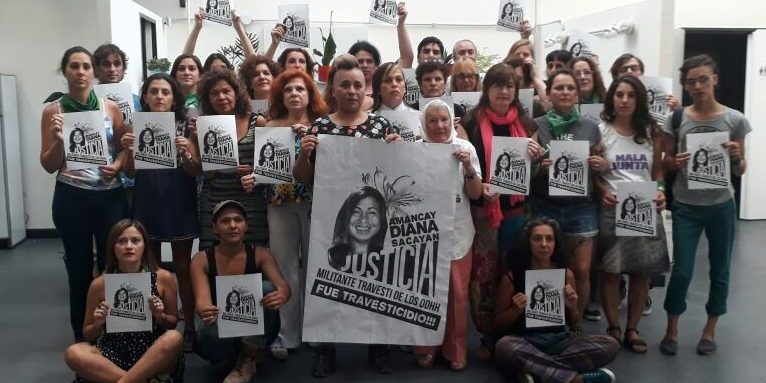
On Friday, March 9, a group of human rights leaders and political figures added their explicit support to the call for Justice for Diana Sacayán and gathered for a group photograph. “Besides the brutality of her murder and the fact that it marks the persecution, we Mothers are present wherever there is great injustice. And here I am. We must continue to be present at the trials and demand justice for Diana Sacayán,” Nora Cortiñas, a member of the Mothers of Plaza de Mayo Founding Line, told Presentes after taking the photo with the sign demanding Justice.[READ MORE: Artists demand justice for the transphobic murder of Diana Sacayán]
“It’s a powerful moment. Not only does the oral trial begin, but also the possibility that the justice system will determine whether this constitutes the crime of transphobic murder,” said Karina Nazábal, currently head of the Gender and Childhood Secretariat of the Ombudsman's Office of the Province of Buenos Aires. Nazábal championed the trans employment quota bill as a provincial deputy (Front for Victory). She added: “Diana has, through her own story, even unintentionally, brought to the forefront important issues in the fight for sexual diversity. Not only because of the trans employment quota law. And she is here, not physically, but in spirit and in her activism, and in the strength of a struggle that will not stop until, in Argentina, for the first time, the justice system rules on a transphobic murder and the situation of transvestites and trans people.”We are present
We are committed to journalism that delves into the territories and conducts thorough investigations, combined with new technologies and narrative formats. We want the protagonists, their stories, and their struggles to be present.
SUPPORT US

FOLLOW US
Related notes


We are present
This and other stories are not usually on the media agenda. Together we can bring them to light.