

March 7: Why is it Lesbian Visibility Day?
What do we mean when we talk about lesbian visibility? Women from different generations share what visibility means to each of them today.


Share

By Amanda Alma
Photos: Luli Leiras, Mariana Leder Kremer Hernández, Ariel Gutraich,/Present Agency
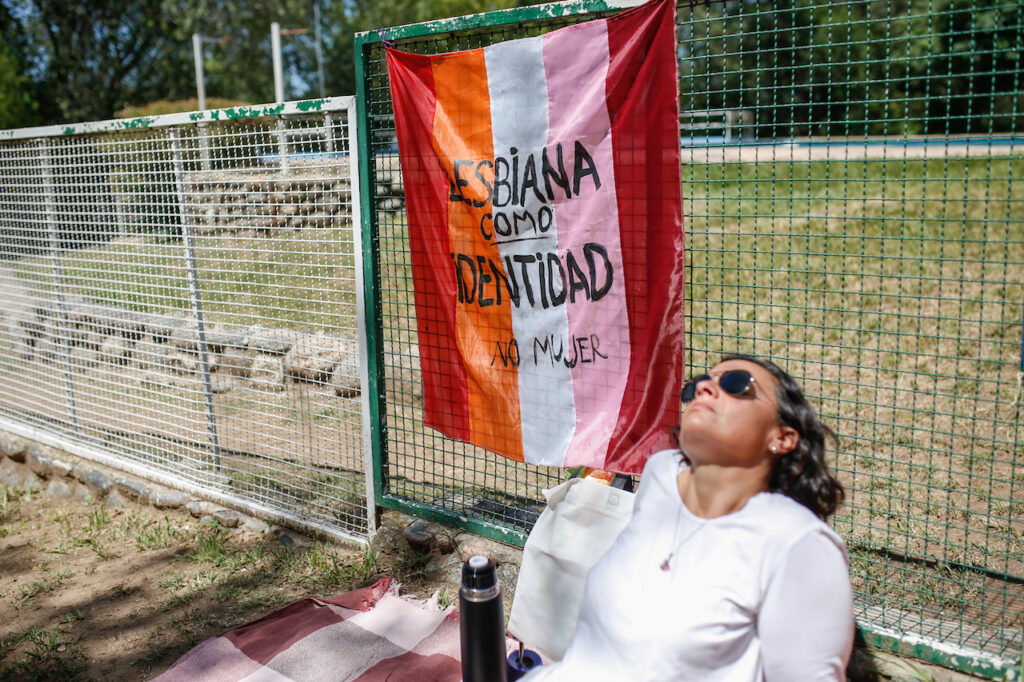
Following the hate crime against Natalia “Pepa” Gaitán in March 2010 in the city of Córdoba, Argentina commemorates Lesbian Visibility Day every year on March 7th. It is a political action to occupy the streets, build community, and showcase the diversity of lesbian experiences. Is it possible to conceive of lesbian visibility solely as an expression of love between women?
Expand your romantic possibilities
Kekena Corvalán is a professor of Latin American art history, teaches at private universities, and is active in Peronism through the Instituto Patria. To discuss visibility, she argues, one must begin with the central value society places on heterosexuality. “It functions as a system for ordering bodies, where the male-female relationship is considered 'normal' and natural. Anything outside of this is labeled as abnormal, which is why visibility seeks to transform this idea in order to expand people's possibilities for love,” says Corvalán.
Lesbian visibility, an individual and collective process
Visibility is part of an individual and collective process. It begins with the discovery of lesbianism, continues with acceptance, and culminates in the act of becoming socially visible. It involves a great deal of work to confront fears, guilt, feelings of being different or strange, and prejudices. Pepa Gaitán was 27 years old when she was murdered because of her visibility. Corvalán is 52 years old and became visible in the 1990s, when being a lesbian could cost you your job. While discrimination and workplace harassment persist, before 2010, when the Equal Marriage Law was passed, many more women "avoided talking about their partners or didn't specify who they were in a relationship with because the prejudices were so strong." The emergence of lesbianism in the public debate and on the societal agenda has allowed society to become more receptive. For her, "it's about not having to hide, being able to be myself and live my happiness in a relaxed way."
Lesbians in the media
For many lesbians, it's clear that the legal changes have impacted social and media discourse. Since the passage of Law 26.618, more than 10,000 same-sex couples have married in Argentina. Furthermore, the massive Pride marches and their proliferation in different cities across the country have fostered better organization. And this mobilization on various fronts generates stronger responses to the attacks lesbians face. Another important effect they highlight is the media coverage of the #Tetazo (Topless Protest) on February 7th in downtown Buenos Aires. This action of occupying the streets with lesbian bodies allowed for other reflections on non-heterosexual bodies to appear in the mainstream media—the same media that generally reduce dissident identities solely to sexual practices.
“I’m here, this is who I am, and this is who I want to be.”
Mariana Leder Kremer Hernández is 28 years old, a photographer, and a member of the Emerging Independent Artists collective. She affirms, “Calling myself a lesbian means acknowledging that I am here, that this is who I am, and that this is who I want to be.” As a cultural worker, she focuses on the social representation that portrays only heterosexual love as natural in film, music, and literature. This generates survival mechanisms that affect the free expression of desire, leading to lies or falsehoods about names and identities to avoid detection. “It’s not about an individual act, but about giving space for another person to listen and recognize that they are not alone,” says Leder Kremer Hernández.
 When relationships between women move beyond fiction
 When relationships between women move beyond fiction
Lesbian poet Gabriela Borrelli Azara recalls that for many years, female couples “had to maintain a fiction. They are friends, partners, they live together.” From a literary critic's perspective, the author of Océano says that visibility allows us “to bring romantic relationships between women out of fiction and give them their rightful name.” The representation of sex between women is often associated with male desire. And because lesbians challenge the place that society has assigned to women, they assume the risk of “not being for” men. That is why it is common to hear heterosexual people say “it doesn't matter who a lesbian sleeps with” or “why do they need to say who they have sex with?” Many believe that this idea of intimacy condemns lesbianism to secrecy and concealment.
Proudly out of the closet
Coming out as a lesbian is a way of distancing oneself from the characteristics traditionally associated with women. The act of rebelling against what is expected of an entire gender also provokes a reaction within that community. And it is women themselves who sometimes hold lesbophobic prejudices that complicate the path to visibility. An example of this is the murder of Marcela Crelz in Isidro Casanova, Buenos Aires province. In mid-October 2016, her mother killed her for being a lesbian. The hate crime, which came to light in the media, exposed the violence that visibility can unleash within institutions like the family.
More attacks on lesbians
 More attacks on lesbians
Many lesbians continue to be attacked in the street, in plazas, or in bars while enjoying their visibility. They are discriminated against for kissing or insulted for holding hands. In Buenos Aires, in September 2016, a lesbian couple was kicked out of the traditional bar La Biela. This sparked a protest. Something similar had happened in 2015 at the Kentucky pizzeria. There, the owners of the establishment publicly apologized due to the media attention the public outcry received. Others are sexually assaulted in an attempt to force them back into “normality.” This is what happened to Analía “Higui” de Jesús.
“Many men treat you as if you were one of them.”
Visibility isn't easy. Borrelli Azara exposes some reactions that seem to accept lesbianism but actually assimilate it to the male gaze. She says that many men "start treating you as if you were one of them, as if we shared the same male perspective on women's bodies."
“A way of positioning oneself and living in the world”
For Kamila Villar, a social worker, journalist, and teacher who has been openly lesbian for over 20 years, “being a lesbian is not the same in some worlds as in others. But by making ourselves visible, we pave the way for others, and others for us. It is a transcendent act because it is a way of positioning oneself and living in the world.”
More exclusion for trans lesbians or “transbians”
Everything becomes more violent when it comes to trans bodies, which further challenge the prevailing mindset that assumes genitalia as the defining factor of identity. There, the backlash also affects the LGBTQ+ community with the same force as the heterosexual world. Trans lesbians or transbians are viciously targeted when they become visible even among cisgender bodies. They are often excluded from lesbian organizing spaces and prevented from participating.
Is it possible to be an open lesbian on your own?
Corvalán states that “cultural change is not immediate, and although there is currently a setback where fear, an increase in attacks, and lesbophobic comments are more prevalent, progress has been made.” Experiencing sexuality in a pleasurable way is the starting point for visibility.
We are present
We are committed to journalism that delves into the territories and conducts thorough investigations, combined with new technologies and narrative formats. We want the protagonists, their stories, and their struggles to be present.
SUPPORT US

FOLLOW US
Related notes



We are present
This and other stories are not usually on the media agenda. Together we can bring them to light.