

Police arrest and torture a trans woman in downtown Asunción
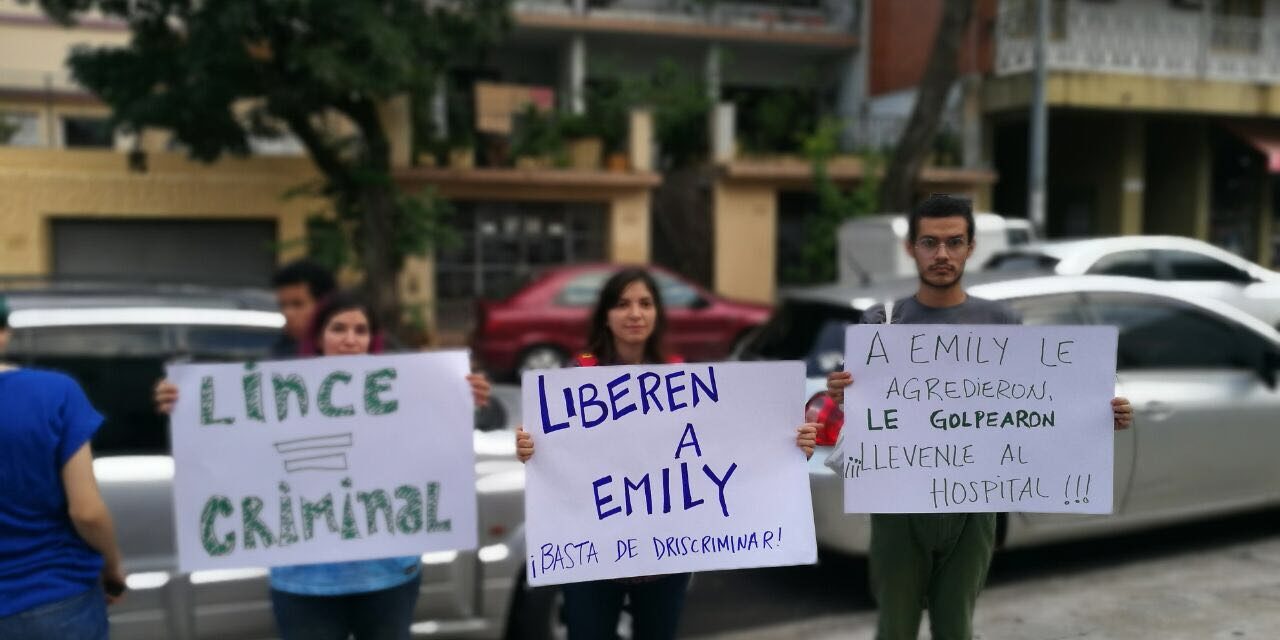
Emily Marín, a 22-year-old trans woman, was arrested on Wednesday, February 28, in a plaza in downtown Asunción. Five officers from the police's tactical operations group, known as Grupo Lince, insulted her because of her gender identity, beat her, and locked her up in a nearby police station.

Share

Emily Marín, a 22-year-old trans woman, was arrested on Wednesday, February 28, in a plaza in downtown Asunción. Five officers from the police's specialized tactical operations group, known as Grupo Lince, insulted her because of her gender identity, beat her, and locked her up in a nearby police station. Emily went more than 24 hours without receiving medical attention after the beating she suffered. Thanks to the support of activists, a report was filed with the National Mechanism for the Prevention of Torture (MNP) . By María Sanz, from Asunción. Emily Marín was sitting in Plaza Italia, in downtown Asunción, last Wednesday at noon. She saw some officers from the police's specialized tactical operations group, Grupo Lince . The "Lynxes," as they are popularly known, are easily recognizable by their attire: camouflage uniforms, bulletproof vests, helmets, and their faces covered up to their eyes. They are armed with pistols, carbines, or machine guns, and travel by motorcycle through urban areas. According to her testimony, the officers approached Emily and confronted her. They asked her why she was there, interrogated her contemptuously about whether she was a man or a woman, and insulted her because of her gender identity. She began recording the assaults with her cell phone, but one of the officers snatched the phone from her hands and hit it until it was damaged. Emily suddenly found herself surrounded by five officers from the Lynx unit who beat her, dragged her along the ground, and immobilized her, kicking her in the back, according to her own testimony.
[READ ALSO: Paraguay: Trans women excluded from comprehensive protection law]
The police took Emily to the nearby Third Police Station in downtown Asunción. There, she was detained, accused of resisting arrest. The officers stated that Emily had assaulted them with punches and kicks and resisted arrest. They also asserted that “during the arrest, force was used proportionally, according to the level of resistance,” as stated in the arrest report. The document identifies the officers involved in the arrest as Óscar Ferreira, Joel González, Fernando Amarilla, Avelio Segovia, and Gerardo Torales. The report does not mention Emily's chosen name, nor does it respect her self-identified gender. It also does not specify the reason for her arrest; it only mentions that she exhibited “suspicious behavior” and resisted arrest.The alarm bell
On the afternoon of Thursday, the 1st, more than 24 hours after her arrest, Emily was still locked in a cell at the Third Police Station. Her back and arms were covered in bruises, bumps, scratches, and scrapes, but she had still not received medical attention. A friend raised the alarm through social media, and several feminist women involved in organizing the International Women's Strike On March 8th, they went to the police station to inquire about her situation. “The response from our comrades was immediate. We learned about the various injustices committed against her: the violent manner of her arrest, the irregularities surrounding why she was detained, the denial of medical assistance, and the unfounded legal actions taken against her,” Soledad Duré, an activist with the 8M organization in Paraguay, told Presentes. At the entrance of the Third Police Station, which occupies the facilities of a former clandestine detention center during the Stroessner dictatorship (1954-1989), the activists organized a protest against the actions of the Lince group, which they equated with state terrorism during the dictatorship.[READ ALSO: Paraguay: Trans people doubled their reports of violence]
Duré stated that the Lince group acts “almost like a paramilitary squad,” with all its officers masked, entering public squares on motorcycles and, far from protecting security, “creating anxiety and insecurity among people.” “We don’t understand this supposed suspicious behavior they claim exists toward people sitting in squares. They specifically target young people, trans people, poor people, or generally all forms of diversity, anything that doesn’t fit their prejudices. We don’t understand the purpose of this police group, unless it’s for social control and persecution,” the activist declared. For Duré and her colleagues, Emily’s arrest was a discriminatory act, fueled by hatred and transphobia, since the officers constantly questioned her gender identity and addressed her using masculine pronouns. “It was an abuse of power, a way to set an example and send a message to all trans girls, so that they would somehow be afraid to go out. They are experiencing systematic attacks from hateful people on a daily basis, and now that attack came from a state agency, in broad daylight and in full view of everyone,” she emphasized.Complaint of torture
Faced with pressure from activists and the press covering the protest, Emily was finally taken to the Emergency Medical Hospital, also in Asunción. There, she was examined by a doctor due to the marks of violence on her skin and the pain she reported in her armpits, where the police had held her during her arrest. On Friday morning, Emily appeared in court for a hearing regarding the imposition of measures for the alleged crime of resisting arrest. She was accompanied by several feminist activists and by Yren RotelaEmily, a human rights defender and leading figure in the Panambí association (which defends the rights of transgender people in Paraguay), was released but must report to the courthouse on the first of each month and is prohibited from leaving the country, her lawyer, Carlota Rivarola, told Presentes. However, the lawyer stated that she will focus on proving that Emily did not commit any crime, but rather was a victim of police aggression and abuse.A human rights report
Emily also received a visit from two commissioners of the National Mechanism for the Prevention of Torture (NMP)A state agency that monitors the conditions of detention for people deprived of their liberty and others held in government institutions. The commissioners issued a report detailing Emily's account and including photographs of her injuries. This report was submitted to the Specialized Unit for Crimes Against Human Rights of the Paraguayan Prosecutor's OfficeThe National Preventive Mechanism (NPM) will have to open an investigation into alleged acts of torture, as confirmed to Presentes by Natalia Ruiz Díaz, communications director of the NPM. The NPM itself oversaw the drafting process of a protocol for the care of trans people deprived of libertyThe protocol, which was approved by the Paraguayan government in August 2015, establishes, among other measures, that transgender people deprived of their liberty must not be subjected to any degrading acts, and that their comprehensive healthcare must be guaranteed. It also states that a record must be kept of the transgender person's chosen name, and that any injuries or signs of mistreatment observed must be documented.We are present
We are committed to journalism that delves into the territories and conducts thorough investigations, combined with new technologies and narrative formats. We want the protagonists, their stories, and their struggles to be present.
SUPPORT US

FOLLOW US
Related notes

We are present
This and other stories are not usually on the media agenda. Together we can bring them to light.