

Hearing before the IACHR: reports on increased violence against trans people in Argentina
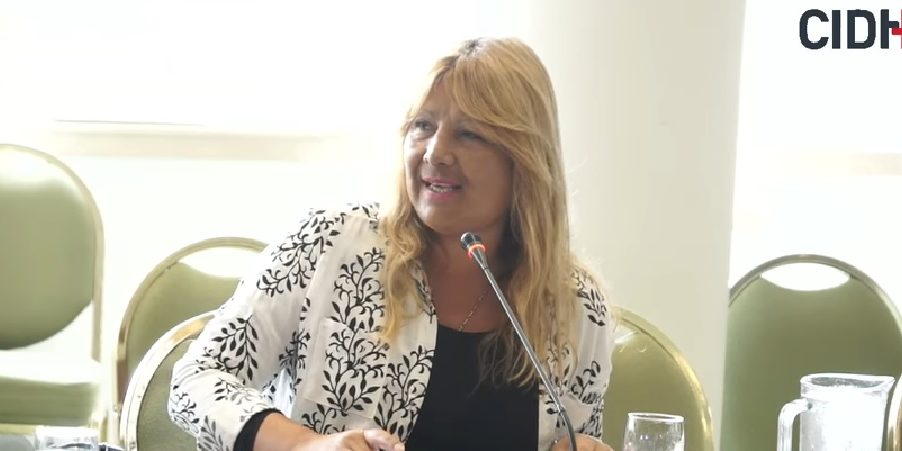
Marcela Romero, president of the Association of Transvestites, Transsexuals, and Transgender People of Argentina (ATTTA), presented a report to the Inter-American Commission on Human Rights detailing the current situation of trans women in Argentina. Her report was titled: “Waiting for Death.”

Share

“In Argentina, institutional violence against trans people is intensifying. The progress that has been made is suffering a serious setback in the region, and violence and exclusion prevent us from achieving equality,” denounced the representative of ATTTA. She based her statement on a report from the Latin American Center for Documentation for Trans People (CEDOSTAL), which records 58% of human rights violations, physical and psychological injuries to the bodies of trans people, and 18% of hate crimes, sexual abuse, and gender-based violence during 2016 and 2017. This statement was made during the 167th session of the Inter-American Commission on Human Rights (IACHR), held from February 26 to March 2 in Bogotá, Colombia. “The objective of this hearing is to hear the presentation of ATTTA’s report in order to bring to the human rights debate the data and information we need to carry out all the necessary actions and procedures to achieve this protection,” said President Esmeralda de Troitiño at the opening of the hearing.
READ MORE Hearing at the IACHR highlighted violence against intersex people

“It became commonplace for the police to mistreat you, harass you, and imprison you.”
“In Argentina, more than 5,000 trans women are detained, abused, and treated as victims of the Argentine police,” the activist denounced, listing some of the forms of violence trans women face daily at the hands of the state: “When we go to a bank, when we try to enter the workforce or education system, when we go to file a complaint. We have an absent state, ill-equipped to serve trans women, and it has become commonplace for our population to be mistreated, persecuted, and imprisoned by the police,” she said. She added, “The end result of this persecution, this institutional violence, is hate crimes and the deaths of trans people.”The transvesticide of Ayelén Gómez
In her presentation, Romero highlighted that between January and February of this year, 18 trans women were murdered “with violence and cruelty,” she said. She pointed out that this news was not reported on any news program. “The deaths of trans women are made invisible,” she said. And she referred to the transvesticide of Ayelén Gómez in Tucumán. “She had filed a police report in Buenos Aires, returned to Tucumán due to police harassment, and was brutally murdered. She was found raped and assaulted at a golf club. In Argentina, the life of a trans woman is worthless. She is not included in any state report aimed at addressing these hate crimes,” Romero stated in her presentation.
[READ ALSO: Transvesticide in Tucumán: according to the autopsy, Ayelén died of asphyxiation]
The urgency of the trans employment quota
Romero also referred to the trans employment quota law that was passed in October 2015 in the province of Buenos Aires. “We have a governor who hasn't implemented it for over two years, but we have an Argentine government that signed a protocol to stop us in less than 24 hours,” she said. She added, “Employment quotas are about inclusion. There are municipalities where three trans women live, and the quota is for 2%, meaning there aren't enough trans people to fill those positions.” It is urgent that the trans employment quota be signed and put into action so that trans people are no longer subjected to sexual exploitation and prostitution.”“We have no other option,” she said. The activist explained that 99% of trans women “engage in sex work and prostitution because we have no other means of survival. It’s our only way to survive.” She recounted that most trans people have to migrate to Buenos Aires due to police persecution in their hometowns. On that point, she identified the provinces with the highest levels of violence against trans people: Salta, Jujuy, Mendoza, Córdoba, and Buenos Aires. “In those provinces, every day a trans woman is a victim of institutional violence, from being arrested or suffering police abuse to having to have sex with the police in exchange for her freedom.” She also addressed the judicial system. “We don’t have a judicial system that serves the trans community without stigmatization and discrimination. I ask the judges to come out of the closet,” she said. https://www.youtube.com/watch?v=K074PLcJb38&feature=youtu.beThe health of the trans population
The activist called on the Argentine government to amend the HIV law and the anti-discrimination law, and to increase the budget for sexual diversity: “LGBTIQ+ organizations want to be part of that budget, and we ask that it not come from specific areas, but rather from the national budget, and be specifically allocated to the trans population,” she said. Romero denounced the fact that Argentina has a dysfunctional Ministry of Social Development, the Health Superintendency does not respond to the demands of the trans population, and that a budget is needed to train doctors. “There are more than 600 people on the waiting lists, and they operate on only 5 people per year, but if I have the money, the doctor will operate on me, and it's the same doctor we need. It's necessary to break with this corruption,” she said. She also demanded safe, legal, and free abortion for trans men. “Not one more trans woman lost, we want to be alive and free. Trans activists are in danger, we don't want to be the next political prisoners for defending an equal democracy. We ask the Argentine government not to exclude us from democracy. We are also part of it,” Romero said at the end of her presentation.[READ ALSO: #Argentina: progress and shortcomings of the trans employment quota]
The responses from the Argentine government
 Diego Borisonik, National Director of Comprehensive Sexual Diversity Policies, took the floor to respond to Romero's accusations. "In Argentina, we cannot easily speak of regression; inclusion has been pursued through National Projects, Programs, Registries, and Plans," the official stated. He emphasized Argentina's commitment to continue developing practices and public policies on Sexual Diversity. In this regard, he referred to the creation of the Directorate of Comprehensive Sexual Diversity Policies and the Permanent Federal Roundtable on Sexual Diversity, in which all 23 provinces and the Autonomous City of Buenos Aires participate. Regarding hate crimes, the official said that a registry of trans femicides was created in 2016 and that "the State is working to generate a cultural shift in stereotypes that affect the trans population." He cited the National Archive of the Memory of Sexual Diversity as an example. Commissioner Flavia Piovesan said that “Waiting for Death” coincides with the report (2015) of the rapporteurship on violence suffered by LGBTI people, “There is an aggravated violence that demands a response within the legislative framework,” she said.
Argentina has no place on the human rights map
In an interview with Presentes, Marcela Romero said that the purpose of the hearing was to inform the IACHR that there has been a setback in our country. “It’s not the model we had two years ago. If there’s no budget for sexual diversity, everything ends up being just meetings.” She added that the Argentine government could face sanctions for the situation regarding the rights of transgender people. “We need to make it clear that Argentina is no longer on the map of countries that respect human rights,” she said.
Diego Borisonik, National Director of Comprehensive Sexual Diversity Policies, took the floor to respond to Romero's accusations. "In Argentina, we cannot easily speak of regression; inclusion has been pursued through National Projects, Programs, Registries, and Plans," the official stated. He emphasized Argentina's commitment to continue developing practices and public policies on Sexual Diversity. In this regard, he referred to the creation of the Directorate of Comprehensive Sexual Diversity Policies and the Permanent Federal Roundtable on Sexual Diversity, in which all 23 provinces and the Autonomous City of Buenos Aires participate. Regarding hate crimes, the official said that a registry of trans femicides was created in 2016 and that "the State is working to generate a cultural shift in stereotypes that affect the trans population." He cited the National Archive of the Memory of Sexual Diversity as an example. Commissioner Flavia Piovesan said that “Waiting for Death” coincides with the report (2015) of the rapporteurship on violence suffered by LGBTI people, “There is an aggravated violence that demands a response within the legislative framework,” she said.
Argentina has no place on the human rights map
In an interview with Presentes, Marcela Romero said that the purpose of the hearing was to inform the IACHR that there has been a setback in our country. “It’s not the model we had two years ago. If there’s no budget for sexual diversity, everything ends up being just meetings.” She added that the Argentine government could face sanctions for the situation regarding the rights of transgender people. “We need to make it clear that Argentina is no longer on the map of countries that respect human rights,” she said.
We are present
We are committed to journalism that delves into the territories and conducts thorough investigations, combined with new technologies and narrative formats. We want the protagonists, their stories, and their struggles to be present.
SUPPORT US

FOLLOW US
Related notes

We are present
This and other stories are not usually on the media agenda. Together we can bring them to light.