

Marta Dillon: “There are no human rights without feminism”
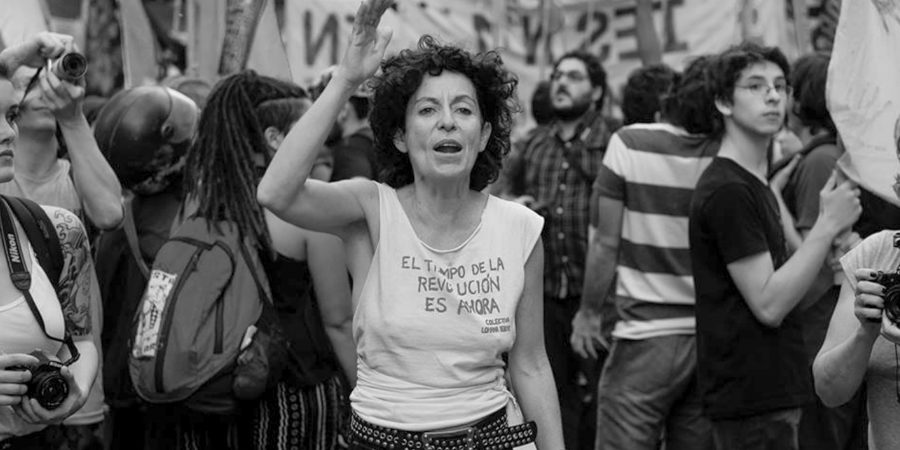
Opening photo: Sebastián Miquel By María Eugenia Ludueña A month before #8M, Marta Dillon sat in one of the courtrooms at Comodoro Py to testify in a trial for the kidnapping and disappearance of her mother, Marta Taboada. She was wearing a Ni Una Menos t-shirt – a movement that…

Share

Opening photo: Sebastián Miquel By María Eugenia Ludueña A month before March 8th, Marta Dillon sat in one of the courtrooms of the Comodoro Py courthouse to testify in a trial for the kidnapping and disappearance of her mother, Marta Taboada. She wore a Ni Una Menos t-shirt—a movement she has participated in since its inception in 2015—a HIJOS scarf, and a green scarf for legal, safe, and free abortion. Activist, journalist, writer, feminist, and lesbian, Marta Dillon has lent her voice and body to activism. She directs the Las Doce supplement (pagina/12), a pioneering publication that incorporates a gender perspective in the media, and was involved in the creation of Soy, a magazine focused on sexual diversity. One week before the March 8th Feminist Strike, she answers the 5 questions:
-What place do diverse femininities occupy in Ni Una Menos?
The place they occupy is the place we all occupy. Ni Una Menos is a movement that speaks in the feminine and includes ways of naming other identities that are also violated by patriarchy. That's why our documents always include a list that says "lesbian, transvestite, and trans women." The letter X also appears as an unknown, and we speak in the feminine, but not a biological feminine, rather a feminine that includes feminized bodies. There have always been lesbians in Ni Una Menos; it's not that there was a process of expansion or recognition. We exist, we narrate ourselves, we tell our stories, and in that "we," lesbian, transvestite, and trans women have been present from the beginning. What I do believe is that in the creation of documents and in the assembly processes... Today, those bodies are appearing with greater force..-Which of the Ni Una Menos slogans do you think are the most difficult to hear and amplify?
-I don't know if there are more difficult slogans. Complexity is power. to continue contributing to the understanding of what sexist and patriarchal violence meansThis is the most difficult thing, because it may seem easy to talk about, for example, sexual abuse at a certain point. It seems easy to talk about abortion in the debate. But when feminists move away from the strict gender agenda, to address issues that affect the body and violence, it's harder to be understood and easier to be attacked. When we talk about the economy, access to work, unpaid domestic labor, when we start thinking about the State and exclusion from wealth, there are difficulties. And that has been the great contribution of Ni Una Menos: understanding that sexist violence is not a matter of interpersonal relationships. Male chauvinist violence is a structure and mechanism between the intersection of interpersonal male chauvinist violence, and the social and institutional violence exercised by the State.
-You're an openly lesbian person, an openly HIV-positive person. Has that visibility brought you, or does it bring you, conflicts? How do you experience it?
-At some point, having HIV and talking about it might have caused me some problems. But strictly speaking, the problem hasn't been talking about it, but rather the problems that come with living with HIV. I recently went to the dentist and he almost fainted when I told him I have HIV. For me, visibility is more of a protection than a risk. Everything else, anything that isn't visible, is, in a way, hypocrisy to me. And I'm not saying everyone has to be visible. But for me, anything that isn't visible is hypocrisy, and it affects my family. If I didn't say I'm a lesbian, for example, my son wouldn't be able to explain what his family is like. For me, visibility is about protecting ourselves and unleashing that lesbian power.[READ MORE: #Books Marta Dillon, Living with Viruses]
-Human rights activist, daughter of Marta Taboada, disappeared by the dictatorship; feminist, lesbian. How do you deal with this multiplicity of struggles? Are they all one and the same?
– Yes, for me they are one and the same. And that became very clear on February 8th. On February 8th, a month before #8M, Marta testified as a witness to the kidnapping, murder, and disappearance of her mother, Marta Taboada. It was in a trial investigating crimes against humanity committed against 150 people at the clandestine detention, torture, and extermination center Puente 12. Miguel Osvaldo Etchecolatz, the repressor who was in charge of the General Directorate of Investigations of the province of Buenos Aires, is one of the nine defendants. – When I testified in the trial, with the women of Ni Una Menos we built a This document makes visible what we talk about.We speak from a feminist perspective, questioning what happens behind closed doors. When we say that a genocidal maniac's home is a prison, it's because we build other homes and connections. The dictatorship required a specific role for women.. AND Although state terrorism has ended, we know that many of its ideas and methods of discipline have remained. And in these ways, women still have a specific role to play. But there are no human rights without feminism. Feminism has contributed to the human rights struggles, especially the fight against the crimes of the dictatorship. It opened the possibility for women to speak out and tell their stories about sexual crimes, so that it is understood that the crimes committed against women in clandestine detention centers were not just another form of torture. The bodies of women, girls, and boys were taken as spoils of war, on which violent and moralizing messages were written. for them and their classmates.
 -We are living in a moment of expanding and irreversible feminism. What do you think feminism is lacking today?
I think we still need to build meaning, reaching the many women who still view us with suspicion. I think we need to reach rural women, women from the poor neighborhoods. We need to break down this notion that feminism threatens some identity. We need to think about how this power unleashed in the streets and assemblies can be channeled into a way of building upon it, so that we don't have to start from scratch every time, but rather reach basic agreements that allow us to continue working. On the other hand, One of the most important strengths of feminism is its transversality. One has to Be alert to the rapid appropriation of feminism by some sectors and movements. Our need is to stand up to power and all forms of oppression. That is the most urgent thing.]]>
We are present
We are committed to journalism that delves into the territories and conducts thorough investigations, combined with new technologies and narrative formats. We want the protagonists, their stories, and their struggles to be present.
SUPPORT US

FOLLOW US
Related notes


We are present
This and other stories are not usually on the media agenda. Together we can bring them to light.