

My experience as a trans person at the Global Conference on Investigative Journalism
The insights I gained from the conferences were specific and relate to questions I've been asking myself for some time, but which took on a global dimension here: how are LGBTQ+ issues treated in the media? This question opens the door to many other questions.

Share

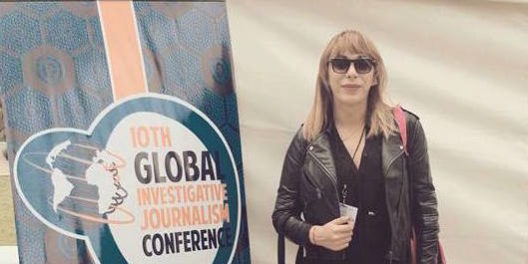
By Violeta Alegre. I was surprised when I read the email, or rather, I couldn't believe it: in mid-2017, I was informed that I had been selected to participate in the 10th Global Conference on Investigative Journalism. It would take place in Johannesburg, South Africa, from November 16 to 19. I had applied from Buenos Aires, Argentina, representing the news outlet Presentes LGBT, a regional agency focused on LGBTQ+ news, where I have collaborated as a columnist and researcher since its inception. Esteban Marchand, a Peruvian journalist and correspondent for the same outlet in Lima, was also selected for the conference.
"Transvestite, South American, and Spanish speaker"
Arriving in South Africa was a rollercoaster of emotions. From the most basic—the fears we face when embarking on a journey to unfamiliar places—to navigating different territorial and political systems, amplified by my trans identity. Being trans means living with the constant uncertainty that any bureaucratic process could be complicated in an office or airport simply because of having a non-hegemonic identity. In this case, I was also South American and Spanish-speaking. This time, I was able to reach my destination without any problems, much luckier than in Madrid, where they practically took my X-ray just to enter the European Union. Upon arriving at the hotel, I was surprised to find so many other Spanish speakers. They had come from Latin America and around the world for the conference, with approximately 500 participants—another surprise! I was the only trans woman among the conference audience, unless there were other trans women I hadn't been able to identify. With South African intersex activist Jabulani Pereira
During those days of meetings at Wits University with journalists, activists, and researchers, I was amazed not only by the different bodies, ethnicities, cultures, and clothing from various regions. I could see and feel the richness of that diversity. For some reason, or several, it seemed to be celebrated, in an atmosphere of respect, constant smiles, and kindness.
With South African intersex activist Jabulani Pereira
During those days of meetings at Wits University with journalists, activists, and researchers, I was amazed not only by the different bodies, ethnicities, cultures, and clothing from various regions. I could see and feel the richness of that diversity. For some reason, or several, it seemed to be celebrated, in an atmosphere of respect, constant smiles, and kindness.
Journalism workshops
From the beginning I knew I wanted to participate in the LGBTIQ-themed workshops. I signed up for “A Workshop for Reporting on LGBTQ Communities” and “LGBTQ Resources – A New Guide from GIJN's Online Resource Center”I also attended others whenever I could. I listened to Brian Pellot, Marks Schoofs, and Jabulani Pereyra. They provided different journalistic and investigative tools for addressing LGBTQ+ issues in the media. I left each talk reflecting on the many facets of the violence that LGBTQ+ people face, not as an individual occurrence but as a global and social phenomenon, and one that is worsening. It was striking to think that being LGBTQ+ is still grounds for condemnation in many countries. The testimonies were among us. The insights I gained from the conferences were specific and relate to questions I've been asking myself for some time, but which took on a global dimension here: how are LGBTQ+ issues treated in the media? This question opens the door to many other questions.How to communicate LGBT issues
When we cease to be invisible and silenced, some media outlets often condemn our identities. They turn them into objects of stigmatization, discrimination, and criminalization. In journalism, some call it "bad practices." That is, when news about this community is reported primarily using police sources, without considering the members of the community or their contexts, sensationalizing and distorting the communication of the news and its factual content. Bad journalistic practices also include not asking questions about a person's self-perception of identity. That should be one of the first questions when dealing with news about LGBTIQ people: how do the protagonists of those events perceive themselves? These are not static or binary terms. Respecting gender identity, gender expression, and sexual orientation is the first step toward respectful coverage of the rights of this community. Proper communication practices should be based on respect and commitment, first and foremost, giving voice to LGBTIQ people whenever possible, framing stories and political contexts of each region, taking into account exclusion and rights violations, and using the opportunity that news provides to inform about laws and people's rights.
The use of sources
Diversifying sources, developing our own agendas, and focusing on underreported issues through research and follow-up are some of the lessons we shared at the Conference. It's about raising awareness and visibility to break down prejudices, using inclusive language, and avoiding the hegemony of diversity. But it's also about understanding that within diversity there are multiple forms of diversity—ethnic, class-based, and so many more—as we experienced during those days of encounter and diversity in South Africa. What I learned during the workshops and the exchanges we had in those spaces led me to observe and reflect during my stay in Africa about the very different and varied bodiesTo consider the convergence of trans identities and blackness, and how their coexistence increases marginalization in a society where both factors are "activated" by physical, corporeal characteristics (skin pigment and/or disruption of the gender binary). This concern sparked my desire to investigate the struggles for emancipation of Black bodies, particularly in Africa and Namibia under apartheid.Perhaps with the hope of finding something like a "guide" or orientation that will give me tools to put into practice in this struggle that I take on when I register as a Trans activist. A global perspective
Being able to access a global perspective through firsthand experience was very meaningful. I perceived this in conversations with other participants at GIJN 2017. I live in Argentina, where we have a Gender Identity Law. It's a law that depathologizes and respects self-perception. But that doesn't guarantee that it will be enforced.
Some believe that in Argentina we have “won the great battle.” This idea is far removed from reality. Many organizations in the country where I was born and where I live have been denouncing a setback in terms of rights, and they document an increase in attacks—often fatal—against the LGBTIQ community.
It often happens that most major advances, such as our law, are accompanied by significant resistance. And they coexist with the constant attempt to "normalize" binary thinking and hegemony. However, we cannot ignore that the foundation provided by the Gender Identity Law, in terms of citizenship and rights, and therefore in terms of cultural change, now allows us to think of ourselves in different terms. Terms that are condemned and punished in many countries. Because Diverse identities are considered a crime in 72 states, and eight of them punish them with the death penalty.
 A global perspective
Trans children
Another topic I discussed at the Conference, based on my experience in Argentina, was that of transgender children. Many were particularly interested in the story of Luana, a trans girl, and in the struggle of her mother, Gabriela Mansilla. Gabriela achieved something historic: Luana received her national identity document (DNI) reflecting her self-perceived gender identity at age six. I shared that Gabi not only fought for her daughter but also collectively channeled that responsible love by founding the "Free Childhoods" association with other families. There, mothers, fathers, and relatives of trans children find a supportive space where experiences are grounded in love and a commitment to protecting children from a hostile world—at least within the family, a fundamental pillar of our identities. Of course, this dimension is also related to our Gender Identity Law, which generates concern due to the children's young age. In many countries, they are not included in research due to the sensitive nature of addressing trans identities and childhood.
Today, back in Argentina, I reflect on the experience of a space like GIJN and I believe that it not only provided me with the strength of the journalistic tools I mentioned before, but also a whole learning experience. Through exchange with others, understanding how and where we stand in relation to other countries around the world. Through my voice, I can carry the Latin American experience (especially that of Argentina, so rich in trans and travesti struggles) to South Africa, and share the immense learning I put into practice and wish to replicate. So that journalistic commitment not only knows how to address our issues, but is also able to identify the contexts in which it communicates and its objectives. The questions resonate with greater emphasis and trigger others. Why do the mainstream media strive to maintain “normality” in a Latin American context of neoliberal advancement like the one we are currently experiencing?]]>
 Trans children
We are present
We are committed to journalism that delves into the territories and conducts thorough investigations, combined with new technologies and narrative formats. We want the protagonists, their stories, and their struggles to be present.
SUPPORT US

FOLLOW US
Related notes
We are present
This and other stories are not usually on the media agenda. Together we can bring them to light.