

#LesbianKisses Mariana Gómez trial: science fiction justice
On Tuesday, February 27, the Court of Appeals must decide in a public hearing whether to grant the defense's request to dismiss the case against Mariana Gómez, who is being prosecuted for resisting authority and causing injuries.

Share

On Tuesday, February 27, the Court of Appeals must decide in a public hearing whether to grant the defense's request to dismiss the case against Mariana Gómez, who is being prosecuted for resisting authority and causing injuries.
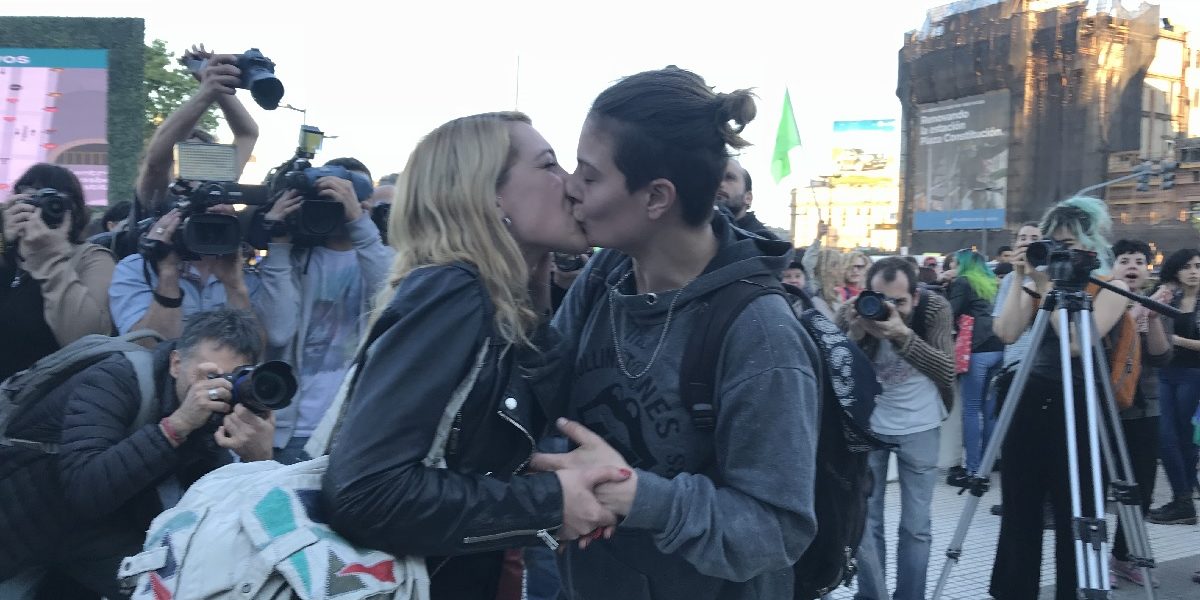
On October 2, 2017, she was arrested and beaten by police while kissing her wife, Rocío Girat, in the Constitución neighborhood. In addition to being charged, her assets were frozen. This was decided by Judge María Fontbona de Pombo on December 29.
Given this scenario, lawyer and lesbian activist Luciana Sánchez wrote this opinion column in an absurdist style.
By Luciana Sánchez* A dystopian scenario unfolding on Tuesday, February 27, 2018. Names have been changed to protect the protagonists. Constitución, a busy midday. In the subway station hall, people are coming and going, street vendors arranging their wares. Some people are smoking. Only two people, María and Rosa, are saying goodbye with kisses and hugs. Metrovías employee González, along with police officer Marrón, are several meters away, watching. They see Rosa and María say goodbye. They see that half a cigarette is dangling between María's fingers, burning down. González goes first, walks up to the girls, and this is where all lesbians in the world imagine that Metrovías employee González will very politely and respectfully ask María to put out her cigarette. But María is one of those fussy lesbians who lives in the past. And although she doubts herself a little and looks around first to make sure she doesn't make a mistake, she looks González in the eye and saysThere are other people smoking (point one); I finish my cigarette and leave (point two); You can't touch me, because you're male and I'm female (Point three). Of course. María believes, at that very moment, that she has been the victim of discriminatory profiling by the Metrovías employee. María believes that González approached her because she and Rosa are two lesbians who are publicly expressing their affection, and that he's the typical creepy guy who, if he has even a millimeter of authority like a Metrovías employee, will use it to harass you in some way whenever he has the slightest opportunity or lame excuse. She also believes that the violence could turn physical at any moment, and since she lives in the past where the world was binary in matters of gender, she tries to ensure that, at least, it's another woman who lays hands on him. But González is an agent of the future, of change, and María's response frightens him, understandably, so he goes to find Officer Marrón, to whom he reports the incident. Marrón doesn't need to know more; luckily, he's armed and equipped to intervene, and between him and González, they'll surely be able to control the situation. She needs to be stopped right now, before she escapes and causes more harm. Faced with the intervention of the armed police officer, Maria only deepens her mistake, misinterpreting the situation again. Because the rules are clear now, and they're strictly enforced. Right? I mean, it's not like you can assume that if you're a woman and a male police officer comes to arrest you, he's doing it on purpose. Even if, five minutes after her request, a female police officer appears. femaleVery feminine. María also doesn't understand that body parts are now deconstructed and dehierarchized, and therefore again interprets as sexual assault the fact that the policeman Marrón gropes her breasts, or rather tries to, because she manages to raise her arms and protect what she still considers valuable, intimate. As a result of this obsolete defense, Marrón ended up with a blow to his face. And finally, what María doesn't know, or doesn't understand, or doesn't want to understand, because she lives in the past, is the paradigm of the current world, which is a one hundred percent lesbian paradigm, based on the two classic lesbian moral principles, namely: -The “ferocity” of his “irrational hatred towards men”, which leads them to constantly try to castrate them, “attacking his testicles" -He "deliberate contempt” towards the “feminine attributes"that leads lesbians to"attacking women to disfigure themThis is why lesbians are currently considered superior beings, goddesses full of privileges. Furthermore, we have been implanted with a microchip that gives us superpowers: -Thenatural aggressiveness"of lesbians, especially those"male" -The "magnitude” of his “force” “superior to that of a woman"and even to that of "several men“Therefore, we ask that before convicting her of assault and resisting arrest, you consider these errors. Maria has recently been thawed out, and she is not yet in control of her natural aggression and super strength. Proof that her super strength chip is only just being activated is that, despite kicking Officer Marrón in the testicles, he did not suffer the slightest injury or consequence. Nor has Officer Villa Diamante suffered any permanent disfigurement. At the beginning of the proceedings, there were fears that she could be permanently bald, since Maria had pulled out a lock of her hair during her arrest. In any case, we are aware that it took three government agents to subdue and arrest her, two of them armed. And that she only sustained such minor injuries as a result of this situation that they don't even need to be taken into account. Although it is true that Maria used as an excuse having been hit on the head and having an injury to her right foot, it was not enough to prevent her from walking and force the police to drag her across the hall From the Constitution. Heroic police officers, who, despite being injured by María, always treated her with utmost propriety and respect during her arrest and transfer. In conclusion, while we believe it is excessive that María be condemned, given that her conduct was motivated by error, we understand that the judge acted correctly when she prosecuted María for assault and resisting arrest. She acted in good faith, trying to protect state agents from the abuse of power by lesbians, a crime that these days corrodes the foundations of our society. *Luciana Sánchez is a lawyer and lesbian feminist activist, member of the Collective for Diversity.[READ MORE: Mariana Gómez testified before the court: “It was a case of lesbophobia”]
[READ MORE: Big kiss in PHOTOS and VOICES: against Lesbophobia, #LesbianKisses ]
]]>We are present
We are committed to journalism that delves into the territories and conducts thorough investigations, combined with new technologies and narrative formats. We want the protagonists, their stories, and their struggles to be present.
SUPPORT US

FOLLOW US
Related notes
We are present
This and other stories are not usually on the media agenda. Together we can bring them to light.