

#LesbianKisses Mariana Gómez's hearing: why the case should be dismissed
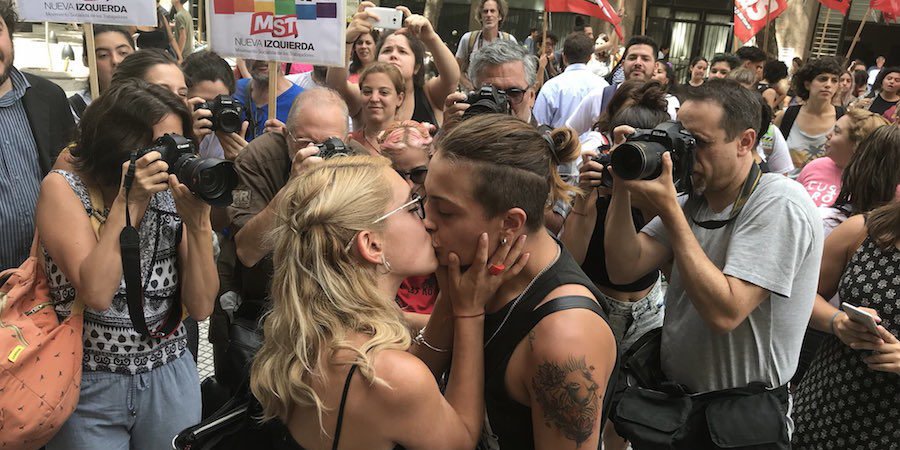
The organizations Colectivo para la Diversidad (COPADI), 100% Diversidad y Derechos, the Asociación Pensamiento Penal, and the Public Defender's Office filed amicus curiae brief with the Sixth Chamber of the Court of Appeals. The Court must decide whether to grant the defense's request to dismiss the case against Mariana Gómez, who was prosecuted and had her assets seized for resisting authority and causing injuries, a decision made by Judge María Fontbona de Pombo.

Share

Amicus curiae brief has been filed with the Sixth Chamber of the Court of Appeals. The Court must decide whether to grant the defense's request to dismiss the case against Mariana Gómez, who was charged and had her assets seized for resisting arrest and assault by Judge María Fontbona de Pombo. Amicus curiae briefs are non-binding submissions that can be filed by third parties not involved in the legal proceedings to offer opinions and arguments on the case. Mariana Gómez was arrested by police on October 2nd while kissing her wife, Rocío Girat, in the Constitución neighborhood of Buenos Aires. On December 29th, Judge María Fontbona de Pombo formally charged her with resisting arrest and assault. She also ordered her assets seized. Mariana reported at the time that she had been assaulted by Officer Jonatan Rojo, who arrested her after confronting her for smoking in a prohibited area. From the outset, Gómez and Girat have denounced it as a case of lesbophobia.
[READ ALSO: #LesbianKisses Mariana Gómez is prosecuted after being arrested for kissing her wife]
The group 100% Diversity and Rights told Presentes that they appeared before the Chamber to contribute the perspective of sexual diversity, which they believe is nonexistent in this process. “We understand that Mariana belongs to a vulnerable group, namely lesbian women, who are exposed to violence, especially institutional violence. We believe there was a selective and criminalizing approach. "This selectivity by the City Police personnel demonstrates how prejudice and institutional violence operate when sexual orientation is made visible," said Greta Pena, president of the organization.Arrest for resisting authority: "a practice of social control"
“We believe that what happened to Mariana Gómez is a recurring case, because the police, using any excuse, arrest people and charge them with resisting authority without any justification. Each year in the City of Buenos Aires, there are 1,500 arrests of parking attendants, young people gathered in the street, street vendors, and sex workers, without any explanation; it's unclear what they were resisting. That's why the Public Defender's Office intervenes to show the court that this is a practice of social control, not a criminal case,” Luis Duacastella, Deputy Public Defender of the City of Buenos Aires, told this publication. He added that if Mariana resisted the arrest warrant, "the legality of that warrant must be determined." He explained that Tobacco Law No. 1799 does not penalize the smoker, but rather the person in charge of the establishment, office, or organization that fails to enforce the smoking ban: "It's a law that doesn't seek punishment but rather the protection of public health," he explained, adding that the police officer who arrested Gómez himself acknowledged that "everyone smokes, and Metrovías doesn't have any signs in that area."[READ ALSO: #LesbianKisses Mariana Gómez trial: science fiction justice]
Duacastella said that the police officer violated the principles of opportunity, proportionality and gradualism of article 83 of the Law 5688 of the Comprehensive Public Security System of CABA“Therefore, the arrest is not justified.” She added that witnesses stated the police officer referred to the young woman as “guy” and, although she told him she was married, he wrote “single” on the report because she could not prove her marriage. “Clearly, this is a case of lesbophobia; the arrest warrant was invalid and tainted by discrimination, an aspect that was not taken into account by the judge who prosecuted her.”
“An excessive and irrational action”
Mirta López González of the Criminal Law Association told this publication that they filed the complaint with the court because they believe the police action was excessive and irrational. "Clearly, there were other motives at play. She was singled out because there were other people smoking in the area at the time. It's clear that what they didn't like was Mariana's behavior with her partner. So she was targeted, and the police officer didn't act with the professionalism a police officer should have. He could have persuaded her to stop smoking, but he didn't. It was an illegitimate order, and that's why Mariana reacted the way she did; she was defending herself against the aggression," explained the criminal law specialist.[READ ALSO: Mariana Gómez testified before the court: “It was a case of lesbophobia”]
López González highlighted the selectivity the judge made with the inadmissible evidence: "one of them is that neither the police officer nor his partner had ever issued a citation in that place, even though they acknowledged seeing people smoking there."A biased ruling against sexual orientation
"Police harassment of lesbians is a daily and deplorable occurrence that must be eradicated. What is exceptional here, and what should be sanctioned by the Chamber, is..." The judge's lesbophobia, who cannot distinguish between the victim and the aggressor, and who perpetuates the negative stereotype of lesbians. “There is a United Nations mandate to eradicate stereotypes in judicial rulings,” said Luciana Sánchez, a lawyer with COPADI. The organization's presentation highlights the judge's characterization of Gómez as a violent and aggressive lesbian.[READ ALSO: #BigKiss for Mariana Gómez: prosecuted for defending herself against the police]
In addition to the young woman's acquittal, the petitions call for training courses for the judiciary to ensure the eradication of lesbophobic prejudices when handing down sentences. They also request the establishment of a registry of incidents and legal proceedings involving hate crimes against LGBT people. ]]>We are present
We are committed to journalism that delves into the territories and conducts thorough investigations, combined with new technologies and narrative formats. We want the protagonists, their stories, and their struggles to be present.
SUPPORT US

FOLLOW US
Related notes


We are present
This and other stories are not usually on the media agenda. Together we can bring them to light.