

Homophobia: They were violently thrown out of a bar in Necochea for kissing
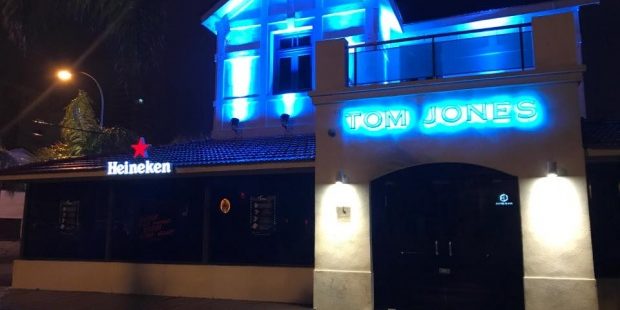
In the early hours of Sunday, February 11, Marcelo Mangini was at the Tom Jones bar in Necochea (Buenos Aires province) with friends. They were dancing with a young man and started kissing when, according to Marcelo's account to Presentes, the owner approached them and said, "It's all good with you, but slow down with the kissing if you want to stay." A short time later, two bouncers forcibly removed them from the bar.

Share

By Paula Bistagnino. In the early hours of Sunday, February 11, Marcelo Mangini was at the Tom Jones bar in Necochea (Buenos Aires province) with friends. They were dancing with a young man and started kissing when, according to Marcelo's account to Presentes, the owner approached them and said, "It's all good with you, but tone down the kissing if you want to stay." A short time later, two bouncers forcibly removed them from the bar. When they went to the police station to file a report, the officer told them, "You went there to provoke someone. There are other places where you can do this." Marcelo is 33 years old, originally from the city of La Plata but living in Buenos Aires. He works at the National Ministry of Labor and is an LGBTQ+ activist. On Wednesday afternoon, after returning from the coast, he filed a complaint with the National Institute Against Discrimination and Xenophobia (INADI). Sources at INADI (National Institute Against Discrimination, Xenophobia and Racism) informed Presentes that yesterday the delegate for the province of Buenos Aires contacted Mangini, who stated that he would file a complaint today. Of all the complaints received by INADI in 2017, 8.5% were related to sexual orientation. And within those complaints, 60% involved discrimination against gay people. "What they want is to force us back into the heterosexual closet and make us invisible: don't kiss in public, hide it, blend in." “We don’t want to see them,” the young man who was assaulted told Presentes. Furthermore, due to the story going viral on social media, institutions reacted immediately: the Human Rights Commission of the Necochea City Council issued a statement condemning the incident and summoned the nightclub owner to appear before them and provide an explanation. In addition, the mayor's office released a statement condemning the attack and announced a collaboration with the Human Rights Department of the Province of Buenos Aires to implement training programs for nightclub employees. “The Diversity Directorate of the National Secretariat of Human Rights also contacted me about talks and training sessions for both nightclubs and the police,” Marcelo added.
“Stop kissing, there are families here.”
Marcelo had gone to spend the carnival weekend with friends in Quequén, a coastal town near Necochea, and they went out on Saturday. There were several of them: him, a young man he had met during those days, several female friends, and a male friend with his girlfriend. “They stayed in the patio, and I was with a guy on the dance floor. We were kissing when suddenly someone touched my shoulder. This person introduced himself as the owner of the bar; later I learned his name is Gonzalo J. Irazoqui. He told me everything was fine but that we should tone down the kissing. I said, “What?” And he replied that he didn't have a problem with it, but if we wanted to stay, we had to slow down a bit. When I asked him why, he argued, ‘I don't have a problem with you, but there are families here.’ To which I replied, ‘I think you do have a problem with us.’ And then he left, as if dismissing the conversation.” Mangini and their friend immediately went to the patio to find their friends and tell them what had happened. They all stayed and danced together. When they started kissing again, two bouncers appeared—they had been keeping a close eye on them. “And it was the same sequence: they told us to stop kissing. They said they were on duty and relaying orders from the owner.” Now certain that it was a homophobic incident, because their straight friends kissed and no one said anything to them, they considered what to do. Then the owner of the place walked by, and they wanted to talk to him so he could explain why he was harassing them. “The guy said something like, ‘I don’t have to talk to you,’ kept walking, and gestured to the bouncers, saying, ‘Get these guys out of here.’” The bouncers approached and told them they had to leave. They started arguing until one of them said, “Well, this is going to be one way or another.” Mangini told Presentes that the bouncer, since he was the one arguing, put him in a pincer movement with his arms, lifted him up, and started dragging him through the crowd, pushing his way through. “I started struggling and trying to get away, and at that moment I apparently hit him, and he punched me in the head. That's how he dragged me out and threw me on the sidewalk.” According to his friends, while they were dragging him out, people were asking why they were taking him out like that and were showing their support. He didn't realize what was happening. A minute later, the same bouncer returned with his friend and threw him on the sidewalk too. His girlfriend was also hit because she tried to defend him.
“You have places where you can go to do what you do.”
Once everyone was outside, they were locked out of the club. Mangini wanted to file a police report, even though several of her friends told her it was pointless. First, they went to Police Station 1 in Necochea, which is very close to the club. They told an officer what had happened. The officer said, “Well, first of all, let’s use common sense.” “I knew what was coming. Then he started with the right of admission and how the owner sets the rules and decides because it’s a private space. And then he ended up telling us that we had incited violence because we had been warned… And he went around in circles to say that it was pointless for us to file a report,” Mangini told Presentes. When they told him that it was an act of discrimination, that there was an Anti-Discrimination Law, the officer interrupted them and said, “I don’t know that law. I don’t know about gender laws.” “In the end, he said, ‘You have places to go to do what you’re doing.’” A friend of Manigni's took out her cell phone and started filming what the police officer was saying. “Things got a little worse, and the guy started asking us if we had been drinking. He said he was going to give us a breathalyzer test because if we were over the legal alcohol limit, he couldn't take our report. That's when I told him that was it, we should leave. And then things calmed down a bit, and he told me that if there had been violence, then he could take my report. The officer went back to the office where Manigni was waiting and said, “I don't agree with your methods at all. If any of you upload that video to social media, I'll file a complaint against each of you.” And that's when I realized it was pointless, so I got up and told him that the conditions weren't right for me to file a report because if he was threatening me, I didn't want to give him even my personal information. And I told him that he was also behaving in a homophobic way. And I told my friends, and we left.” “They want to put us back in the closet.”
“It’s a very strange feeling. I’ve experienced discrimination in the streets, I’ve gotten into fights because someone said something to me, I’ve endured stares. But I’d never experienced anything so psychologically and physically violent. And then, on top of that, going to an institution and leaving with this feeling of humiliation, helplessness, and powerlessness. So much loneliness. And I went to sleep very distressed, even though I was surrounded by friends.” It wasn’t until Monday that he dared to write something on Facebook, but then he regretted posting it. He felt it was pointless because surely nothing would come of it. “Until I stood up and said: no, wait, it was really hard for me to come out of the closet. Not the gay closet, but the heterosexual one, the imposed one. Which is the closet they want to put us back in. Because the argument was very clear: as long as you don't visibly act gay, everything's fine. Blend in. I mean: don't kiss. And I'm not going back there. So in the end, I shared something really small to expose the club's page. Because I went in and saw that everyone was saying: 'what a great place, what great service.' And clearly, good service is a heterosexual privilege. So I shared it and the reaction was amazing: there were more than 700 shares. And they had to shut down the fan page because people started reporting them for homophobia.” Mangini says that everything that happened on social media and with the friends who called was very healing. “In everything that happened, in this collective gathering, I felt a healing of that anguish I had. And the most important thing is that, in addition to my personal healing, I believe we have to use it. Because if what the powerful and these violent regimes want is to silence us, beat us, instill fear in us, make us feel powerless and alone, and depress us, I think that clearly, collectivizing the pain and anger is a good thing.”
 “They want to put us back in the closet.”
“ Homophobia is a local policy”
Yesterday afternoon, Presentes tried to contact the establishment, but no one answered. Furthermore, following Mangini's complaint on social media and his request for help in launching a "virtual shaming" campaign against the bar, they immediately shut down their Facebook page. Before that, dozens of people left messages accusing the establishment of various homophobic incidents and other acts of violence. One user stated that it wasn't the individual behavior of a single employee, but rather a "policy" imposed on their staff by the owners. A local news outlet reported something similar: "No summer season goes by without the Tom Jones bar being the scene of violent incidents perpetrated by its own staff. This time, the attack against customers was motivated by a clearly homophobic orientation of the establishment's owners," reported the local news website NdeN, which was the first to publish the story.We are present
We are committed to journalism that delves into the territories and conducts thorough investigations, combined with new technologies and narrative formats. We want the protagonists, their stories, and their struggles to be present.
SUPPORT US

FOLLOW US
Related notes



We are present
This and other stories are not usually on the media agenda. Together we can bring them to light.