

#Paraguay: Lesbians, bisexuals and trans people call for a strike on #March8
The Paraguayan women's movement, which includes social organizations, feminist collectives, unions and self-organized women, called yesterday for a strike on March 8, in protest against labor exploitation and violence against women.

Share

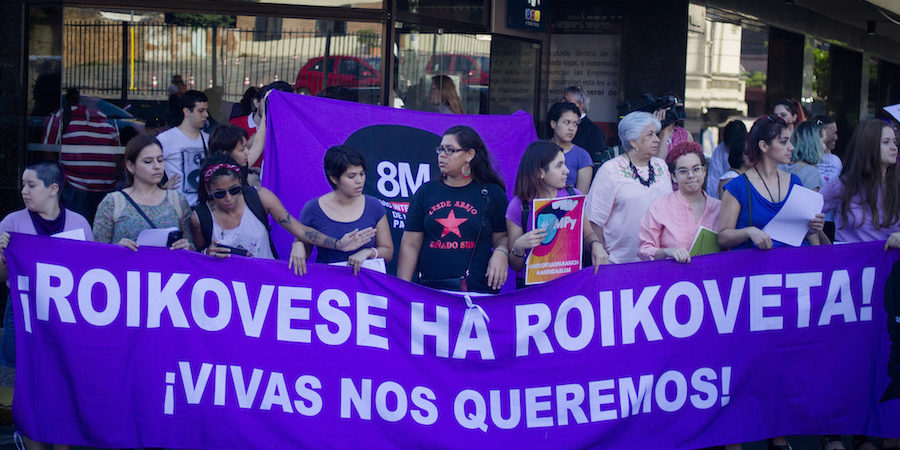
By María Sanz, from Asunción. Photographs: Mayeli Villalba. The Paraguayan women's network, which includes social organizations, feminist collectives, unions, and self-organized women, called yesterday for a strike on March 8th to protest labor exploitation and violence against women. The strike will take place in at least 54 countries worldwide, commemorating International Women's Day. In Paraguay, the strike aims to highlight the paid work and caregiving tasks performed by women and seeks to extend to all sectors: urban and rural women, Indigenous women, poor women, domestic workers, women living with HIV, informal sector workers, high school and university students, older women, sex workers, athletes, and union members. Among them, lesbian women, trans women, and representatives of different forms of sexual diversity are inviting others to join the strike to fight against the discrimination and workplace exclusion they face due to their sexual orientation or gender identity.
[READ ALSO: #HateCrimes2017: More than 400 reports of violence against LGBT people in Paraguay]
The warning is clear: “In one month, women will bring the world to a standstill.” It's about staging a strike, whether it lasts a full day or just a few minutes, to highlight the importance of women's work and to protest against violence, exploitation, and discrimination against female workers. “Being a lesbian is not a crime”
One month after the strike, at the entrance to the Ministry of Labor, Employment and Social Security, in downtown Asunción, seven women dressed in white staged a protest. Seven cases of femicide have been registered so far in 2018 against Paraguayan women. They recite their names, their ages, how many children they had, where they were from, what their plans were. The dates on which their lives were taken are marked with chalk on the floor, in a macabre timeline. After them, more women reveal cases of other types of violence they suffered in the workplace. These are accounts based on real stories of endless hours, firings, harassment, and humiliation simply for being women. One of the participants raises her voice to her companions: “I’m a lesbian, but I can’t talk about it at work, my boss can’t know. I want to feel free to be who I am, because being a lesbian isn’t a crime.” She draws applause. And her companions reply: “We’re not alone, we’re all on strike.”
 “Being a lesbian is not a crime”
Discriminated against for not having a normative appearance
“In Paraguay, sexual orientation is still an obstacle to getting a job, or it causes problems once you're employed. You can't talk about it, you're not allowed to be seen in public with your partner, or you face discrimination,” Xelina Coronel Fernández, spokesperson for the organization, told Presentes. LesbosCoronel, a 21-year-old student with a shaved head dyed blue, a lip ring, and several ear piercings, is fighting for equal rights for lesbian women. She admits that she hasn't experienced discrimination for being a lesbian in the workplace, but she has had difficulty finding employment due to her physical appearance. “It does happen that, since my appearance isn't very normative, it's hard for me to get a job. It's the same thing that happens to trans people, or queer people, or anyone who represents diversity. Since it's kind of difficult to get a job with this appearance, I started my own business,” she explained. Dismissals and discrimination in the workplace and education system, motivated by sexual orientation or gender identity, were the reason for consultation in nine of the 203 calls received by the organization. “Rohendu” free telephone line (“I hear you”, in Guarani), which is maintained by the Aireana organization – a group for lesbian rights.
 Discriminated against for not having a normative appearance
Trans women strike for alternatives to sex work
Trans women are also joining the March 8th strike to protest a labor market that excludes them and offers sex work as their only option. “98% of trans people in Paraguay engage in sex work as their only means of employment and survival. We are not against sex work: it is everyone's right to decide whether to do it, but we want other opportunities. We want to show that we are producers and builders of better societies. We need to rethink how we are perceived, and we no longer want to be recognized solely for sex work. We want to be recognized in other facets,” Yren Rotela, a human rights activist and leader of [the organization], told Presentes. Panambi, an organization that represents transsexual, transvestite and transgender people in Paraguay. [READ ALSO: Paraguay: Trans people doubled their reports of violence]
Rotela also warned that sex work, especially when practiced on the street, exposes trans workers to a higher level of violence. “98% of trans deaths in Paraguay occurred in areas where sex work takes place,” she explained. In the country, there have been 59 trans femicide victims since the end of the dictatorship in 1989, and most of these cases remain unsolved. The activist acknowledged that there is a minority of trans people (around 2%) who work in alternatives to sex work, such as decorating, sewing, or hairdressing. “But they are poorly paid, exploited, and abused in these jobs. That is why we also demand fair wages and equal conditions and opportunities,” Rotela stated. Paraguay ended 2017 with more than 400 reports of violence against LGBT people. Among these reports, trans women warned around October of a wave of attacks against them in the outskirts of Asunción, especially against sex workers. One of these attacks resulted in the femicide of Romina Vargas, a 28-year-old trans woman.
We are present
We are committed to journalism that delves into the territories and conducts thorough investigations, combined with new technologies and narrative formats. We want the protagonists, their stories, and their struggles to be present.
SUPPORT US

FOLLOW US
Related notes
We are present
This and other stories are not usually on the media agenda. Together we can bring them to light.