

Benito Cerati: “There is homophobia due to ignorance, repetition, and fear”
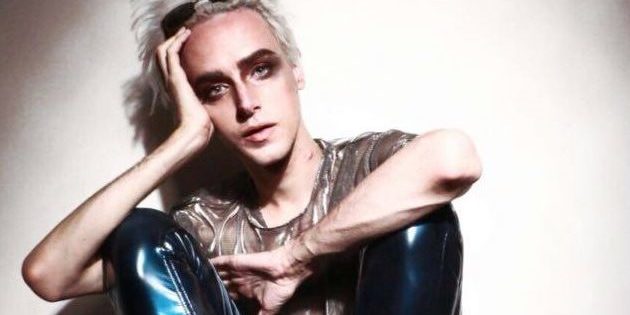
"Benito Cerati has always been me, as obvious as that may sound. I've always had that inner drive to be who I am, for better or for worse. I'm a very emotional person; my tastes and preferences always have to do with a high level of sensitivity." The 24-year-old musician, frontman of the band Zero Kill since 2013, and a social media activist, thus settles the matter of his identity.

Share

By Lucy Ways Photos: Belén Asad “ Benito Cerati has always been me, as obvious as that may sound. I’ve always had that inner drive to be who I am, for better or for worse. I’m a very emotional person; my tastes and preferences always have to do with a high level of sensitivity.” The 24-year-old musician, frontman of the band Zero Kill since 2013, and a social media activist, thus settles the question of his identity. He is Gustavo’s son, of course, but for years he has been recognized as an artist making a strong impact on the Latin American techno scene. A former Anthropology student, and a chameleon-like artist, like his admired David Bowie, he can make music, do a photo shoot, and also fight for feminism and diversity from the Twitter trenches in a single day. Two weeks ago, one of his tweets made headlines on several entertainment websites. It wasn’t news:
Hello. I'm Benito Cerati. Musician. Creator of the project @_Zerokill , two albums out and a third on the way. I'm a feminist and I fight for gender equality and the inclusion of minorities. I'm gay and I'm happy.
— benito cerati (@Vanity_Sexx) January 31, 2018
-You said: “I am gay and happy”: was there a specific reason why?
–I never sought to say it publicly; in fact, I've been openly expressing myself for years. One day in particular, perhaps spurred by the whole heated debate surrounding feminism, they decided to focus on one of the many tweets in which I mention my orientation, just like I would any other topic of conversation. In that tweet, I was actually supporting feminism and minorities. And if I mentioned there that I'm gay, it's because the key is to be proud of it, just like with any other physical, emotional, or other characteristic that defines you. I didn't do it for anything personal at all; I personally gain nothing from my orientation being made public. It's also worth clarifying that for a long time the "gay" label served me well. Lately, not so much; I feel that pigeonholing myself there was like imprisoning myself and losing the opportunity to feel other things. If I really think about who I am, I don't think I have a particular definition. I believe in the spectrum, not the extremes. Therefore, if I said I'm gay, it was to make it visible and for it to become normalized more quickly, so we can move towards the disuse of any labels related to sexuality because it truly won't matter. If this incident caused a stir, it's simply an echo of the homophobia present today: it does matter.
-How did you discover yourself and how did you experience it with your family?
My gender isn't fluid; it's always been static. What happened to me is what happens to everyone: repression of certain parts of myself due to the need to belong. Once I let go of all that and strengthened my self-esteem and stopped trying to "please," I realized I was only functioning at half capacity, and that I had a whole other half unexplored. Then came a process of feeling whole for the first time and marveling at what I was experiencing, realizing there was so much more to me than I had thought. My family loves me. We've all gone through a process of deconstruction based on what happened to me, but the love we have for each other has been the same since day one. Family support is important, of course; it's a huge relief. Luckily, I also know cases where it wasn't like that, but they were still able to move forward. The only thing that needs to be worked on is building confidence moving forward. Sometimes I think that if we have to go through these things, it's so we can teach our families.
-Regarding LGBT rights: what achievements do you highlight and what do you think is still missing?
Since the legalization of same-sex marriage, there has been a great deal of progress and openness on this issue. There's still a long way to go. We tend to isolate ourselves in a small circle of people who are open about this, and we're drawn to it, as with everything in life. Sometimes we forget that it's, as I said, a small circle. You stick your head outside that niche and they're ready to tear you apart. There's still a long way to go. Of course, there are more homophobic environments. There's homophobia born of ignorance, homophobia due to repetition, homophobia born of fear. That's true in any environment. The artistic world is more relaxed, unlike the industry surrounding art. Journalism is still mostly incredibly sexist (I experienced it firsthand) and, in general, it doesn't help to broaden perspectives. I personally haven't had serious episodes of homophobia. I have, however, received comments my whole life from random people trying to offend me by calling me a faggot, or whatever. But it's always online; nobody says anything to your face. However, I know of cases of violence, harm, and mistreatment related to the same issue.-In a note you said that your father was very feminine. Do you link that representation with your feminist activism?
My dad was always a sensitive person, and that allowed him to make wonderful music. He also had that natural leadership quality. I'm much more about uniting groups or easing conflicts than leading. He had a lot of respect for humanity in general, in the sense that he understood values. I grew up seeing a lot of inequality in the world, especially from a privileged position, which bothered me a lot and I couldn't ignore it. Slowly, these thoughts took shape and honed into what is now a defense of rights and equality for all. At home, they taught me to be a good kid, but I forged my own ideas, thoughts, and values based on that.
Click to listen to the interview that Franco Torchia did with him on You Can't Live on Love.
Three or four years ago, I came out as a gay man who considered his homosexuality a personal matter and wasn't interested in the LGBT rights movement. Today, I see that as an insecurity. I couldn't stop speaking out. Because before I'm a musician, I'm a PERSON.
— benito cerati (@Vanity_Sexx) February 7, 2018
The feminist struggle and the LGBT struggle are sister struggles, allies. Let's not segregate ourselves, let's unite; we are trying to tear down the same wall.
— benito cerati (@Vanity_Sexx) February 7, 2018
Lesbians suffer doubly because on top of everything else they are objectified simply because men objectify them.
— benito cerati (@Vanity_Sexx) February 6, 2018
Here with my own flag pic.twitter.com/QZNfuE3h00
— benito cerati (@Vanity_Sexx) June 27, 2015
]]>Dad, I'm sorry you have so many followers who never understood our family and who never understood respect and openness the way you did. If you came back to life, as some say, it would be to slap all these sick people.
— benito cerati (@Vanity_Sexx) February 2, 2018
We are present
We are committed to journalism that delves into the territories and conducts thorough investigations, combined with new technologies and narrative formats. We want the protagonists, their stories, and their struggles to be present.
SUPPORT US

FOLLOW US
Related notes


We are present
This and other stories are not usually on the media agenda. Together we can bring them to light.