

Inter-American Court of Human Rights decision: LGBT activists have low expectations for its application in Paraguay
Although Paraguay is one of the countries subject to the jurisdiction of the Inter-American Court of Human Rights, civil society organizations believe that these recommendations will not be implemented in the country.

Share

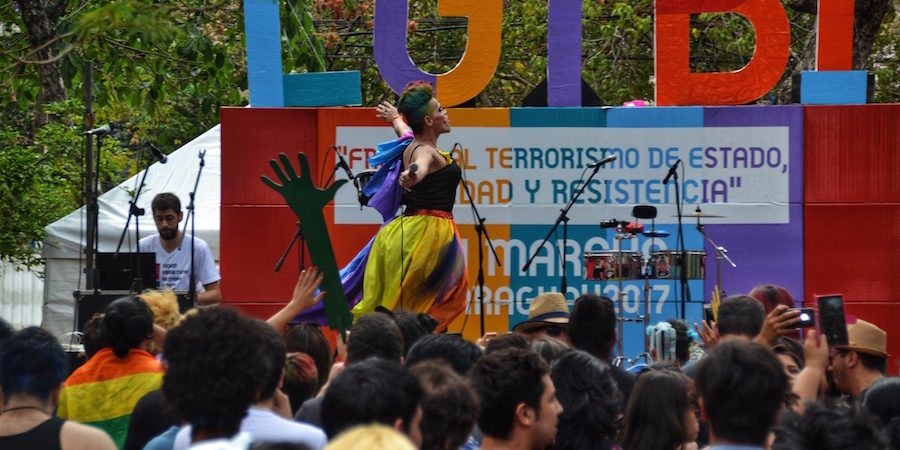
By María Sanz, from Asunción. Photo: Jess Insfrán Pérez. At the beginning of the year, the Inter-American Court of Human Rights issued an advisory opinion recommending respect for various rights of LGBTI people: name and gender marker changes on official documents, marriage equality, recognition of gender identity for transgender people, protection for all types of families, and the prohibition of discrimination based on sexual orientation or gender identity. Although Paraguay is one of the countries under the jurisdiction of the IACHR, civil society organizations believe these recommendations will not be implemented in the country. In recent years, Paraguay has maintained a stance against the rights of LGBTI people, a position it has even expressed before the Organization of American States (OAS).
[READ ALSO: #HateCrimes2017: more than 400 reports of violence against LGBT people in Paraguay]
“The last attempt by the Paraguayan State to align itself with its international human rights obligations was in 2011, when it released its National Human Rights Plan,” Óscar Ayala, Secretary General of the Human Rights Coordinator of Paraguay (Codehupy)which encompasses more than 30 social organizations. This plan, built with the active participation of civil society, included the rights of LGBTI people, and sexual and reproductive rights, among others, says Ayala. “But later, with the government that came after the parliamentary coup (the impeachment of President Fernando Lugo in 2012), that plan was emptied of its content. That's when a course began to be set in which the rights of LGBTI people were removed from the agenda and from state policy on human rights. The current government, with that same conservative framework, is promoting a aggressive diplomatic campaign to defend positions that go against the opinion of the Court"...and of its obligations under international law," Ayala said. As a lawyer for the NGO Living EarthAyala accompanied several legal cases that ended with three judgments of the Inter-American Court of Human Rights which condemned Paraguay to return lands and rights to several indigenous communities. These rulings have not yet been fully implemented. as denounced by several organizations, such as Oxfam.[READ ALSO: #Paraguay: the government banned content on gender in schools]
Regarding the advisory opinion on the rights of LGBTI people, Ayala expressed “great pessimism” about the possibility of the Paraguayan government implementing it, given its openly expressed opposition to the rights of the LGBTI community. Despite this, he affirmed that the Inter-American Court of Human Rights' opinion It opens the door for LGBTI individuals and organizations to file international lawsuits to demand respect for their rights. “The legal framework being forged (regarding LGBTI rights), with provisions already existing in international treaties and with the Court's jurisprudence, clearly allows anyone who feels their rights have been violated to take action to guarantee them. If they are not heard by local authorities, the option of appealing to international bodies such as the Inter-American Commission and Court is available, beyond domestic legislation,” he explained. He detailed that, until now, there are no precedents in Paraguay of international rulings on LGBTI rights, but “Paraguay is open to future lawsuits in these areas and has an obligation to comply with recommendations and judgments as long as it remains a signatory to the Inter-American Convention on Human Rights.", said.[READ ALSO: “Paraguay assumed an active role against LGBTI rights at the OAS Assembly”]
He emphasized that the advisory opinion is “a binding indicator of public policy.” “It is not a mandate, but the Court is telling all the countries that ratified the Convention on Human Rights: ‘this is what needs to be done.’” If there are specific cases in the future, the Court will rule within that framework.” Ayala declared.“Paraguay must comply, but it does not.”
The organization Aireana - a group for lesbian rights - recalled that The Inter-American Convention on Human Rights was the first law passed by Paraguay after the end of the dictatorship in 1989.as proof that it “wanted to enter the world of international human rights.” By ratifying the Convention, Paraguay voluntarily and in good faith commits to complying with its content. This includes the advisory opinion, which is “an official interpretation of an international legal text,” Aireana explained. Furthermore, Paraguay expressly accepts the jurisdiction of the Inter-American Court of Human Rights. “But at the same time, We know that Paraguay has happily stopped complying with the rulings of the Inter-American Court of Human Rights. like the Sawhoyamaxa case“For example,” Aireana recalled, referring to the case of a land restitution ruling for an Indigenous community that has not yet been fully implemented. Rosa Posa Guinea, from Aireana, told Presentes that The Inter-American Court of Human Rights' advisory opinion "reaffirms, puts into words, something that this government does not understand, which is that all people have the same rightswhether they are indigenous, peasant, lesbian, trans…but the government is not clear on the universality of human rights.”[READ ALSO: Paraguay: Trans people doubled their reports of violence]
“We don’t expect miracles from the government of (Horacio) Cartes. We have zero hope in this government, which has never understood what human rights are, and which is profoundly anti-rights.” There is no political will to safeguard people's rights. “Excuses such as culture or religion are used to justify not respecting rights,” Posa said. She added that a possible change of government, following the general elections next April, could mean a change in human rights policies. “We hope that there will be progressive senators and representatives, regardless of their party affiliation, so that progress can be made.” law against all forms of discrimination"And that there may be a favorable legal framework (for human rights)," he declared.“Peace and relief” for trans people
Another of the Court's provisions protects the right to change one's name and gender on personal documents, so that they reflect each person's self-perception. In this regard, Paraguay does not have a gender identity law that explicitly states this right specifically for trans people. However, Article 25 of the Paraguayan Constitution It states that “every person has the right to the free expression of their personality, to creativity, and to the formation of their own identity and image.” This was the legal argument presented by trans activist and human rights defender Yren Rotela to request a change of her legal name on her documents to her chosen name. In May 2017, A judge authorized this changebased on the Paraguayan Civil Code, which recognizes the name change “for just cause.” However, the Prosecutor's Office appealed this judicial decision, and the case has not yet been resolved. Rotela told Presentes that The Inter-American Court of Human Rights' ruling "is a source of peace and relief for the trans community"which guarantees that, if they resort to international bodies, their right to identity will be recognized. However, he warned that before appearing before the Court, it is necessary to go to national courts, which entails “a lot of time and a great human cost.”In Paraguay, trans people have no respect for our identity, nor any guarantee that we will be granted a name change. "It depends on the judge you get. Not only do we have a conservative state, but there's also a great deal of corruption in the judiciary," he declared.[READ ALSO: Yren Rotela, the spokesperson for trans people who is calling for #8M ]
She explained that, in her case, the name Yren is not registered for either female or male individuals. Thus, the judge was able to grant her a name change without requiring a change of gender on her documents, which Paraguayan law does not allow. However, the court ruling remains stalled in the Court of Appeals because the Prosecutor's Office objects, arguing that her name could create confusion regarding her gender. Rotela asserted that, in Paraguay, many Guarani names are used interchangeably for male and female. The name change process generally takes about three months to become effective, although in some cases it is granted in as little as fifteen days, according to her research. “I have been waiting almost a year to change my name, and that is clear discrimination because I am a trans person.” The Paraguayan state continues to violate the rights of trans people through the judicial system.“,” he stated.Marriages celebrated in Argentina will be presented to the courts
Following the publication of the Court's opinion on LGBTI rights, the Paraguayan organization Somosgay issued a statement In the statement, the organization celebrated the ruling and demanded that the Paraguayan state comply with the recommendations to “guarantee full equality before the law for all its citizens.” The organization also announced the filing of several cases before the Supreme Court of Justice of Paraguay to compel the Paraguayan state to adopt the Inter-American Court of Human Rights' provisions. Simón Cazal, of Somosgay, told Presentes that he will request the Civil Registry to register his marriage to Sergio López, as well as the marriage of radio host Karen Ovando and illustrator Leda Sostoa, both of which took place in Argentina.[READ ALSO: Karen Ovando: “The situation of the LGBTQ+ community in our country is still very vulnerable”]
Cazal explained that if the Civil Registry denies registration, they will appeal to the Supreme Court of Justice of Paraguay, which will have to rule either in favor of recognizing the marriages or against it, providing a legal justification. If the Court rules against them, they will appeal to the Inter-American Court of Human Rights, which, following its advisory opinion, has already taken a position in favor of marriage equality and can issue a binding ruling for Paraguay. “One way or another, the Supreme Court will have to comply with the guidance the Inter-American Court of Human Rights has just given it. The advisory opinion is about 150 pages long and provides the region's judicial systems with a concise legal framework on the rights of all people,” Cazal stated. The activist also recounted that, in 2012, he submitted his marriage certificate to the Paraguayan Foreign Ministry, which was celebrated in the Argentine province of Santa Fe, to have the document validated in Paraguay. But Foreign Ministry officials rejected the document outright, without even analyzing its contents, on the express orders of the Foreign Minister. Cazal attributed this attitude to the political crisis at the time he submitted the request. "It was a de facto government, after the parliamentary coup, with Federico Franco as president, and the institutions were not at their strongest," he recalled. He hopes that now, following the Inter-American Court of Human Rights' opinion, the documents can proceed. He plans to file the claims as soon as the court recess ends, around March.Paraguay, leader against LGBT rights
At the regional level, Paraguay is among the countries that openly oppose the rights of LGBTI people. At the last General Assembly of the Organization of American States (OAS), held last June in Cancún, Mexico, Paraguay's Foreign Minister, Eladio Loizaga, objected to a section of a resolution against violence and discrimination based on sexual orientation, gender identity, and gender expression. Paraguayan LGBTI organizations believe that their government is leading an increasingly open and belligerent anti-rights stance in the region. Another example of this position occurred in October 2017, when the then Minister of Education, Enrique Riera, issued a resolution prohibiting the dissemination of content related to "gender theory and/or ideology" in public schools throughout the country. In an appearance before Congress, Riera even offered to "burn" all books related to this content.We are present
We are committed to journalism that delves into the territories and conducts thorough investigations, combined with new technologies and narrative formats. We want the protagonists, their stories, and their struggles to be present.
SUPPORT US

FOLLOW US
Related notes
We are present
This and other stories are not usually on the media agenda. Together we can bring them to light.