

The Chamber of Deputies approved the gender identity law: now it goes to the Senate
With 68 votes in favor and 35 against, it will now proceed to its third reading in the Senate.

Share

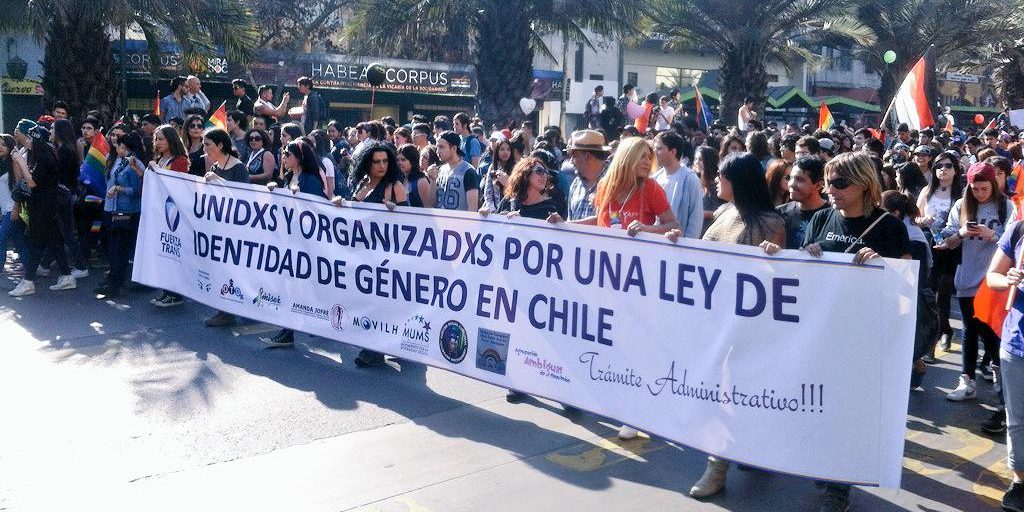
Airam Fernández, reporting from Santiago, Chile: Today was an important day for the Chilean LGBTI community, but not for trans children. The Chamber of Deputies approved the gender identity bill, without including minors. Diversity activists and leaders of some organizations that worked on the document for five years are celebrating with mixed feelings. Although the bill passed its third reading in the Senate, with 68 votes in favor and 35 against, the necessary quorum was not reached to approve the provision allowing for legal gender change for children. Constanza Valdés, legal advisor for Organizing Trans Diversities (OTD), had already warned that if the remaining amendments were voted down and a procedure for making the change was not discussed, then the law would be meaningless. And that is precisely what happened.
In #Chile, the Chamber of Deputies overwhelmingly approved the Gender Identity Bill! Congratulations to the mobilization and LGBTI organizations 🏳️🌈🏳️🌈🏳️🌈 Let's get the Law passed!!! pic.twitter.com/5NnFYSlwLN
— Juan Pablo Martinez (@JuanPocba) January 23, 2018
“We needed 67 votes and only got 62 to include the provision stipulating that the procedure would be carried out before Family Courts. That's why all references to children and adolescents were eliminated. This doesn't mean they don't have the right to gender identity, but the problem is that there's no longer a procedure regulating these changes,” Valdés told Presentes after the session. Married people will also be unable to access the law, the lawyer added, since the provision regulating them was also eliminated. However, in the vote, the phrase “of legal age” was removed and replaced with “every person has the right to” in the procedure before the Civil Registry, which caused great confusion in the chamber. Some representatives argued that children could be included in this modification, but Valdés clarified that this is not a correct interpretation: “The fourth paragraph clearly states that any application submitted by a minor will be declared inadmissible,” she explained. He described it as a "huge setback" and ruled out the possibility of its reinstatement in the third stage in the Senate.
READ ALSO: Gender Identity Law: the challenges after the reincorporation of children into the project]
For the Movement for Homosexual Integration and Liberation (Movilh), the day was "bittersweet and contradictory," but they don't believe children are completely excluded from the project: "The inclusion of children and adolescents is approved, but they are left in limbo," Rolando Jiménez told the press optimistically. "We hope to resolve this in the Joint Committee," he stated. The Selenna Foundation, an organization that works with trans children and their families, never agreed with including minors and having the change made through the courts. That's why they say they agree with the vote: "We never supported the judicialization of children. We wanted the change to be administrative and not through a court. That's why we're happy, because we also have a group between 18 and 20 years old who urgently need the project to be approved so they can move forward," said Ximena Maturana, a member of the foundation's board.
[READ ALSO: Selenna, the Chilean trans girl who became a symbol of pride]
Among the approved articles were those concerning the guarantees derived from the law and the principles of non-pathologizing the difference between biological and social gender, along with the elimination of a medical evaluation certifying the psychological and psychiatric capacity required to justify a request for gender reassignment. Article 3, regarding the right to access hormonal treatments and surgical interventions, which had been modified in the previous session, was also reinstated. The debate was marked by protests in the galleries, with religious zealots and conservative groups being removed from the Chamber of Deputies for disrupting the vote and shouting Bible verses after Representative René Manuel García concluded his remarks with, "If they were born men, they will remain men because God decided it."
[READ ALSO: “A Fantastic Woman,” starring a trans actress, is nominated for best foreign film at the Oscars]
The session was also preceded by good news, celebrated by the entire community, the activists present, and even President Michelle Bachelet: “A Fantastic Woman,” Sebastián Lelio’s film starring trans actress Daniela Vega, was nominated for an Oscar. The announcement came minutes before the vote on the gender identity bill began: “This is a portrait of a reality emerging in Chile, that of respect for diversity and the defense of the rights of transgender people,” the president wrote on her Twitter account.
Attention: The Chamber of Deputies approved a contradiction regarding children and adolescents: It rejected that the rule be exclusive to those over 18 years of age, but also rejected the procedure that regulates the legal change of name and sex of minors.
— Movilh Chile (@Movilh) January 23, 2018
[READ ALSO: Gender Identity Law: the challenges after the reintegration of children into the project]
On the other hand, she addressed the legislative timeline facing the bill as Bachelet's presidential term nears its end on March 11. “For us, a sense of reality must prevail, and that means we have a very demanding agenda, both in the Chamber of Deputies and the Senate. It's something we need to discuss with the Minister Secretary General of the Presidency to see if there's room for a third reading.” The spokesperson also didn't rule out the possibility of the bill going to a Joint Committee, but that “scenario will probably be left for the incoming government.” A week ago, the bill was approved by the Chamber's Human Rights Committee. There, it was also approved that minors can exercise this right, with parental authorization. Furthermore, people over 18 can request a change of sex at the civil registry without having to submit psychological documentation.
]]>We are present
We are committed to journalism that delves into the territories and conducts thorough investigations, combined with new technologies and narrative formats. We want the protagonists, their stories, and their struggles to be present.
SUPPORT US

FOLLOW US
Related notes

We are present
This and other stories are not usually on the media agenda. Together we can bring them to light.