

Trans census with trans census takers in Jujuy: it is the first in Latin America
A team of ten trans women has been traveling through the province of Jujuy for a few days to carry out the First Census of Trans Female People.

Share

By Agencia Presentes
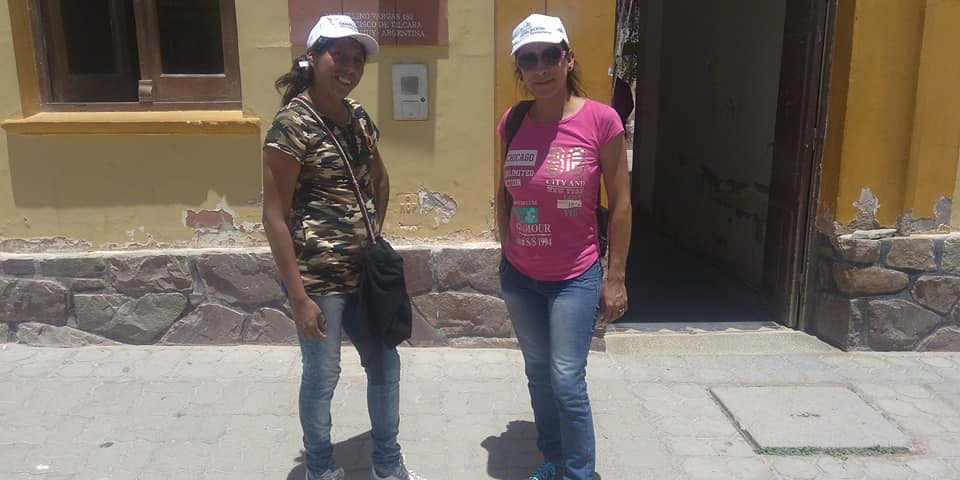
Photo: Courtesy of Damas de Hierro A team of ten trans women has been traveling through the province of Jujuy for the past few days to conduct the First Census of the Trans Female Population. “With this census, we aim to find out how many of us there are in the province and how we live. But we also want to understand the specific situations we face throughout our lives, so that public policies can be developed to guarantee the fulfillment of our rights,” said Lourdes Ibarra, president of the Damas de Hierro Foundation, the local organization that secured funding to promote the census. The First Census of the Trans Female Population is gathering information on access to health, education, and employment for trans women in Jujuy. It began in mid-December 2017, and one hundred trans women have already been surveyed. They estimate that the first results will be available in March. Dayra Delfina is one of the census takers. A stylist, she lives in Palpalá, where she is conducting the survey. “This census is a very powerful tool for us, because it will show how we live. In conversations with trans women, the issue of police violence comes up a lot, as well as the way we are treated when we go to do personal paperwork and access to healthcare. We are not treated as we should be,” said Dayra.

Trans census takers: for the first time in Latin America
“There is no official information about this highly vulnerable and under-visible group. As a state, we need to know about them in order to adjust social policies,” Ana Juárez Oroquieta, provincial director of Statistics, told Presentes. She explained that This is the first time in Latin America that a census has been conducted with transgender female pollsters. The form consists of 95 questions. It was developed by the census takers themselves, in collaboration with the Provincial Directorate of Statistics and Census (DIPEC) of Jujuy. The project began in October 2017, when Damas de Hierro (Iron Ladies) won a grant from the program "Our Right, Our Pride." The prize was seed funding from the Córdoba-based organization Mujeres del Sur (Women of the South) for statistical work, Lourdes told Presentes. Lourdes is in charge of conducting the census in the town of Tilcara. "It's a great achievement for us, not only for the data, but also to identify women in vulnerable situations and be able to help them," she said. "With this census, we have high hopes of opening a new agenda so that, once and for all, we can implement the trans employment quota, a bill that was shelved in 2017. We also need the anti-discrimination law and a protocol for police conduct with trans people within the Security Secretariat." Jujuy is a province in northwestern Argentina with more than 700,000 inhabitants. According to data from the National Institute of Statistics and Censuses (INDEC), in December 2016, 85,907 (25.7%) people in Jujuy were living below the poverty line, while 14,958 (4.5%) were living in extreme poverty. The survey was conducted in the cities of San Salvador de Jujuy and Palpalá, which have a combined population of 334,232. Since 2016, the Jujuy government has been under scrutiny from international human rights organizations—among others. The Inter-American Commission on Human Rights intervened– for the arrest of social activist Milagro Sala. In December, workers from the La Esperanza sugar mill were repressed with tear gas and rubber bullets by the police while blocking Route 34 to demand payment of their November wages. There were injuries and arrests, in what was considered the last repressive episode of 2017, in a province criticized for arbitrary arrests and the administration of justice.
How is information on trans femininities collected?
To collect the information, focused and transdisciplinary teams were formed. These teams are composed of members of Damas de Hierro (Iron Ladies), the organization Abogados y Abogadas del Noroeste Argentino en Derechos Humanos y Estudios Sociales (Andhes), and Unidad Diversa (Diverse Unit). They are accompanied by staff from the Provincial Ombudsman's Office, the Municipality of Jujuy, and the Provincial HIV/AIDS Program. The census takers were trained by DIPEC (Provincial Directorate of Statistics and Censuses) staff, with whom they meet every Tuesday before going out into the field to coordinate their work. The survey uses the "snowball" methodology. Trans women conduct door-to-door interviews in the neighborhoods where people who identify as trans women live. "In addition, each of the informants interviewed mentions three other trans women so that we can achieve complete coverage," said Oroquieta, the Provincial Director of Statistics. She explained that there is one CIPEC supervisor for every three census takers. They also work with receptionists and coders. “The coders have the key to adjusting if the survey has a distortion. If it does, it's returned to the field. We're using the same adjustment and control systems for the Permanent Household Survey and the CPI survey,” he said. To cover the province's territory, six focal points were defined where the census matrix will be developed: Perico, Palpalá, Monterrico, San Pedro, and San Salvador de Jujuy. There is also a mobile unit that travels through the communities of the Quebrada and the Puna regions of Jujuy.
The project began in October 2017, when Damas de Hierro (Iron Ladies) won a grant from the program "Our Right, Our Pride." The prize was seed funding from the Córdoba-based organization Mujeres del Sur (Women of the South) for statistical work, Lourdes told Presentes. Lourdes is in charge of conducting the census in the town of Tilcara. "It's a great achievement for us, not only for the data, but also to identify women in vulnerable situations and be able to help them," she said. "With this census, we have high hopes of opening a new agenda so that, once and for all, we can implement the trans employment quota, a bill that was shelved in 2017. We also need the anti-discrimination law and a protocol for police conduct with trans people within the Security Secretariat." Jujuy is a province in northwestern Argentina with more than 700,000 inhabitants. According to data from the National Institute of Statistics and Censuses (INDEC), in December 2016, 85,907 (25.7%) people in Jujuy were living below the poverty line, while 14,958 (4.5%) were living in extreme poverty. The survey was conducted in the cities of San Salvador de Jujuy and Palpalá, which have a combined population of 334,232. Since 2016, the Jujuy government has been under scrutiny from international human rights organizations—among others. The Inter-American Commission on Human Rights intervened– for the arrest of social activist Milagro Sala. In December, workers from the La Esperanza sugar mill were repressed with tear gas and rubber bullets by the police while blocking Route 34 to demand payment of their November wages. There were injuries and arrests, in what was considered the last repressive episode of 2017, in a province criticized for arbitrary arrests and the administration of justice.
How is information on trans femininities collected?
To collect the information, focused and transdisciplinary teams were formed. These teams are composed of members of Damas de Hierro (Iron Ladies), the organization Abogados y Abogadas del Noroeste Argentino en Derechos Humanos y Estudios Sociales (Andhes), and Unidad Diversa (Diverse Unit). They are accompanied by staff from the Provincial Ombudsman's Office, the Municipality of Jujuy, and the Provincial HIV/AIDS Program. The census takers were trained by DIPEC (Provincial Directorate of Statistics and Censuses) staff, with whom they meet every Tuesday before going out into the field to coordinate their work. The survey uses the "snowball" methodology. Trans women conduct door-to-door interviews in the neighborhoods where people who identify as trans women live. "In addition, each of the informants interviewed mentions three other trans women so that we can achieve complete coverage," said Oroquieta, the Provincial Director of Statistics. She explained that there is one CIPEC supervisor for every three census takers. They also work with receptionists and coders. “The coders have the key to adjusting if the survey has a distortion. If it does, it's returned to the field. We're using the same adjustment and control systems for the Permanent Household Survey and the CPI survey,” he said. To cover the province's territory, six focal points were defined where the census matrix will be developed: Perico, Palpalá, Monterrico, San Pedro, and San Salvador de Jujuy. There is also a mobile unit that travels through the communities of the Quebrada and the Puna regions of Jujuy.

First results of the trans census: in March
The organizers estimate that the first census results will be available in March 2018. The final analysis will be carried out by the Catholic University of Santiago del Estero. Why the Catholic University of Santiago del Estero? “That university has a chair of Statistical and Sociodemographic Analysis that offered to do the work on our survey data,” explained Lourdes Ibarra. “The data will help us to develop specific legislation. But This is an official census. This means that it must be used as input by all government departments for their work.That is the commitment.”We are present
We are committed to journalism that delves into the territories and conducts thorough investigations, combined with new technologies and narrative formats. We want the protagonists, their stories, and their struggles to be present.
SUPPORT US

FOLLOW US
Related notes


We are present
This and other stories are not usually on the media agenda. Together we can bring them to light.