

Alejandra González, the trans councilwoman who won a historic legal battle against discrimination
By Víctor Hugo Robles, The Gay Che. Photo: courtesy of Rodrigo Chandia and TV screenshot. After a long legal battle, in the last days of December 2017, the Supreme Court of Justice of Chile ruled in favor of transgender activist Alejandra González Pino. Meanwhile, the Chilean Parliament is debating…

Share

By Víctor Hugo Robles, The Che of the Gays
Photo: courtesy of Rodrigo Chandia and TV capture After a long legal battle, in the last days of December 2017 the Supreme Court of Justice of Chile ruled in favor of the transgender activist Alejandra González Pino . While the Chilean Parliament debates a Gender Identity Law, she says: "Justice may be slow, but it comes." At 49, the former councilwoman from Lampa, a rural area near Santiago, has been in the news for winning an unprecedented Supreme Court case against the current mayor of Lampa, invoking the Anti-Discrimination Law. The story dates back to the early 2000s. At that time, Alejandra served as a councilwoman in Lampa. She became the first transgender person to win an elected office in Chile, a paradigm of political influence that later inspired Zuliana Araya in Valparaíso and Juliana Zapata in Collipulli, in the Araucanía Region of southern Chile. Alejandra González, Katty Fontey of TravesChile, and Víctor Hugo Robles, on the subway, after the Selenna Foundation Gala
“I started feeling different when I was 7 years old”
Alejandra's life is marked by social struggles, but also by poverty, vulnerability, and a resisted gender identity. Family problems and a lack of resources began to intersect with a sexuality and gender identity that differed from the norm. It was noticeable at school. Of those days of play and educational conditioning, Alejandra recalls: “I started to discover I was different at seven years old because of my attitude, my mannerisms. I remember that I spent more time with the girls; I liked being with them. In that process, when I was in eighth grade, I discovered that I behaved differently from my male classmates. I was more feminine. So much so that the teachers at that time decided I couldn't shower with the boys. A teacher asked my female classmates how they saw me. They said I was a girl, just like them. The difficult issue was showering, then it became gym class.”The Awakening: A Transformation Circus
Alejandra's gender identity began to unfold amidst hostility and misinformation. The arrival of a drag circus in town, when Alejandra was 20 years old, marked a turning point in her life. She remembers that day with ecstasy: “The first time I encountered sexual diversity was when I was 20, at a drag circus that came to the neighborhood. It was the first time a drag circus had ever come to Batuco, and I was president of a neighborhood association, so I had to review the permit. I remember the circus owner, Mandi, a transgender woman, asked me for permission to set up the circus and explained that it wasn't a circus with clowns, but a circus for 'people with well-formed opinions.' I asked her what the show consisted of. She told me it was men who dressed as women and performed a show. They were in Batuco for three months. It was completely packed; people were excited because they were going to see Felipe, that is, me, Alejandra, who was already working in the circus.”A transgender councilwoman in a suit and tie?
Social life, community work, and political activism were always part of Alejandra González's life. So when her community experienced a tragedy, she was the first to organize aid, earning the affection and respect of her people, the same people who elected her councilwoman for three consecutive terms with high vote counts from 2004 to 2016. From those days of arduous oversight work, she has both beautiful and bitter memories, tinged with a traditional political system that did not accept her differences. Alejandra recalls her debut on the Lampa Municipal Council: “In 2003, my community, my town, asked me to run for councilwoman. I ran as an independent. It was in 2004, and I received a lot of support. I even had to resign from the neighborhood associations so they wouldn't be linked to the political campaign. I never imagined I'd be involved in this. It was a humble but dedicated campaign. In fact, on election day, I didn't even know I'd been elected. It was exciting and unexpected.”The first sexist blow
“The first argument and confrontation was with the former mayor,” Alejandra recalls. “I was supposed to take office on December 6, 2004, and the mayor summoned me. He said, ‘Well, Felipe, I’m glad. Look, I want to ask you something. You know you have to be sworn in, these are the steps to follow, you have to come in a suit and tie.’ I was stunned,” confesses the former public official who had to dress formally according to the strict requirements of “protocol.” The battle with the mayor at the time, while the beginning of an arduous struggle, wasn’t the hardest; worse times were to come. The most exhausting and unbearable discrimination of all, Alejandra remembers, occurred in 2014. It was during her third term that she denounced the current mayor, Graciela Ortúzar, for repeated discrimination based on her transgender identity. The complaint became public, and Alejandra was harassed; her house was attacked by unknown assailants, all while she was running an election campaign that she lost. After the defeat, Alejandra returned to her former profession, hairdressing, her weapon of choice. Meanwhile, the discrimination lawsuit continued its course until a radio reporter caught the former councilwoman off guard. The Supreme Court had ruled in her favor and condemned the mayor of Lampa under the Anti-Discrimination Law. An unprecedented, unexpected ruling. Alejandra had won a momentous battle that she had often thought lost.The historic ruling
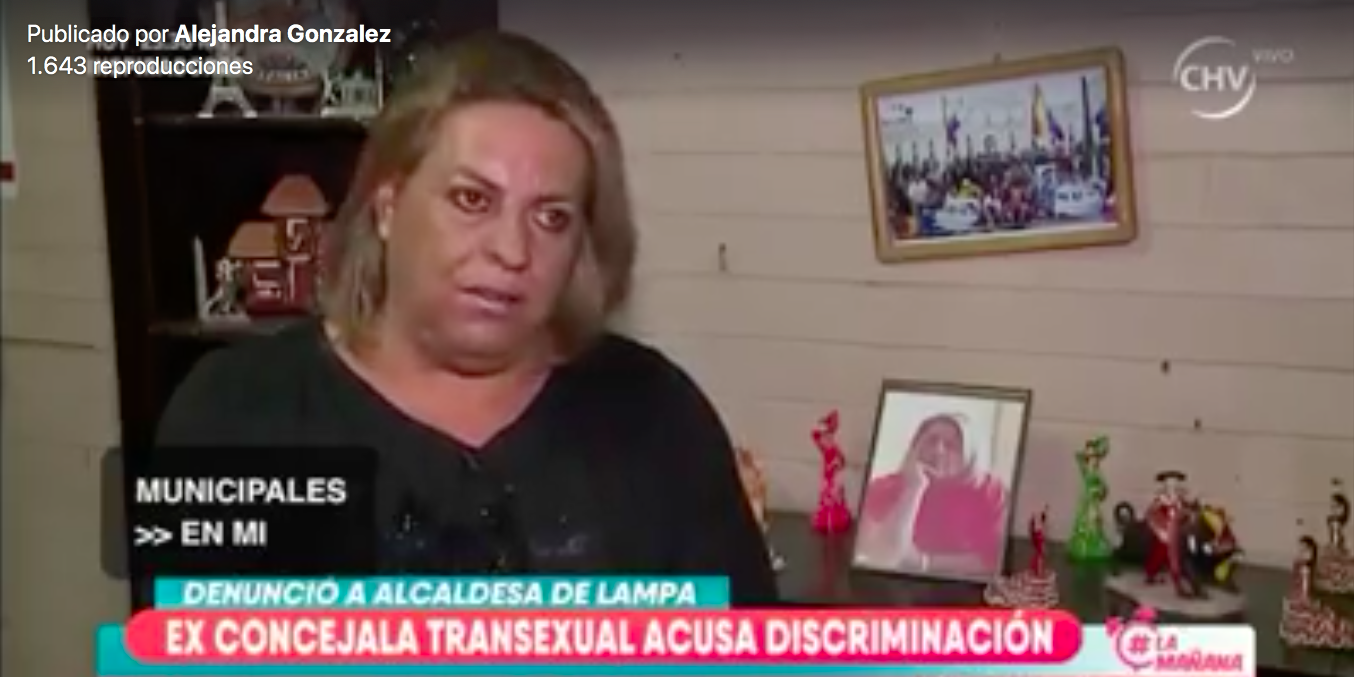
The ruling established the The mayor discriminated against the plaintiff by referring to her legal identity rather than her chosen gender identity, and by repeatedly mocking her gender identity. Alejandra with Chilevisión, after learning of the historic ruling.
“It should be borne in mind that, according to the provisions of Article 2 of Law No. 20,609, arbitrary discrimination is understood to be any distinction, exclusion, or restriction lacking reasonable justification, carried out by agents of the State or private individuals, and which causes deprivation, disruption, or threat to the legitimate exercise of fundamental rights established in the Political Constitution of the Republic or in international human rights treaties ratified by Chile and currently in force, particularly when based on the reasons indicated as examples,” the court ruling states. It is a final and unappealable decision. Along with citing a ruling by the European Court of Human Rights that recently declared “that requiring surgical interventions or sterilization treatment as a prerequisite for recognizing gender identity violates the right to respect for private and family life,” the Chilean Supreme Court of Justice ruled: “The defendant, Ms. Graciela Fernanda Ortúzar Novoa, mayor of the municipality of Lampa, committed an act of discrimination against Ms. Alejandra González Pino based on her gender identity, and must cease such conduct and address her by her chosen name. Furthermore, she is ordered to pay a fine equivalent to five monthly tax units, payable to the Treasury, without court costs.”
Alejandra with Chilevisión, after learning of the historic ruling.
“It should be borne in mind that, according to the provisions of Article 2 of Law No. 20,609, arbitrary discrimination is understood to be any distinction, exclusion, or restriction lacking reasonable justification, carried out by agents of the State or private individuals, and which causes deprivation, disruption, or threat to the legitimate exercise of fundamental rights established in the Political Constitution of the Republic or in international human rights treaties ratified by Chile and currently in force, particularly when based on the reasons indicated as examples,” the court ruling states. It is a final and unappealable decision. Along with citing a ruling by the European Court of Human Rights that recently declared “that requiring surgical interventions or sterilization treatment as a prerequisite for recognizing gender identity violates the right to respect for private and family life,” the Chilean Supreme Court of Justice ruled: “The defendant, Ms. Graciela Fernanda Ortúzar Novoa, mayor of the municipality of Lampa, committed an act of discrimination against Ms. Alejandra González Pino based on her gender identity, and must cease such conduct and address her by her chosen name. Furthermore, she is ordered to pay a fine equivalent to five monthly tax units, payable to the Treasury, without court costs.”
In Batuco, after the ruling
Serene but happy about the historical significance of the ruling, Alejandra González spoke with Presentes: “I receive it with humility but also with joy because This ruling sets a social and political precedent. “It represents a step forward that opens many windows, the same windows that had been closed to me before,” Alejandra symbolizes politically. “I am a 49-year-old trans woman who has fought my whole life for my sexuality and identity,” Alejandra adds. She dedicates the ruling to her lifelong companions: “Today I think not only of myself, but of all the young people, children, and trans people who fight for a good life. I share this ruling with my community, particularly with the most vulnerable, my trans friends, the most humble, the trans circus performers, the trans people living with HIV, and the trans people who can’t find work because of who we are. I share this ruling with the youngest, the teenagers, especially the trans boys and girls who bravely make the invisible visible in times when our sexual and gender identities must be defended and validated.” Good news for trans communities Various LGBTQ+ organizations have celebrated the good news. From MOVILH to Fundación Iguales, including the spokesperson for the Chilean government, they have congratulated the Supreme Court on its historic ruling. The most excited and involved have been transgender community organizations such as OTD, Fundación Selenna, and TravesChile, among others. “All trans people deserve reparations for what we have endured. This is crucial to the community’s social struggles,” says Silvia Parada, a long-time leader of TravesChile, a collective that began in the early 2000s. Why is this a high-impact failure? Constanza Valdés, a graduate in Legal and Social Sciences and advisor to transgender organizations, analyzed the ruling for Present“The ruling becomes the first non-discrimination action upheld on the grounds of arbitrary discrimination based on gender identity since the enactment of the Zamudio Law. Furthermore, the ruling recognizes the councilwoman's right to use her chosen name and to be respected, regardless of whether she obtained a legal name and gender change.” From Spain, the renowned transgender congresswoman for Madrid, Carla Antonelli, celebrated on social media: “Bravo, little by little, much more slowly than we would really like, but taking steps forward, because equality is not true equality until it is real. Congratulations on this great step.” In Santiago, Alejandra González praised the Supreme Court's ruling at the annual gala of the Selenna Foundation, which brings together transgender children: “When I see these children, I realize that I am fighting for them, because they are the future of Chile.” Perhaps they could be members of parliament who work for a more inclusive, more tolerant, and less discriminatory law.”[READ THE FULL RULING]
]]>We are present
We are committed to journalism that delves into the territories and conducts thorough investigations, combined with new technologies and narrative formats. We want the protagonists, their stories, and their struggles to be present.
SUPPORT US

FOLLOW US
Related notes

We are present
This and other stories are not usually on the media agenda. Together we can bring them to light.