

#HateCrimes2017 Drastic increase in street attacks in Argentina
This occurs within a political and social context where violence against the LGBTI community has noticeably increased. According to the Observatory of Hate Crimes against the LGBT community of the Ombudsman's Office of the City of Buenos Aires and FALGBT, 61 cases of violence were reported in 2017…

Share

This occurs within a political and social context where violence against the LGBTI community has noticeably increased.
According to the Observatory of Hate Crimes against the LGBT community of the Ombudsman's Office of the City of Buenos Aires and FALGBT, in 2017 there were 61 reported cases of street violence or attacks based on sexual orientation or gender identity, and 11 murders (9 of trans women and transvestites; one of a trans man; and one of a cisgender gay man).
While these are preliminary figures, attacks against gay, lesbian, trans, and bisexual people continue, as do cases of discrimination in public spaces.
Transvesticides, transfemicides, transhomicides
The murders of trans women, trans femicides, and trans homicides (the killing of trans men) are the final link in a chain of violence suffered by trans and gender-diverse people from childhood and adolescence, and are difficult to document. The justice system often fails to respect gender identity, and when it does, these crimes are not considered hate crimes or aggravated by gender.
Charly Guerrero in Salta, 21 years old
Charly Guerrero, a 21-year-old trans man, was murdered on May 13 in Ceferino, a low-income neighborhood in the city of Salta. Charly was stabbed and bled to death in the street , where his neighbors found him and called the police. Neither the justice system nor the press respected his gender identity, using the excuse that he had not yet changed his legal gender on his national identity document. According to Article 12 of the Gender Identity Law, which addresses the right to "dignified treatment," the first name a person chooses must be used in both public and private settings upon request.
"One woman killed another" was the headline in the Salta media. The Salta Women's Multisectoral Group has filed a lawsuit and is demanding that this murder be investigated as a "trans homicide."
Pamela Tabares in Rosario, 35 years old
Pamela Tabares was a 35-year-old trans woman living in extremely vulnerable conditions in the city of Rosario. She was murdered on July 26, 2017, shot at least five times. Morena García, a member of the Rosario Trans Community, told us about the status of the case that, "so far, there hasn't been much progress."
While she acknowledged the willingness of the prosecutor in charge, Rafael Coria, Morena said that, "the updates are the same, which is to say, none." She added that among the limited information available, it is known that they are still analyzing the images captured by security cameras and those in public areas. She emphasized that, "several cameras recorded the car, but so far it seems that none of them captured the license plate."

[READ ALSO: Transvesticide: Pamela Tabares tried to report gender violence ]
Meanwhile, the Trans community of Rosario has been carrying out activities demanding justice for Pamela. Last November 25th, as part of the International Day for the Elimination of Violence against Women, a mural was painted at the site where the march would end. It carries a clear message: to put an end to transphobic murders, to remember and demand justice for Pamela, and to call for “education, health, housing, and work for trans women.”
Ayelén Gómez in Tucumán, 31 years old
The murdered body of Ayelén Gómez was found on August 12th under the stands of the Lawn Tennis Club in Tucumán, bearing signs of blows and asphyxiation. She had returned to her province last year to reunite with her mother, with whom she lived, after spending several years in Buenos Aires. In 2012, she had filed a police report. She had then moved to Buenos Aires, where she studied at the Mocha Celis Trans Popular High School.

Azul Montoro, in Córdoba, 23 years old.
Azul Montoro, a young trans woman, was murdered in the early hours of October 18th, stabbed approximately twenty times, in a boarding house near the northern market of Córdoba city. The assailant also killed the victim's dog. That same night, 23-year-old Fabián Alejandro Casivo was arrested near the Provincial Neuropsychiatric Hospital, where, according to a later testimony from an acquaintance, he intended to "feign insanity." Casivo was found in possession of the victim's cell phone.
The head of Prosecutor's Office 12, Guillermo González, in charge of the case, initially charged Casivo with simple homicide, but in November changed the charge to aggravated homicide due to gender-based violence, an unprecedented classification in Córdoba's criminal history for a trans victim. "We even avoided the term 'travesticide,' because both in her own self-identification and according to the law, she was a woman. That's why it's a femicide," the prosecutor explained to Presentes. Azul was 23 years old and a native of Villa Mercedes, San Luis. Immediately after the crime, the Córdoba branch of the Argentine Association of Transvestites and Transsexuals (ATTA) demanded that it be considered a femicide.

The latest development in the case is the preventive detention order issued two weeks ago. Currently, interviews and psychiatric evaluations are being finalized to determine if the accused was aware of his actions and is fit to stand trial. Casivo has a criminal record for assault and threats, primarily against his mother and sister, cases in which he was found not criminally responsible. However, Prosecutor González considers these incidents indicators of his aversion to women. "Without a doubt, Azul Montoro's gender played a significant role in this homicide," he stated. If the accused is deemed criminally responsible by the forensic psychiatrists, the case could go to trial in April or May of next year.
Street attacks
JANUARY
Kimberly is a trans woman from Ecuador who was working as a prostitute. On Saturday, January 3, in the early morning, three men attacked her with sticks, metal bars, and stones: they broke her nose and cut her arms, while insulting her and threatening to kill her. It happened at the corner of Moreno and Catamarca streets, in the Once neighborhood of Buenos Aires. The young woman managed to run away and escape. Days earlier, she had been beaten while with three other trans women near Plaza Misere.
FEBRUARY
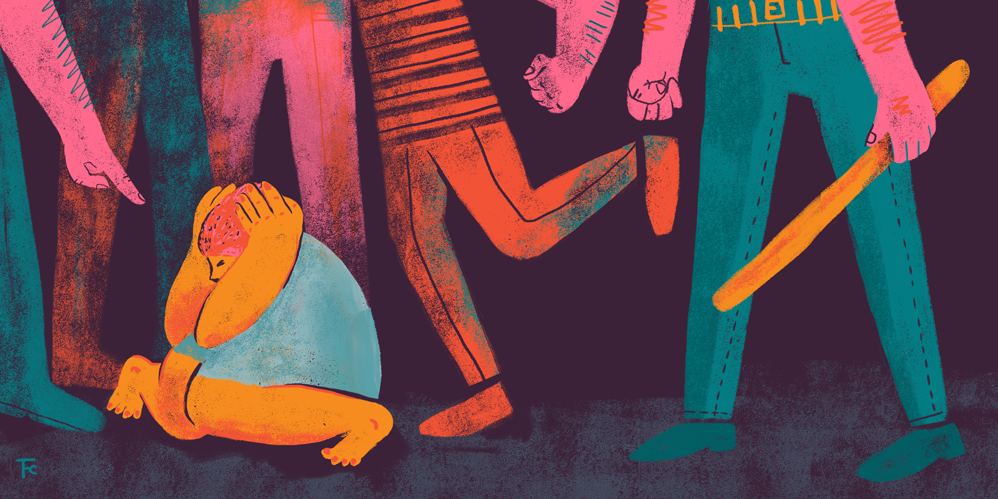
On Saturday, February 18, two LGBTQ+ couples were attacked in very close proximity to each other in the City of Buenos Aires . Both attacks were motivated by homophobia, lesbophobia, and transphobia and occurred in broad daylight. In addition to physical violence, a common element was the insults and indifference of passersby.
February 21 - About twenty men attacked trans activist Alessandra Luna and two companions in Glew, Buenos Aires Province . They beat them for twenty minutes and stole all their belongings. Today they expanded their complaint at Provincial Prosecutor's Office 20 in Lomas de Zamora. "We were terrified by the morbid curiosity of those watching and filming," Luna told Presentes.
April
3 - Dana Valiente, president of an NGO working for the implementation of a trans employment quota, reported that a group of young men forced their way into her home in Garupá and vandalized it while threatening to kill her . Following the report of the attack, the 6th Investigating Court is conducting the investigation.
April 28 -
A group of young men attacked a trans woman in Córdoba and filmed the assault in the General Paz neighborhood, near the city's civic center. The video was posted this week by the attackers as a “joke” on their social media, generating outrage among some of their contacts, who then shared it widely. After several days of searching, LGBTQ+ organizations located the victim, who is now out of danger.
In May
, Claudia Vásquez Haro, president of Otrans Argentina , reported that she was attacked and nearly killed on Saturday, May 13, at 10:30 p.m. at her home in the La Loma neighborhood of La Plata. The report was filed at the 4th police station in La Plata, and the investigation is being led by prosecutor Ana Medina of UFI 1. In recent weeks, the prosecutor released Mendoza from jail, which raised concerns among several human rights organizations. They requested preventative protection measures for Vásquez Haro, who in recent years has been denouncing harassment and police violence against the trans community.
June
16 : At 3:30 a.m., two men attacked Walter, a 20-year-old student from Córdoba who worked at a restaurant, because of his sexual orientation. The incident occurred just meters from the corner of Santa Fe and Pueyrredón streets in the Autonomous City of Buenos Aires, a landmark in the fight for LGBTQ+ rights . This happened less than 24 hours after another beating in the city, where sexual orientation was also the trigger for the attack against another gay man.
June 20: In the heart of Buenos Aires, a group of twenty-somethings attacked Charly, 37, because of his sexual orientation. Charly told Presentes that he hadn't suffered a homophobic attack on the street in many years.
August
On Monday the 21st, at 10:30 p.m., Franchesca was in the red-light district of the Itatí II neighborhood in Formosa when a man approached her on a motorcycle and suggested they go to a hotel. Before arriving, they stopped in a dark area where, while soliciting sex, he shot her in the eye. The 31-year-old trans woman was conscious and was able to describe the attacker.
SEPTEMBER
The attack occurred on Friday, September 1st , and was recorded on the security cameras of the Municipality of La Plata. Jhonan and Joel were waiting for the bus when they were beaten and insulted by more than ten young men who shouted homophobic slurs at them.
September 10th - A gang of four men broke into a man's house while he was sleeping and savagely beat him . They were his neighbors from a neighborhood in the city of Posadas. The victim was hospitalized. It took him several days to recover. On September 20th, he filed a complaint with the National Institute Against Discrimination, Xenophobia, and Racism (INADI) in Misiones. He was accompanied at the filing by Colectivo 108, a civil society group that defends the rights of sexual diversity.
OCTOBER
In the early morning of September 30, 26-year-old Aracely Figueroa was on the corner of Buenos Aires and Crisóstomo Alvarez streets in the city of San Miguel de Tucumán. A police officer approached her and physically, psychologically, and verbally assaulted her because of her gender identity. Aracely reported the incident to the First Police Station. “I was discriminated against, and she treated me as if I were worthless the whole time,” she stated in her complaint. She requested that action be taken against the officer: “A homophobic person cannot be part of the police force.”
NOVEMBER
From noon until 8:30 p.m., the 26th Pride March was a festive and joyful mobilization without incident, with approximately 200,000 people in the streets of Buenos Aires. But as the participants began to disperse from the Plaza del Congreso de la Nación, a group of men emerged from a squatted house on a side street off Avenida de Mayo —the route the march had taken—and attacked passersby. One of the assailants, who was arrested hours later, struck a young man in the head with a hockey stick.

In December
, Jonathan Uriel Castellari, 25, was attacked by a group of five young men outside the McDonald's at 3188 Avenida Córdoba in Buenos Aires . He was hospitalized for several days, and now the assailants have been released from custody. “Judge Baños did not consider that they could obstruct the investigation or flee, so preventive detention was not ordered,” Gastón Llopart, the victim's lawyer, told Presentes. However, the assailants were charged with aggravated assault, with the aggravating circumstance of the victim's sexual orientation.
INSTITUTIONAL VIOLENCE
Persecution of Trans and Lesbian People
: 2017 was a particularly harsh year of persecution and violence for lesbians in the streets. The most high-profile case was that of Higui de Jesús, attacked by a group of men who attempted to rape her in October 2016, although she was the one who ended up being prosecuted and imprisoned. In self-defense, she fatally wounded one of her attackers and was denied access to justice, which discriminated against her for being a lesbian and poor.
Throughout the year, the police carried out several raids and arbitrary arrests before and after the Women's Strike march. They also harassed a lesbian couple in a plaza in Morón and arrested and assaulted Mariana Gómez in a subway station while she was with her wife, Rocío Girat. Six lesbian activists were prosecuted, accused of painting walls on March 7, Lesbian Visibility Day.
[READ ALSO: The UN demands that Argentina put a stop to the persecution of transvestites and trans people]
Transvestites and transgender people continue to be harassed by security forces, victims of fabricated charges brought by the police, and mistreated in prisons. This year, the organization OTRANS denounced the lack of access to healthcare in the Buenos Aires prison of Florencia Varela, which resulted in the deaths of two activists within two months.
[READ ALSO: Demands for justice for the death of a trans woman detained in Florencio Varela]
]]>
We are present
We are committed to journalism that delves into the territories and conducts thorough investigations, combined with new technologies and narrative formats. We want the protagonists, their stories, and their struggles to be present.
SUPPORT US

FOLLOW US
Related notes

We are present
This and other stories are not usually on the media agenda. Together we can bring them to light.