

Trial for the transphobic murder of Vanesa Zabala: life imprisonment for the murderers
The Santa Fe court sentenced the four defendants accused of the murder of Vanesa Zabala, a young trans woman, which occurred on March 29, 2013, in the city of Reconquista: José Luis “Cocido” Petroni, Gustavo Daniel “Virulana” Vallejos, José Daniel “Chuky” Villasboas, and Ana Virginia Abasto were found guilty and will serve life imprisonment. However, the court did not consider the aggravating circumstance of a hate crime based on gender identity.

Share

By Soledad Mizerniuk and Victoria Rodríguez
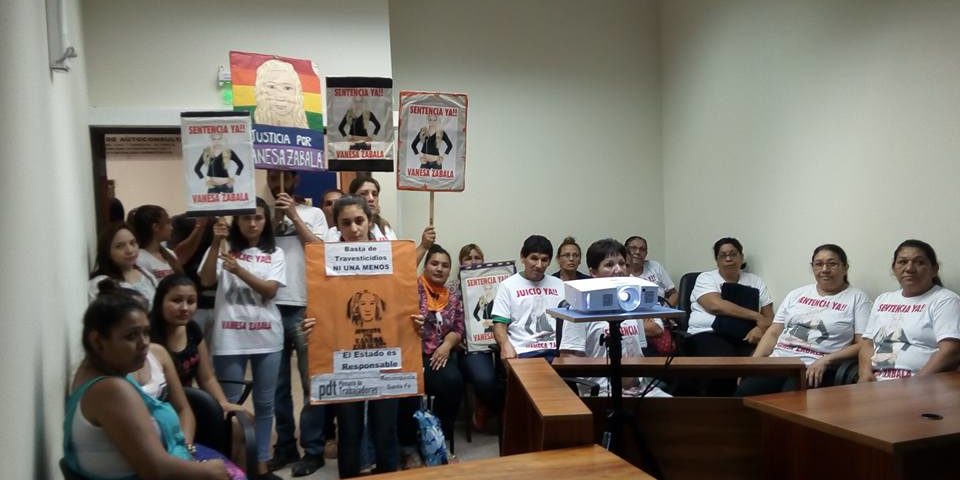
Photos: Justice for Vanesa Zabala Front The Santa Fe justice system sentenced the four defendants accused of the murder of Vanesa Zabala, a young trans woman, which occurred on March 29, 2013, in the city of Reconquista: José Luis “Cocido” Petroni, Gustavo Daniel “Virulana” Vallejos, José Daniel “Chuky” Villasboas, and Ana Virginia Abasto were found guilty and received life sentences. However, the court did not consider the aggravating circumstance of a hate crime based on gender identity. “Vanesa Zabala present!” shouted her family and friends in the hall of the Vera Sentencing Court. Minutes earlier, they had heard the life sentences handed down to the four defendants for the murder of the young trans woman in Reconquista on March 29, 2013. Although it did not consider it a hate crime, the court ordered the immediate detention of the convicted individuals. As they led her away in handcuffs, Ana Virginia Abasto shouted, “May all the bastards die.” Vanesa was attacked by the four convicted men and two minors on the side of the road. They beat her with a fan pipe, strangled her, and impaled her. Then they left her lying there. When emergency crews arrived, there was nothing they could do. “We will never have peace because we will never get Vanesa back,” Marisa, her niece, told Presentes , adding, “But it’s a relief that the people who took her life are paying for what they did.”
READ MORE: Transvesticide of Vanesa Zabala: Four sisters seek justice

The cry of the murderers: “May all the faggots die”
Judges Gonzalo Basualdo, Claudia Bressán, and Ireneo Berzano today sentenced the four people accused of the crime of "aggravated homicide with premeditation, cruelty, and the participation of minors" against Vanesa Zabala to life imprisonment with immediate detention. "We are innocent. May all the bastards die. What do I care about the families or anything? May all the bastards rot," shouted Ana Virginia Abasto as she was transferred to the Vera police station. There she will await the decision on which prison will be used to serve her sentence. Next to her, also guarded by police officers, Chuky Villasboas was crying. "What are you crying about? We're innocent, what's the big deal?" Abasto challenged him. And, in front of the cameras of the local media covering the transfer, she pointed the finger at the police as responsible for Vanesa's murder. "Who is investigating the Narcotics Division and the Reconquista Investigations Unit?" “They killed him! Bunch of corrupt, murderous, rapist bastards. The dead man will never rest in peace,” she said. Vanesa’s trans friends and those present in the courthouse watched in silence. Although the court had ruled against the accused, it failed to refer to the case as a transvesticide or transfeminicide—terms that denote a crime motivated by hatred of gender identity. Therefore, the prosecution will now appeal the sentence and present Abasto’s statements as evidence.[READ ALSO: Investigation: How the Justice System Acted in the Face of Hate Crimes 2015 ]
 The court rejected the prosecution's request to have the attack prosecuted as a "hate crime based on gender identity," which would have set a historic precedent in Argentine justice as the first conviction for the murder of a trans woman. In an interview with PresentFederico Lombardi, the lawyer representing Vanesa's family, expressed satisfaction with the judges' decision to sentence the accused to life imprisonment and immediate incarceration, but anticipated that—once the grounds for the sentence are released—he will appeal to insist that the crime be declared a transphobic hate crime. "We have to wait for them to send us the written grounds, because the sentence did not recognize the aggravating circumstance of 'hatred based on gender identity,'" Lombardi emphasized, clarifying that the judges' decision on this point may be related to the fact that "the case was processed under the old Penal Code and only with some provisions of the new legislation." "Because it is governed by a special Code, it is likely that the judges will argue that this aggravating circumstance was not included in the indictment. At that stage, another lawyer was involved who did not include this aggravating circumstance," Lombardi surmised. The judges also failed to address in their ruling the accusation of perjury against several witnesses, and, even more seriously, the court did not rule on the situation of one of the four defendants, Gustavo Vallejos, regarding whom the prosecution had requested a separate investigation. Vallejos's wife testified at trial that her husband forced her into prostitution, after which Lombardi requested an investigation, but this request was not reflected in today's sentencing.
The collective struggle
In these almost five years of struggle, Vanesa's family was supported by friends, neighbors, and social organizations that formed the Justice for Vanesa Zabala Front. From day one, they organized to demand a thorough investigation and that all necessary steps be taken to secure a conviction. “We feel relieved to understand that the family, like all of society, deserves this act of justice,” remarked Eliana Ibarra, a member of the Front, adding, “It was a long and difficult road. If we hadn't gone out to demonstrate, to speak to the media, to build a network of people and organizations around this struggle, this surely wouldn't have been achieved. We understand that the triumph of this struggle is because we went out to demonstrate, to denounce what was happening, to forge bonds of solidarity.” Beyond the importance of the court's decision, Ibarra acknowledged that the reading was a very tense experience. A group of family and friends was in an adjoining room, while the rest were able to enter the room where the judges, lawyers, and defendants were. Although they had to witness Abasto's shouts, they were also together to support each other and celebrate a victory that belongs to Vanesa and to all of society. “As Vanesa’s sisters say, what we want is for there to be no more cases like Vanesa Zabala’s,” the Frente representative concluded.
Structural hatred
The murder of Vanesa Zabala laid bare a stark reality in that region of Santa Fe province. “Throughout the trial, and upon reviewing all the witness testimonies, we observed that the language used by many witnesses was completely discriminatory toward Vanesa Zabala. Furthermore, what happened with the only woman charged in the trial is now evidence for the appeal, because her shouts expressed hatred toward Vanesa's gender identity. Everything in the trial demonstrated that there is a structural hatred toward gender identity,” described Federico Lombardi. At the same time, the lawyer acknowledged that “the struggle of the family and activists was also key to bringing this trial to fruition.” “I believe that this struggle serves as an example to follow, because it is a clear demonstration that rights are won through struggle,” he emphasized. And his assertion coincides with the long road traveled by Vanesa's family since March 29, 2013, and those who accompanied them. In this case, there was institutional judicial violence. This is demonstrated by the fact that Lombardi is the fourth lawyer to represent the family; The number of judges and associate judges recused or who resigned; the Court's initial questioning of Vanesa's sisters' right to appear as plaintiffs (after their parents' death); and the fact that the case was on the verge of collapse due to being caught in the middle of the provincial penal system's transition. The scenario is rife with evidence of the cultural and institutional obstacles the Zabala family faced. "I believe all these elements corroborate a structural hatred against the trans community, and that even if we don't manage to have this crime recognized as a transphobic hate crime, at least we've put it on the agenda," Lombardi summarized.
“We feel relieved to understand that the family, like all of society, deserves this act of justice,” remarked Eliana Ibarra, a member of the Front, adding, “It was a long and difficult road. If we hadn't gone out to demonstrate, to speak to the media, to build a network of people and organizations around this struggle, this surely wouldn't have been achieved. We understand that the triumph of this struggle is because we went out to demonstrate, to denounce what was happening, to forge bonds of solidarity.” Beyond the importance of the court's decision, Ibarra acknowledged that the reading was a very tense experience. A group of family and friends was in an adjoining room, while the rest were able to enter the room where the judges, lawyers, and defendants were. Although they had to witness Abasto's shouts, they were also together to support each other and celebrate a victory that belongs to Vanesa and to all of society. “As Vanesa’s sisters say, what we want is for there to be no more cases like Vanesa Zabala’s,” the Frente representative concluded.
Structural hatred
The murder of Vanesa Zabala laid bare a stark reality in that region of Santa Fe province. “Throughout the trial, and upon reviewing all the witness testimonies, we observed that the language used by many witnesses was completely discriminatory toward Vanesa Zabala. Furthermore, what happened with the only woman charged in the trial is now evidence for the appeal, because her shouts expressed hatred toward Vanesa's gender identity. Everything in the trial demonstrated that there is a structural hatred toward gender identity,” described Federico Lombardi. At the same time, the lawyer acknowledged that “the struggle of the family and activists was also key to bringing this trial to fruition.” “I believe that this struggle serves as an example to follow, because it is a clear demonstration that rights are won through struggle,” he emphasized. And his assertion coincides with the long road traveled by Vanesa's family since March 29, 2013, and those who accompanied them. In this case, there was institutional judicial violence. This is demonstrated by the fact that Lombardi is the fourth lawyer to represent the family; The number of judges and associate judges recused or who resigned; the Court's initial questioning of Vanesa's sisters' right to appear as plaintiffs (after their parents' death); and the fact that the case was on the verge of collapse due to being caught in the middle of the provincial penal system's transition. The scenario is rife with evidence of the cultural and institutional obstacles the Zabala family faced. "I believe all these elements corroborate a structural hatred against the trans community, and that even if we don't manage to have this crime recognized as a transphobic hate crime, at least we've put it on the agenda," Lombardi summarized.
We are present
We are committed to journalism that delves into the territories and conducts thorough investigations, combined with new technologies and narrative formats. We want the protagonists, their stories, and their struggles to be present.
SUPPORT US

FOLLOW US
Related notes


We are present
This and other stories are not usually on the media agenda. Together we can bring them to light.