

#TacklingHomophobia: Pampas Deer, Latin America's first sexually diverse rugby team
For Ciervos Pampas, playing rugby is more than just about scoring points on the field. This club works to raise awareness of sexual diversity and fights against homophobia.

Share

By Lucas Gutiérrez
Photos: Amanda Huerta-Morán
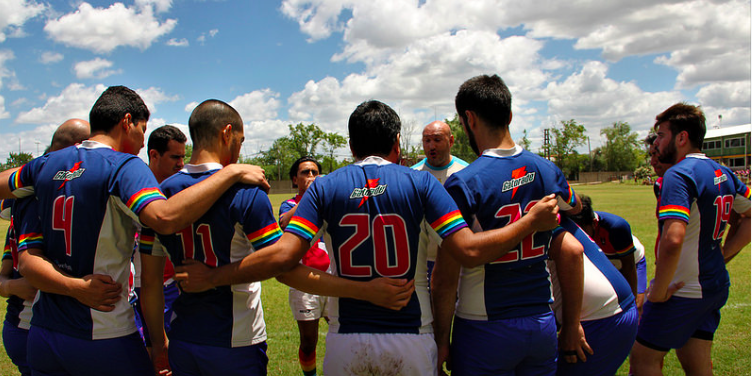
For Ciervos Pampas , playing rugby is more than just about scoring points on the field. This club works to raise awareness of sexual diversity and fights against homophobia. Between matches and gym sessions, there are talks and activities to discuss discrimination, human rights, HIV, and more. They don't aim to be the politically correct 'gay team'; they prefer to call themselves 'faggots' to transform the insult into pride. Ciervos Pampas enters a world that is assumed to be upper-middle class, heterosexual, and macho to tackle prejudice and demonstrate that rugby is for everyone.
Yesterday, Sunday, they joined more than ten traditional, women's, and mixed rugby clubs to share the first #TackleandoLaHomofobia (Tackling Homophobia) rugby event. Jonathan Castellari , the Ciervos Pampas member who was attacked three weeks ago in Palermo, was there. A group of thugs beat him so badly he ended up in the hospital while hurling homophobic slurs at him.
“We seek to break with rugby stereotypes”
Until recently, rugby wasn't a professional sport in Argentina. Salaries rarely came from the clubs themselves; instead, they were provided by sponsors. Hugo Agüero, president of the Ciervos Pampas club . “This tells you that a player has other things in his life sorted out. So, in our country, rugby has been an upper-middle-class sport, belonging to a certain socio-cultural elite: white, heterosexual, and with an exaggerated masculinity,” Agüero explained.
Also heterosexuals
“We’re the faggot team. Plain and simple,” says Hugo Agüero. While the media searches for a thousand ways to present them in the most “correct” light, the Pampas Deer reclaim the aggression and turn it into their identity.
“We call our straight teammates ‘faggot’ too. They understand the message and our ambition; regardless of their sexual orientation, they’re just another faggot,” Hugo explains, opening the discussion. Yes, straight guys here play and share the experience too.

[READ ALSO: Homophobic attack: Jonathan was discharged from the hospital and the Justice system continues searching for the attackers]
“We don’t use the word gay. We are not a product that can be bought and sold in a market; we don’t sell our identity. Nor are we the homosexual team. The word homosexual was once a medical disorder; we are not sick. We reclaim the insult to make ourselves visible,” explains Agüero, who comes from the field of mental health, is a psychologist, and currently works in that field.
The T-shirt as a political act
Cristian Guisande Donadio is 27 years old, a recent biotechnologist, and has been part of the team since March. He wears number 1 and the rainbow on his jersey. He once wanted to play rugby, but tells Presentes, "I didn't dare." That desire coincided with his coming out, and the sport didn't seem like a safe space to combine both. Now he runs the field with a rainbow ribbon tying back his fiery red hair. That uniform covered in pride flags is a political statement.
"When you're playing a game and you're down by 100 points and they keep hitting you, when they keep hitting you beyond the violence inherent in the sport, there's something more. It happened to us in the corporate tournament; we looked at each other in shock. Later, we were able to realize that what was happening was homophobia. After talking it out, we played the four or five best games of the tournament. So, if you tell me that activism and sports are two separate things, this clearly shows you that they're not," explains Hector Agüero.
“Sports and social life are inseparable”
“We’re going to kill you, you faggot,” they yelled at Jonathan Castellari as they beat him. On Friday, December 1st, this team member was attacked by a still-unidentified group of men outside a McDonald’s in Buenos Aires. Then, on Saturday the 2nd, the Ciervos Pampas rugby team played on asphalt and marched down Córdoba Avenue from the restaurant to the hospital where “Jony” was hospitalized, demanding an urgent anti-discrimination law.
“Our work is political because we seek to generate social change,” Hugo Agüero told Presentes. Ciervos Pampas is a non-profit civil association governed by a board of directors and comprised of departments such as sports, communications, human rights, and projects.

Caio Fabio Varela is the projects director. At 44, this master’s degree holder in Human Rights and International Relations joined Ciervos four years ago to play rugby for the first time. “It’s a space open to everyone; there are no exclusionary criteria,” says Caio, one of the people in charge of one of the club’s 2018 projects: a Human Rights school.
The school’s objective is to democratize discourse in a circular space, with horizontal dialogue and open meetings, using a popular education methodology to discuss topics such as diversity and gender, human rights for the LGBTI community, inequality and discrimination, and more.
World and local
The Deer are the only Latin American members of International Gay Rugby (IGR). This organization brings together rugby teams from around the world that seek to raise awareness of sexual diversity and organizes the Bingham Cup every two years. This year, 2018, it will be the Pampas' turn to play in it.

While preparing for the World Cup, they continue training in a public square; renting fields is very expensive, and the club decided not to raise membership fees. "This might seem like a very bourgeois and classist project, but we have members who can't afford to top up their SUBE cards to come and play, we have members who can't pay the $200 monthly fee, and that doesn't stop them from continuing to play," shares club president Agüero. The idea that rugby is a sport for the upper middle class is another prejudice that is being broken here.
On Tuesdays and Fridays, you can find the Deer Pampas training in Plaza Uruguay in Buenos Aires. But they also participate in social activities, from playing in a prison to protesting homophobia in front of the Russian embassy. And homophobia isn't the only cause that motivates this team. Sometimes they are the voice, and other times they are the physical presence that accompanies. Urgent issues like the need for a law that addresses the needs of neighborhood clubs , for example, are some of the many objectives that drive and motivate them.
We are present
We are committed to journalism that delves into the territories and conducts thorough investigations, combined with new technologies and narrative formats. We want the protagonists, their stories, and their struggles to be present.
SUPPORT US

FOLLOW US
Related notes
We are present
This and other stories are not usually on the media agenda. Together we can bring them to light.