

Paz, the queer, South American, and non-binary artist who raps about the Mapuche struggle
A descendant of Mapuche people, rapper and queer artist, Cümelen Berti - known as "Paz" - defines himself as a non-binary trans person.

Share

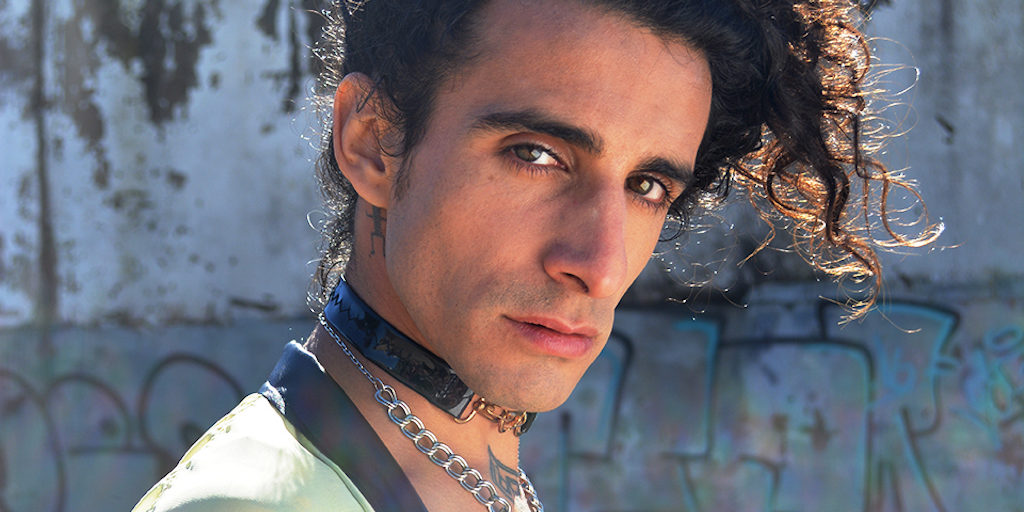
By Paula Bistagnino. Styling: Kami Muc / Photography: Luciano Garcia. A descendant of Mapuche people, rapper, and queer artist, Cümelen Berti—known as "Paz"—defines as a non-binary trans person. Raised in Río Negro, where they were born 29 years ago, they lived in Buenos Aires and, after several seasons in Brazil, have just returned to Argentina. "Yes, I'm queer." I'm a neighborhood faggot and I'm a South American faggotThe word "marika" was one of the first they used to belittle and diminish my existence. It was the weapon heteronormativity used to protect itself and try to marginalize me. They didn't yell "gay" or "homosexual" at me. They yelled "faggot!" at me. So I reclaimed it, as many other faggots have done and continue to do, and I empowered it from my own perspective. For me, being a faggot is an identity, just like being born in the barrio. My place of struggle and resistance defines me.Paz sings and dances from Brazil, but her lyrics speak of diverse struggles. Of the ancestral struggle of the Patagonian indigenous peoples, of survival in the barrio, of patriarchal oppression, of resistance in art, activism, and the daily life of a queer, trans, South American, mixed-race woman. As a child, they participated in their city's choir while taking theater and dance classes. At 17, they grabbed their backpack and headed to Buenos Aires. They did theater and studied Social Psychology. They continued their travels as a backpacker. They wanted to travel, but when they passed through Brazil, they stayed. It wasn't easy to go out and sing; they felt limited by their surroundings. In Rio de Janeiro, they won a scholarship at the National Institute of Choral Singing. They discovered the carioca funk culture at dances in the Providencia favela, where they lived for a year. In Porto Alegre, they did their first project with the artist Karina Sieben—then MC Cholita—and DJ Frede Beck. And with an Argentinian they met in Brazil, Cristo Reventon, they recorded snippets of music remotely, one in Brazil and the other in La Plata. They also performed more and more shows and interviews each time Paz came to Argentina, until in 2017 they released their first album. Emerging PatagoniaHe presented it alongside Feel me Dominga at the Margarita Xirgu theater in Buenos Aires.
-When did you feel like it and start calling yourself Paz?
-In high school. I was around 13 years old and I began my transition to being a non-binary person. PAZ is a name that doesn't necessarily belong to any gender. But it's a feminine word, which confused everyone at my school, in my neighborhood, and in my family. I redefined the word, which always had a Catholic religious connotation, but for me, and in the context of where I come from (the periphery), it was a call to struggle, a goal to unite my people. I found it very interesting that when they call on Paz, I appear, a marika mestiza trans peripheral.-How do art and activism mix, or how closely have they been and continue to be intertwined in your life?
I believe art is activism, and vice versa. For me, the mere fact of having been born in the periphery, without class privilege and in a social context where young people aren't encouraged to make art for fear of going hungry again, makes me see... Music as an indispensable tool for social transformationI tell my story, I talk about my political stance, which is formed from situations that happened in my life. So My music is activism in itself, because I talk about my life as an activist.READ MORE: Gay, Mapuche, and feminist: a young Chilean man questions through art

Cover art: Mauro Tapia.
-From Patagonia to the Rio favela: What are the differences between being trans in one place and the other?
First: I'm aware of the passivity I experience as a non-binary trans person. The fact that I don't define myself as either a man or a woman, and try to make that clear in my body, my gestures, my mannerisms, and my clothes, depending on the context, puts me in a privileged position compared to other people, transvestites for example. Often, in the eyes of the normative system, non-binary people don't define themselves. Or we don't know what we want to be, whether a man or a woman, when in reality we want to escape those labels. We're strangers in many spheres. In both places where I've lived, I was automatically perceived as a "marika" or "bicha," as they say here in Brazil, rather than as a non-binary trans person, a more academic term.-You say the revolution begins now with "feminizing." Why?
-For me, society has gone down the wrong path since men/machos were placed in power. Along with that, there's the masculinization and violence against those who prefer to live with feminine mannerisms.To other men, a feminine man is fragile. Machismo makes us believe that we cannot live feminine lives, that women are inferior, weak, and that any personality resembling them must be repressed. The feminist struggle arose to put a stop to that macho, masculinized male stance over all other female identities. Today, I believe that struggle is expanding. And that femininity is here to show that We can defend ourselves, be warriors, delicate and powerfulOur aesthetics, like our behaviors, placed us (and still place us) in danger. ButNow we are more numerous and stronger. Allowing ourselves to be feminine, in a world built for masculinity to be in power, is revolutionary..
-How do you see the way the media covers the Mapuche struggle, the case of Santiago Maldonado, and the murder of Rafael Nahuel?
It's true that the forced disappearance and murder of Santiago Maldonado brought greater visibility to the ancestral Mapuche struggle. It pains me deeply to interpret that it takes the death of a person for the media and society to begin paying attention to a struggle that has lasted for centuries in a nearly hidden territory like Patagonia. This isn't the first murder the State has committed to exert its power over Wallmapu. Now, with the death of our brother Rafael Nahuel and all the torture the current government is carrying out, the laws seem to be nonexistent, just as they were during the dictatorship. The persecution of the Mapuche people is plunging the community into a brutal and bloody war. The situation seems to be growing increasingly tense. My album is called Emerging Patagonia, precisely so that I can talk about the culture and denounce through my art what is happening to my people. The song Kumelen, which means "peace" in Mapudungun, is a denunciation of the Argentine state and the repressive methods it uses to sell territories to foreign companies, as in the case of Benetton. The song says: “Newen, Newen… He called me, I go without guilt, nor god. Pacha embraced me, he told his story. And the neighborhood gave me a lot of education. All this notion of the ancient nation”A way to give strength and encouragement to all those warriors of the mountains and the city. On Friday, June 15th at 11 PM, he will perform alongside trans copla singer Lola Bhajan & Enanomalhecho at Emergente bar (Gallo 333, Abasto). Also performing will be musician and producer Cristian Puschel and dancer Luciana Viscoitaliano, with a special appearance by the drag queen group Guerreras Galácticas. DJ DDIS PERSÉ (aka Alexis Perseo) will provide the music for the evening. Advance tickets: $100 At the door: $150 / Advance sales: pazmusicaoficial@gmail.com You can listen to it on Spotify: http://sptfy.com/Bp6 / Deezer: https://goo.gl/SViKG8 / Google Play: https://goo.gl/fCMZ3z ]]>We are present
We are committed to journalism that delves into the territories and conducts thorough investigations, combined with new technologies and narrative formats. We want the protagonists, their stories, and their struggles to be present.
SUPPORT US

FOLLOW US
Related notes
We are present
This and other stories are not usually on the media agenda. Together we can bring them to light.