

#DiverseFamilies “We are already visible: there are open minds, we need to open hearts”
For the fifth consecutive year, the Córdoba Meeting of Homoparental and Diverse Families took place. This time in the town of Agua de Oro, in the Sierras Chicas region.

Share

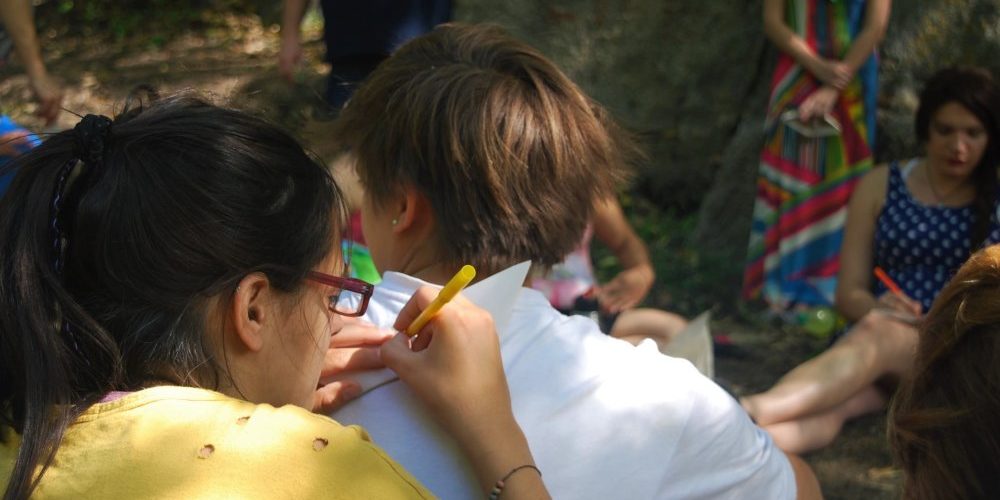
Text and photos: Nayla Azzinnari, from Córdoba. For the fifth consecutive year, same-sex parent and diverse families from Córdoba gathered, this time in the town of Agua de Oro, in the Sierras Chicas mountains. The meeting took place on the last weekend of November, two weeks after the Pride and Diversity March that brought joy to the streets of Córdoba. It was organized by Espacio Sur Diversidad and Ser Acompañante. It's Saturday at midday, and before the introductions, the children gather around paintbrushes and paints. They wait their turn to have their faces painted while choosing between stencils of hearts, stars, and butterflies. A 6-year-old girl organizes the small bottles of paint and decides, "These are for the boys and these are for the girls." She shares her recent decision with her mother, Andrea, who, a trans woman, immediately reminds her that "we can all use any color." With renewed enthusiasm and an even bigger smile, the little girl mixes the jars again. “The goal is always to make ourselves visible and share experiences about our family structures,” says Cecilia Quinteros, one of the organizers. “The gatherings are experiential; we share stories that move people to tears,” describes Juan Delfino, another of the organizers. “These dedicated spaces are essential for connecting with other families facing the same challenges,” adds Cecilia. “It’s also good for our children to meet and experience being part of diverse families so they don’t feel alone,” says Soledad Sánchez.
"Argentina took a step backwards"
The idea is to listen to each other, exchange experiences, and share personal stories. “We invite people to come and participate in the dialogue and answer questions, which is not the same as giving a lecture and monopolizing the conversation,” the organizers explain. The families' introductions and the topics they bring guide the meeting agenda. At one point during its five editions, the gathering was held in the city of Córdoba. “We returned to the mountains because the children can relax by the river, and it also helps us escape the daily grind; we start the day peacefully with mate mid-morning. We hold it in a small town because things happen in small towns too, and it's good to decentralize.” For the organizers, this gathering takes place within a sociopolitical context of oppression, where hard-won rights are once again being challenged. “This year we saw situations like, ‘It’s all good with you, but don’t kiss.’ Argentina suddenly took a step backward. Today, many people feel entitled to say all sorts of things, to discriminate against us, and to negatively differentiate us.”
“Dear families”
With its outdated and exclusionary use of "Dear Parents" or "Moms" when sending notifications, or through more explicit comments against diverse families, the educational sector was one of the first mentioned by families. Soledad and Sol explained that, as a result of these unpleasant experiences, they are looking for a new school for their children. "The institutions are very closed-minded, and some families are too. We're seen as the lesbians, the abnormal ones, the ones who do strange things. When in reality, we have a life like any other family. We take care of taking the kids to school, cooking, and organizing the laundry." Ariel and Adrián have been a couple for over 20 years. They have been parents to Ezequiel for six. "At first, you want to do the right thing and present yourself to society as an excellent parent. We would go to school meetings with a cake, for example. Then you relax and realize that you don't need to stand out to be accepted and be good parents." Diego and Mariano have been married for two years and together for two decades. They confess that before participating in these meetings, they thought raising a child between two men would harm the child. The possibility of having children is a conversation they now allow themselves to have. Irupé is Cielo's partner. They explain to their daughter, whom they are raising together: it's outsiders who need time to understand their reality. They hope that one day those outsiders will be able to do so.Diverse childhoods
“Diverse families aren’t just those made up of two dads or two moms or trans people, but also those that include diverse childhoods, those that listen, seek information, and support each other when their children, sometimes from a very young age, freely and openly express that their gender identities don’t correspond to the sex assigned at birth,” explains Soledad. The concept of diversity transcends definitions once again when Andrea arrives with her recently weaned child in her arms and introduces herself: “I’m a mother of six children with three different fathers. What makes my family diverse is that there are many of us sharing in raising them.” Leticia Veber, a teacher, comments that beyond same-sex parenting or sexual diversity, the traditional family structure of a mother, a father, and children is in the minority: “When you work on students’ family structures in the classroom, it turns out that most of them have family realities involving single mothers, grandparents, aunts, uncles, blended families, and so on.” Available in digital format, the book “Where Does the Stork Go” by Cecilia Quinteros is a pedagogical resource designed to address the topic.“Families are very much on their own when it comes to social services and civil registries.”
Belén Mignon is a lawyer specializing in family law and has assisted several families participating in this meeting. She explains that the parentage process can be biological, through adoption, or via assisted reproductive technologies, and that the legal strategies employed vary depending on the case. The most frequent problems usually arise from issues related to the pregnancy and the origin of the genetic material involved, or during the registration process. “Families are very much on their own claiming our rights before health insurance providers and civil registries,” says Cecilia. “Along the way, institutional violence causes many people to give up on their dreams,” laments Leticia. Rafael, father to Eduardo (15) for almost two years, says that gay men are assigned pre-adolescents or teenagers for adoption, as if raising babies were an exclusively female capacity. Juan clarifies that same-sex couples also do not receive young children for adoption. “Same-sex couples are often passed over by heterosexual couples, who don't want to adopt older children. We accept this because our need to be parents makes us flexible in our expectations.” Belén Mignon nods. “In practice, there are hierarchical criteria by which heterosexual families are prioritized in the single registry of adoptive parents.” Generally, same-sex couples are foster or temporary guardians who, at best, achieve full adoption after lengthy processes that culminate in extraordinary rulings. “The justice system isn't solving people's problems. There are people who take pleasure in the suffering of others, and expanding rights bothers them,” Belén laments. For Juan, Lucas's father, a readjustment of state resources, training, and awareness-raising for its agents are needed: “The worst thing isn't that a father can't adopt for five years, but that a child is alone for all that time.” The lawyer says that denials and delays are what most violate children's rights. “The laws on same-sex marriage, gender identity, and assisted reproduction put us on equal footing, but cultural change is very slow and needs to be continuous. Any gesture of visibility helps,” Cecilia shares. Mariano agrees: “Giving a kiss, shaking hands helps others to do it naturally too.” Pía adds: “We are already visible, there are already open minds, what’s missing is opening hearts.”
Beyond binaries
Celeste is in a relationship with a trans man. A few months ago, they both suspended their hormone treatments because they wanted to conceive a child of their own. “Coming here today is part of my identity recognition and my life project, which isn't just about dressing differently and changing my ID. It's about deconstructing the gender binary ourselves and understanding that I can be a mother even if I don't carry the pregnancy and that Matías can be a father even if he carries the pregnancy. He isn't a woman, nor am I a man, because we are parents in a certain way.” Pía Aldana, provincial representative of ATTTA, points out that most trans women still have sex work as their only option and that they are still fighting for the right to live: “What kind of family planning can we do if our employment situation isn't even resolved?” Between sips of mate and ice cream, the gathering culminates on Sunday afternoon on the riverbank. While the children collect tadpoles a few meters away, the adults build paper boats, which they set afloat after writing their wishes for their families on them. There is laughter as the creations are released into the current, hoping they will stay afloat. And there are tears of emotion because meeting again was possible, and that means friendship, support, and recognition.
We are present
We are committed to journalism that delves into the territories and conducts thorough investigations, combined with new technologies and narrative formats. We want the protagonists, their stories, and their struggles to be present.
SUPPORT US

FOLLOW US
Related notes


We are present
This and other stories are not usually on the media agenda. Together we can bring them to light.