

Massive march for LGBTI rights stirs up the election climate
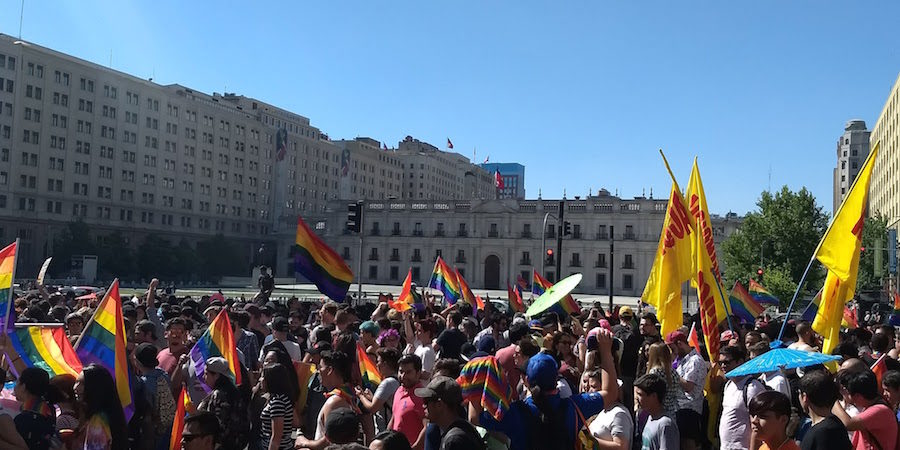
The Santiago Parade 2017 was a massive, colorful event, full of glitter and tinged by the electoral climate that Chile is experiencing these days.

Share

By Airam Fernández, from Santiago, Chile. The 2017 Santiago Parade was a massive, colorful, glitter-filled event, tinged with the electoral climate currently gripping Chile. In a gathering that mobilized thousands of people this past Saturday, November 25th, voices and banners chanted slogans of equality and demanded the approval of two laws that will defend and uphold the rights of the LGBTI community: the equal marriage law and the gender identity law. The Movement for Homosexual Integration and Liberation (Movilh), which organized the event, estimated an attendance of 100,000 people along the route that started at Plaza Italia and ended at Plaza Los Héroes, despite the heat and intense sun of a typical summer day. Three weeks before the second round of the presidential elections, the demonstration was called with the idea of “keeping the need to advance and expedite the passage of these laws in the public discourse and among presidential and parliamentary candidates,” explained Rolando Jiménez, spokesperson for MOVILH. It also took place on the eve of a very important day for the community and the country: the equal marriage bill, which includes same-sex adoption, will begin to be debated in Congress this Monday. It was a politically charged march. The presence of Alejandro Guillier, the government-backed candidate who will face the conservative former president Sebastián Piñera on December 17, was particularly noteworthy. Piñera obtained 36% of the vote in an election that many in his camp and all the polls had predicted he would win. Accompanied by his wife, María Cristina Farga, Guillier walked along the main thoroughfare of the Chilean capital, surrounded by supporters who asked for selfies. “I am here to defend the inclusive and diverse Chile we dream of,” she told Presentes .
 Other politicians who joined the event included the Minister of Social Development, Marcos Barraza, and the communist congresswomen Karol Cariola and Camila Vallejo. Foreign Minister Heraldo Muñoz urged the presidential candidates to speak “firmly” on issues of diversity: “If we work together, very soon your demands will be rights,” he told the crowd on the stage set up by MOVILH before the march began. The demonstration included representatives from the United States embassy and several from the European Union. “In Denmark, we have had marriage equality since 2012 and same-sex adoption since 2010. Trans people have the right to legal gender reassignment without diagnosis or treatment. Now we are marching to support the introduction of the same rights here,” said Trine Danklefsen, counselor at the Danish embassy in Chile.
 Amidst the rainbow that paraded down Alameda Avenue, to the rhythm of powerful electronic music, lots of dancing, euphoria, and emotion, signs stood out calling for respect for the diversity of couples and the dignity of trans people, with an emphasis on children. As in other demonstrations, the children of the Selenna Foundation, accompanied by their parents, marched to the end. “For the right to be” was the most resounding slogan. The National Youth Institute and the organization Gay Action also joined the march with their flags. At a pivotal moment, some members of the Inter-Company Leader Union (SIL), with their representatives dressed as priests, booed and shouted against the Church, just as the march paused for a few minutes in front of the Catholic University.
  Alessia Injoque, a trans activist who identifies as lesbian, is Peruvian and has been living in Chile for 15 years, “on and off.” This Saturday, she felt deeply affected by the two demands of the demonstration. That's why, for the first time in her life, she went to march. “The election results surprised me, like the rest of the country. I thought the right wing would come out much stronger, and I was surprised. That was the impetus for me to come and express myself, and above all, to encourage people not to stop voting, because now there is hope of having a president who supports us and not one who stops all the progress. In my case, the two laws are crucial. I am currently married to my wife because I am legally a man, but as things stand now, if I were to change my name, I would get divorced. That's not an option, because marriage is a very important institution with a lot of meaning and significance for us,” Alessia told Presentes. Oscar Rementería, spokesperson for MOVILH and former Senate candidate, also addressed the electoral landscape. Despite not being elected in the recent elections, he told Presentes that he views the scenario with great optimism: “Parliament surprised everyone; both chambers were renewed, and there was an increase in parliamentarians who support the diversity agenda. This shows that starting in March 2018, there would be a clear majority in the Chamber of Deputies and the Senate to approve the various sexual diversity agendas that exist in Chile. So, if we look at it this way, the movement will benefit, regardless of who is elected president of the Republic.” The executive president of the Iguales Foundation, also present at the march, has a similar view regarding the debate that begins tomorrow in the Senate: “It is good news for the country that we are beginning the discussion of the equal marriage bill, which is important for many Chileans and seeks to end structural discrimination against lesbian, gay, and bisexual people.”
We are present
We are committed to journalism that delves into the territories and conducts thorough investigations, combined with new technologies and narrative formats. We want the protagonists, their stories, and their struggles to be present.
SUPPORT US

FOLLOW US
Related notes



We are present
This and other stories are not usually on the media agenda. Together we can bring them to light.