

Transvesticide and institutional violence: setbacks denounced by LGBTIQ groups
The LGBTIQ community arrived at the 26th Pride March with a series of specific slogans for this year, but also with its long-standing demands of the State. What follows is a possible overview of the progress, shortcomings, and ongoing struggles regarding the rights of lesbian, gay, bisexual, trans, intersex, and queer people in Argentina in 2017.

Share

By Ana Fornaro and María Eugenia Ludueña/Present in Tiempo Argentino. The LGBTIQ community arrived at the 26th Pride March with a series of specific slogans for this year, but also with its historical demands of the State. What follows is a possible overview of the progress, shortcomings, and ongoing struggles regarding the rights of lesbian, gay, bisexual, trans, intersex, and queer people in Argentina in 2017.
#StopTheMurdersOfTransvestites
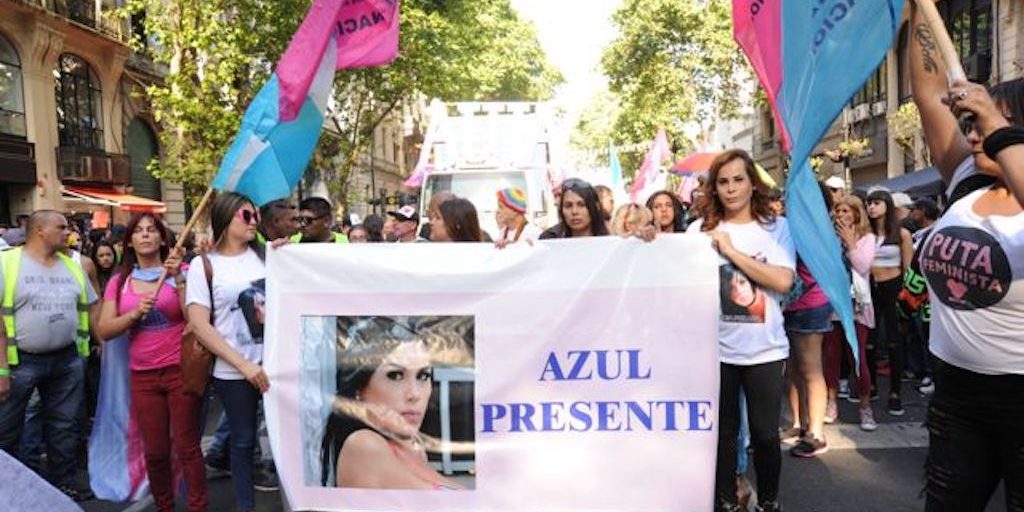
During 2016, there were at least 16 trans women murdered. Azul Montoro, 23, in Córdoba; Ayelén Gómez, 31, in Tucumán; and Pamela Tabares, 35, in Rosario, were some of the trans women and trans people murdered during 2017. Since there are no official figures, it is difficult to determine the number of hate crimes. Furthermore, trans murder is the final link in the chain of "social transvesticide," a cycle of violence that begins with family exclusion and is perpetuated by the state. This year, six trans people died in just one week due to lack of access to healthcare. And the deaths and attacks continue, silenced and rendered invisible. The trans community denounces the fact that their bodies don't matter: "We are not included in the country's emotional agenda."

I condemn the protocol for detaining LGBT people.
On October 30, the Ministry of Security approved the “General Protocol for Personal Searches and Detentions of LGBT Individuals,” which will be used by federal police and security forces. “This protocol is being enacted in a context of increased institutional violence and government persecution against the LGBTIQ community,” says lawyer and lesbian activist Luciana Sánchez, a member of the organization COPADI (Collective for Diversity). READ MORE: Organizations condemn the protocol for detaining LGBT people Institutional violence: persecution of trans people and lesbians 2017 was a particularly difficult year of persecution and violence for lesbians in the streets. The most high-profile case was that of Higui de Jesús, attacked by a group of men who attempted to rape her in October 2016, although she was the one who ended up being prosecuted and imprisoned. In self-defense, she fatally wounded one of her attackers and was denied access to justice, which discriminated against her for being a lesbian and poor. Throughout the year, police conducted several raids and arbitrary arrests before and after the Women's Strike march. They also harassed a lesbian couple in a plaza in Morón and detained and assaulted Mariana Gómez at a subway station while she was with her wife, Rocío Girat. Six lesbian activists were prosecuted, accused of painting walls on March 7, Lesbian Visibility Day.[READ ALSO: The UN demands that Argentina put a stop to the persecution of transvestites and trans people]
Transvestites and transgender people continue to be harassed by security forces, victims of fabricated charges brought by the police, and mistreated in prisons. This year, the organization OTRANS denounced the lack of access to healthcare in the Buenos Aires prison of Florencia Varela, which resulted in the deaths of two activists within two months.[READ ALSO: Demands for justice for the death of a trans woman detained in Florencio Varela]
Another year without an anti-discrimination law
Congress has still not addressed a new law to prevent and penalize discrimination that would update the current law from 1988..#Recognizing is repairing
The bill was presented in the Senate on November 16. The bill, titled “Recognizing is Repairing,” aims to pass Bill 8194, which seeks to provide a special pension to transgender and transvestite individuals over 40 years of age who have suffered violence, whether through police edicts or any other degrading act by security forces.transgender employment quota
The “Diana Sacayán” trans employment quota law, championed by the murdered trans activist and passed in 2015, remains unregulated in the province of Buenos Aires due to a lack of political will. However, both in that province and in the rest of the country, some municipalities have implemented it through resolutions or ordinances. In 2017, Rosario, Río Grande, the University of Mar del Plata, Santa Rosa (La Pampa), and Luján de Cuyo (Mendoza) joined this initiative.Justice for the transphobic murder of Diana Sacayán
Trans activist and human rights defender Diana Sacayán was found murdered on the 13th October 2015, in the department of Flores, where he lived. LThe cause had to be reactivated at the urging of activists. The case was brought by the "Justice for Diana Sacayán: Stop Transvesticide" Commission, headed by her brother, Sasha Sacayán, an activist with MAL (Anti-Discrimination Liberation Movement). One person is currently in pretrial detention, and several others are suspects. The Public Prosecutor's Office—specifically the National Criminal Investigation Prosecutor's Office No. 4 and the Specialized Prosecutor's Unit for Violence against Women (UFEM)—requested that 23-year-old Gabriel David Marino be brought to trial for transvesticide and that the investigation into other suspects be intensified.[READ ALSO: Two years without Diana Sacayán: “She continues to be our guiding light”]
But the trial has not yet been scheduled; it was postponed and is expected to begin in February 2018. If the court continues to delay the start date, the detainee could await trial while free. “We want to know who killed Diana and why. If we don't push her case forward, the situation worsens for everyone. Seeking justice for her means continuing to fight to change the lives of our fellow activists and demanding change from society. I think if it had happened to any of us, we would have done the same,” Sasha told Presentes.#ComprehensiveSexualityEducation
LGBTQ+ organizations are demanding the implementation of the Comprehensive Sex Education Law throughout the country and at all educational levels. But above all, they are calling for the separation of church and state. In September, Archbishop Aguer of La Plata prohibited Catholic schools in the city from making any reference to "gender theory and the texts that support it," stating that it was his "responsibility to protect children." "His directives for Catholic schools in La Plata violate the Comprehensive Sex Education Law and the right to education," Greta Pena, president of 100% Diversity and Rights, told Presentes. This year, the discussion about the constitutionality of Education Law No. 7546 of the province of Salta - which declares the Catholic religion mandatory in public schools - reached the Supreme Court of Justice after seven years of litigation.[READ ALSO: Religion in schools in Salta: “It affects us as an LGBTI community”]
The organizations participated in the Court hearings and expressed the violation of the right to identity and the danger to different groups, including the LGBTI community, of mandatory religious education in schools, which is endorsed by Salta, Catamarca and Tucumán. They also criticized the Religious Freedom bill promoted this year by the Executive Branch.Far from being a bill on the “Right to religious freedom and freedom of conscience of human beings”, as stated in the title of its Article 1, which would be a laudable goal and one that would have our support, many of its provisions enable the violation of the freedom and dignity of other people and groups, third parties, with the bill going so far as to legitimize discriminatory acts against, among others, the broad group of people we represent,” they expressed in a statement. about twenty organizations, including the CHA (Argentine Homosexual Community), Conurbanos por la Diversidad, Movimiento Antidiscriminatorio de Liberación (MAL), Lesbianas y Feministas por la decriminalización del aborto, and several more.Access to health
Lesbians are always spoken to as if they were heterosexual. Intersex people are pathologized, trans people's gender identity is not respected, gay men are associated with HIV, and the list goes on. While there has been progress in Argentina, thanks to inclusive clinics, the healthcare system does not adequately support current legislation, and the LGBT population faces daily—when accessing healthcare—the prejudices of doctors and the violation of their rights. Organizations are demanding the effective implementation of the Gender Identity Law, including in healthcare, and specifically for transgender children and adolescents. Since 2016, they have denounced the cuts to public health policies for inclusive clinics. They are also demanding a new law on HIV, viral hepatitis, and STIs: two weeks ago, the National Front for the Health of People with HIV demanded the immediate consideration of this HIV bill. If it is not addressed in the remaining committees by the end of this year's ordinary sessions, it will lose its parliamentary status. This would mean starting the entire process from scratch. The slogan is #NewHIVandHepatitisLaw #NoMoreTime.More reports of attacks on LGBT people
This year, there have been several attacks against LGBT people in the City of Buenos Aires. Present The LGBT Ombudsman's Office of the City of Buenos Aires was consulted regarding the number of complaints and violations against LGBTI people in recent years. According to the Ombudsman's Office records (which reports to the Ombudsman's Office), 28 cases of attacks and discrimination and 43 cases of rights violations against gay, lesbian, bisexual, transvestite, transgender, and intersex people were reported in 2015. In 2016, 58 attacks and 72 cases of rights violations were recorded. This means that reports of attacks motivated by sexual orientation and gender identity more than doubled in the last year, according to the records of the Buenos Aires LGBT Ombudsman's Office. READ THIS ARTICLE IN ARGENTINE TIME]]>We are present
We are committed to journalism that delves into the territories and conducts thorough investigations, combined with new technologies and narrative formats. We want the protagonists, their stories, and their struggles to be present.
SUPPORT US

FOLLOW US
Related notes


We are present
This and other stories are not usually on the media agenda. Together we can bring them to light.