

She fought for her license and created a national network of trans teachers
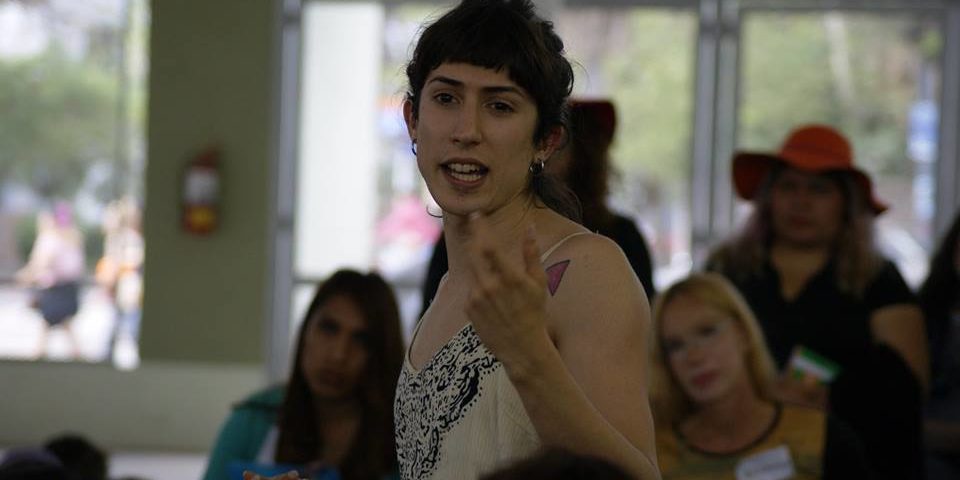
Quimey Ramos, the trans teacher who made headlines last month for transitioning mid-year, is leading a national network of trans teachers. Now, she has just won another battle: she finally obtained the medical leave that had been denied her for gender reassignment surgery. “What happened to me serves as a lesson for any teacher to have the tools to assert their rights. I’m happy to be in this position here, to empower others and continue empowering ourselves together,” she told Presentes.

Share

By Anita Aliberti
Photos: André Araoz (opening) and Agostina Santoliquido (interior)
Quimey Ramos, the trans teacher who made headlines last month for transitioning mid-year, is leading a national network of trans teachers. Now, she has just won another battle: she finally obtained the medical leave that had been denied to her for gender reassignment surgery. “What happened to me serves as a reminder for any teacher to have the tools to assert their rights. I’m happy to be in this position here, to empower others and continue empowering ourselves together,” she told
Presentes. Quimey (22 years old) had rhinoplasty and Adam’s apple surgery as part of the process of aligning with her self-perceived gender. When she tried to apply for the 20-day leave she was entitled to, she waited almost four hours only to be told no, that she should have waited until her vacation: for the doctors, it was considered cosmetic surgery. More than fifty people accompanied her in the protest, including the general secretary of the teachers' union in Ensenada, the director of the Gender Violence Observatory, Laureana Malacalza, and two lawyers.
 When she received the certificate, she posted on her social media: “It is necessary that we recognize that in the face of injustice, collective organization will be the winning response.” That is why she created the first National Network of Trans Teachers. Quimey believes that the trans community can make a significant contribution to the education system, such as a critical review of the Comprehensive Sex Education Law (ESI) from a perspective that embraces diversity.
[READ ALSO: #Argentina: first data on LGBTI climate in schools]
Reasons to review the Comprehensive Sex Education Law
“Comprehensive Sexuality Education (CSE) starts from the paradigm that there is a normality in which we, the trans community, are the diverse ones. Up until now we have experienced an integration, which would be like an annex, like an invitation to join the normal. For integration to become equality, we need to start breaking down this binary. The absence of the State in gender education is a political decision. “And if the state doesn’t provide those workshops, we have to create them ourselves, through struggle,” Quimey told Presentes. “We are debating what future we give to the trans children who will come into the world and to society in general. Are we going to change ourselves to fit into a model, or is society going to open itself to our discourses?” she added.A protocol for action
So far, 20 teachers have joined the Network in places like Santa Fe, Córdoba, Jujuy, Mendoza, and Bariloche, but Quimey dreams of a National Meeting. “We know that very few people can access higher education because that very fact is also part of the human rights violations we experience. If a few of us think this way, I can't imagine all that we can think together,” she told Presentes.[READ ALSO: Religion in schools in Salta: “It affects us as an LGBTI community”]
Once Quimey is out of surgery, she plans to work with her lawyers and the Ombudsman's Office to develop a protocol for addressing these cases of institutional violence. "We shouldn't have to constantly resort to the Gender Identity Law, as if it weren't enough. We need the relevant institutions to update their practices so that it is enforced," the teacher said.]]>We are present
We are committed to journalism that delves into the territories and conducts thorough investigations, combined with new technologies and narrative formats. We want the protagonists, their stories, and their struggles to be present.
SUPPORT US

FOLLOW US
Related notes



We are present
This and other stories are not usually on the media agenda. Together we can bring them to light.