

Cecilia Palmeiro: “Activism was and continues to be the best school for me”
A PhD in Literature, a theorist of queer feminism, a member of the Ni Una Menos collective, a writer, a scholar of Néstor Perlongher's work, and an activist, Cecilia Palmeiro says she never fit into the binary and that for a long time she felt like a faggot trapped in a heteronormative regime. *Cat Power, la toma de la tierra* (Cat Power, the Land Takeover) is her first novel.

Share

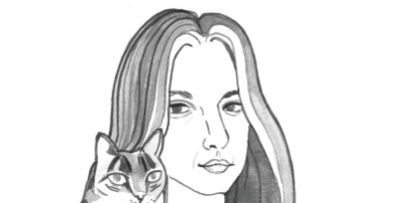
By Paula Bistagnino Photos: CP's personal archive A PhD in Literature, a theorist of queer feminism, a member of the Ni Una Menos collective, a writer, a scholar of Néstor Perlongher's work, and an activist. Cecilia Palmeiro says she never fit into the binary and that for a long time she felt like a faggot trapped in a heteronormative regime. Cat Power, the Land Takeover , is her first novel. Cat Power, the Land Takeover (Tenemos las máquinas) blends academia, literature, activism, and autobiography. Could the first novel by a queer feminist theorist and activist who embodies her beliefs be anything else? Cecilia Palmeiro studied Literature at the University of Buenos Aires, where she trained with Silvia Delfino, one of the founders of the Queer Studies Area. “I learned so much. There weren't any gender studies courses at that time, and activism was and continues to be the best school for me.” From then on, every academic step merged with activism and a life lived at that pace, in a synergistic quest that took her to Princeton, in the United States, where she earned her master's and doctoral degrees in Latin American Literature. To Rio de Janeiro, where she researched and wrote "Desbunde y Felicidad. De la cartonera a Perlongher" (Exuberance and Happiness: From the Cardboard Box to Perlongher), about the work of queer writers and artists between the 1970s and 2001, and also compiled the correspondence of Néstor Perlongher. To London to teach literary theory and cultural studies. And back to Buenos Aires, where she completed her postdoctoral studies in Literature. In between, she went to São Paulo, and back to the United States again, and so on. "The novel is a byproduct of my academic research and my work as an activist," she says, the author, but not the narrator: the one who tells the story is Rorro, her cat.

-Is thinking about a cat as a narrator just a purely literary pursuit?
The original idea came from my thesis advisor, Ricardo Piglia. He suggested I write chronicles of all the crazy things that happened to me while I was studying for my doctorate and postdoctoral degree. All those experiences, which included many research trips and a nomadic and wild life between New York, Buenos Aires, Rio de Janeiro, São Paulo, and London, were mediated by my equal relationship with my cat, Rorro. A silent witness to all my absurdities, he also got up to his own antics. Because of the cosmopolitan and deterritorialized life I made Rorro lead—he traveled with me on planes and moved from house to house and family every three months—I wanted to pay homage to him. I wanted to make our spiritual mimicry a way to explore language and step outside myself, outside my autobiographical voice, to think about the world and humanity from a radical perspective. I sought to think about life against the grain of humanity. I wanted to translate into verbal language what I call feline power, its strength and energy, and make with that a kind of anti-speciesist manifesto.-You once described yourself as a faggot trapped in a woman's body. Is that a construct or a self-perception?
Throughout my life, I've perceived myself in different ways, but never as a cisgender, white, heterosexual, middle-class woman. For a long time, I felt like a fucking idiot trapped in a heteronormative system. I think you perceive yourself in a certain way and then construct your identity from there, but both self-perception and construction can be fluid and ever-changing.
-You've been part of the Ni Una Menos movement since its inception, but you came from a Queer feminist background. Are there common struggles for feminist and LGBT rights and freedoms?
The anti-patriarchal struggle agenda is fully formulated within the framework of the politics of desire, a term that encompasses feminist struggles and those for sexual diversity (which I also like to call the politics of queer people, because that name summons and unites women and queer people). I think it's important to consider women as subjects de-hierarchized by cisheteropatriarchy, as minority and queer subjects. These struggles for the rights and freedoms of all bodies must also be considered in a transversal and intersectional relationship with anti-colonial and anti-racist struggles, and ultimately, with anti-neoliberal and anti-capitalist struggles.-You've repeatedly suggested that activism shouldn't clash with happiness, or that politics shouldn't embitter us. Is the pursuit of happiness possible today in a context of setbacks in rights and freedoms?
–Today more than ever we must not give up on beauty and happiness, which is ultimately what we fight for. Indigenous and Afro-descendant movements speak of good living as a horizon. To get through this moment we need sources from which to draw energy and ideas, to create spaces where we can develop something more than mere survival according to the laws of the market. Activism as the place where we put into practice the world where we want to live, art as the space where we imagine it, the party where bodies are celebrated and enjoyed, the political friendships where we grow, are key instances in this terrible moment. Editorial We have the machines
-One of the book's many postulates states, "For the submission of the mind, the first step is the submission of the body." What is happening to bodies today?
-LBodies are the political arena where social conflicts are played out, the surface of pain on which misogynistic cruelty (whose extreme cases are femicide and prison) and its multiple forms of discipline are inscribed, but also the space of rebellion and pleasure. Today it seems to me that We, feminized bodies, are in a global revolutionary process, the most radical and massive in history, in which we reject violence while entering a process of becoming a woman. We stopped being what the patriarchy wants us to be and dared to think of ourselves as what we can become. Through a process of identification (“soft”, not biological) with one another, where we recognize the oppressions of others as our own, and of disidentification with respect to the social models of subjectivity offered to us by the market, we eroticize politics and politicize life.]]>We are present
We are committed to journalism that delves into the territories and conducts thorough investigations, combined with new technologies and narrative formats. We want the protagonists, their stories, and their struggles to be present.
SUPPORT US

FOLLOW US
Related notes

We are present
This and other stories are not usually on the media agenda. Together we can bring them to light.