

#BeingIntersex: "I have two sets of genitals fighting for the same body"
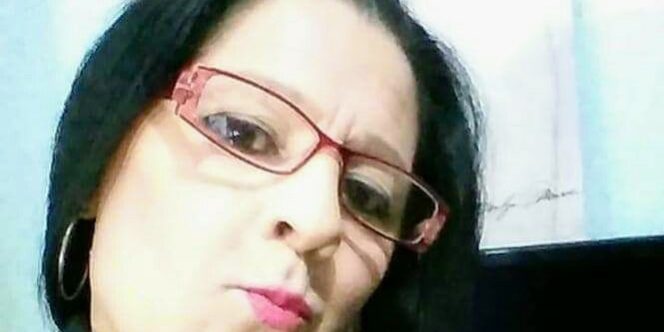
Jennifer Gabriela Aranda was born with male external genitalia. During puberty, when her body began to develop female, it was discovered that her internal genitalia were female. Her father and a doctor pressured her into testosterone treatment, but she stopped taking it. Today, she is 54 years old and an activist.

Share

“I felt feminine in everything: from the games I chose to the fact that I liked using my mom’s things and wanted to be with the girls. It was very strong, but I denied those feelings to myself because I knew I was a boy and wasn’t supposed to act that way,” says the intersex woman and activist, who is now 54 years old and still has the body and internal and external genitalia she was born with. Jennifer at the 2017 National Women’s Meeting in Chaco
"The terrible things started in puberty"
Jennifer is one of the 0.5 to 1.7 percent of people born with sex characteristics that don't correspond to typical binary notions of male or female bodies. And she is one of those even rarer cases where intersex is not visible at birth. That's why, for her, as for many intersex people, “The terrible things started in puberty” with the first changes. “While the boys grew taller, developed muscles, and grew hair and a deep voice, the opposite happened to me: my voice was like a woman's, my breasts grew, and I became hippy.” The feeling that she could not control her body led her to isolate herself and she began to dress in loose clothing because she was afraid of being discovered. “It was the 1970s. Heteronormativity was absolute. There were no trans people, no transvestites, no lesbians, no gays. At least not visible ones. Anyway, I didn't feel gay. I felt feminine and I wanted men to see me and love me as a woman.” That was impossible because I was male. So all of adolescent sexuality was traumatic for me. I had a frustrated adolescence and puberty.”[READ ALSO: Hearing at the IACHR highlighted violence against intersex people]
One day, when she was 13 or 14, her father saw her bathing and realized that her physique wasn't that of a boy. He took her to the doctor immediately. They ran tests and discovered that her entire reproductive system, all her internal genitalia, was that of a woman. That's why she also menstruated. "In my case, I have a duct that goes to the anus, so I always menstruated through there." I believed that my feminine feelings were so strong that my body responded this way.”[READ ALSO: LGBT Intersex: What does it mean to be an intersex person]
Hormone treatment: "It made me ambiguous and condemned me to live in shame."
The doctor then did what the father asked: “All he cared about was that his firstborn son wasn’t gay, so they put me on hormone therapy.” While he told her she was getting vitamins, he was actually injecting her with testosterone. This intervention resulted in a physical transformation contrary to what she wanted. This went on for two years, until she was 17, when she realized what was happening and decided she wouldn’t do it anymore. She stood in front of her father and said: “I am not this monster you are creating. I am not going to live to make you happy.” Now, almost forty years later, he thinks: “They couldn’t break me. Even with all the testosterone they gave me, they still couldn’t. They could never change my mindset. But They made me ambiguous and condemned me to live ashamed and locked up, because I didn't want to go out on the street. “I became completely androgynous.” A year and a half after stopping the treatment, her body began producing estrogen again, and within two years she was the person she is now. But it wasn't without consequences: it actually stunted her female development, leaving her halfway between male and female. Furthermore, the medication caused her liver problems. “I have two sets of genitals fighting in one body.”
Turning suffering into activism
Jennifer's activism began almost out of necessity. And while she had always done things for her peers, it wasn't until 2014 that she began a more formal involvement: alongside Belén Correa, a renowned activist and one of the founders of the Association of Transvestites, Transsexuals, and Transgender People of Argentina (ATTTA), whom she had met at a friend's house in the 1990s. "It was mainly with the rise of social media that, because of what I posted, I became a natural role model because all the trans women in Escobar started coming to me for advice, since I was always helping those I met. It was something that came naturally to me and that I built intuitively." She led ATTTA Escobar Zona Norte for two years, but then left to work independently and joined Mujeres Trans Argentina, the organization founded by Maju Burgos. She spent another year and a half there before becoming independent again and forming her own group. Trans Pride Solidarity Mónica Astorga (OTSMA), OTSMA is a group currently being formalized that works to support and assist transgender people on the streets, in hospitals, and in prisons. OTSMA is self-managed with resources derived from the generosity of those who wish to collaborate and from significant support from Sister Mónica Astorga of Neuquén – hence its name.[READ ALSO: The intersex girl who lived two years registered as male]
Jennifer says that social issues were always a problem for her. Because her physical appearance led her to have to live hiding a body that didn't match her name and that she couldn't quite define. “At first glance, I look like just another transvestite or trans woman. But at the same time, trans women always looked at me strangely because they didn't believe what I told them and thought I was secretly taking hormones or that I had had surgery,” she says. “And at the same time, I suffered all the mistreatment that any trans girl suffers: not being able to find work, being ignored, lack of access to healthcare, abuse… Luckily, my mother always defended me, and I never had to leave home.” The passage of the Gender Identity Law granted her two rights that were previously denied: having an identity document with her name and access to hormone treatments, which are now very important during menopause, and, if she wanted, to surgery. “Now I’m thinking about castration, to stop producing testosterone, because that continues to cause me health problems.”
“We remain invisible”
As the founder of OTSMA, Jennifer attended the last National Women's Meeting in the province of Chaco. There, she reaffirmed something she already knows: that intersex people are still invisible and that, therefore, there is a great lack of awareness about their problems and suffering. “We are a minority within a minority. At the National Women's Meeting, I found that 90 percent of the women there, all activists, didn't know what my flag meant.”And he concludes: “I would love for the world to take us more into account, for us to be recognized and respected, for our rights to be considered. That's what this day is about, and that's why we want our flag to circulate, which has a lot to do with trans people but is something else entirely.”]]>We are present
We are committed to journalism that delves into the territories and conducts thorough investigations, combined with new technologies and narrative formats. We want the protagonists, their stories, and their struggles to be present.
SUPPORT US

FOLLOW US
Related notes


We are present
This and other stories are not usually on the media agenda. Together we can bring them to light.