

Kumbia Queers: “We must educate for diversity, accept and celebrate differences”
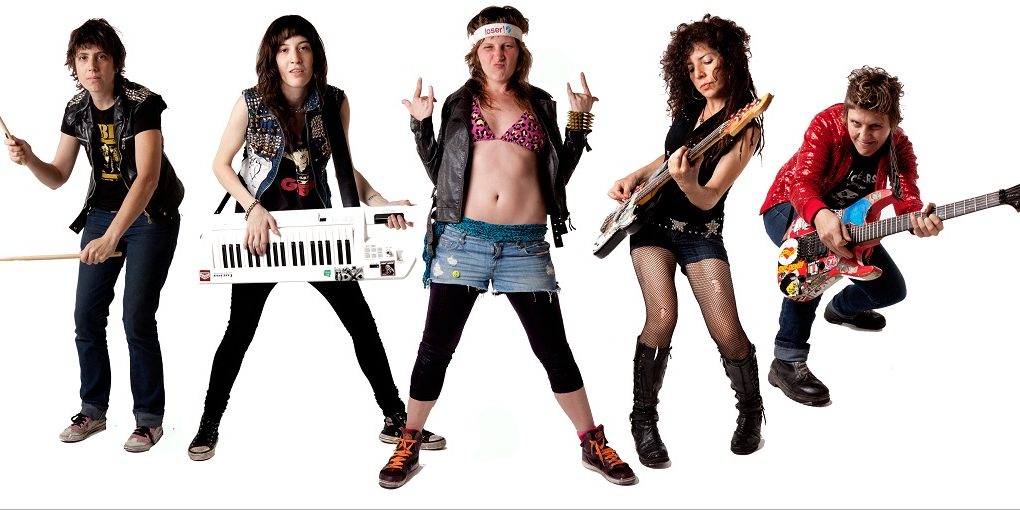
With four albums under their belt (Kumbia nena!, La gran estafa del tropipunk, Pecados Tropicales and Canta y no llores) and after ten years of formation, Kumbia Queers is a band of women that redefined the concept of punk by adding cumbia rhythms.

Share

By Lala Toutonian
“We are the voice without fear, we are the cries of those who fell. / We are another voice that has no owner, we do not belong. / I have no nation nor solace. / We are adverse effects. / Contraindications of their thoughts. / We are the concept of what they would like to see dead. / I have no reason nor solace, that is why I am not afraid.”
Contraindications, Kumbia Queers.
With four albums to his credit (Kumbia nena!, The Great Tropipunk Scam, Tropical Sins and Sing and don't cry) and after ten years of training, Kumbia Queers It's an all-female band that redefined the concept of punk by adding cumbia rhythms. That's how it was born. tropipunk, With these first six, then five members, KC now includes the singer Juana Chang Pat Pietrafesa, the band's bassist, previously played in She Devils alongside guitarist Pilar Arrese, a queercore post-punk trio, and before that in Cadáveres, the legendary punk band. The lineup is completed by Florencia Literas on keyboards and Inés Laurencena on drums. The KQ duo has toured Latin America, the United States, much of Europe, and Japan on several occasions, self-managing their tours, in keeping with their philosophy. “Ali Gua Gua (the other singer) left in early 2015, but she was always part of the family and still is. She lives in Mexico, DJs, and makes music. She'll always be welcome back,” says Juana Chang, the band's vocalist and the one answering the #5Questions. “We went to do a story at MTV, and when we left, someone had the idea for me to climb onto a billboard—a huge marquee with the letter M on it—to take some photos. It fell on top of me, came crashing down with me, and broke my leg in two. But I'm getting my joy back and without losing the silliness that characterizes me.” That's how he greets Juana Chang to Present with the vivacity that is their hallmark and the energy they exude on and off the stage.
— Identity—personal and collective—is generated from experiences. KQ is already ten years old, and yet its identity—post-punk, inclusive, lesbian, activist, musical—has been key from day one. Do you attribute it, as I do, to a gathering of women artists with such strong personalities?
— When we met at the Belladona Festival, each of us with our own personal projects, the connection was so strong, the admiration was immense. She Devils with Inés, Pilar, and Pat, Ali Gua Gua with Ultrasónicas, and me with Juana Chang & the Wookied. We got together and were blown away by what each of us was doing, so we decided to join forces to play cumbia, and we named the group Kumbia Queers. We faced a rhythm none of us were used to; we'd never played it before, and many of us had a big prejudice against it. A huge world of experiences and moments we hadn't imagined opened up; it was very liberating and beautiful. That back-and-forth with the audience, seeing them having fun, dancing, forming couples—all those things that weren't happening in rock at that time. I think that now, with a defined personality, Kumbia Queers is bigger than the sum of its parts.— There are many achievements resulting from the struggle, but you who travel so much and see how plurisexuality is experienced abroad, what do you think is the difference in acceptance and integration with our reality, what is missing?
— Sexual diversity is experienced very differently in a big city than in a small one, or in Europe versus Latin America. In recent years in Argentina, we've made significant progress on legal issues like same-sex marriage and gender identity, although we still have a long way to go. Especially now that we have to fight to prevent the erosion of our rights, to avoid losing what we've gained. We need to educate for diversity and accept and celebrate differences. We need to come together.— How did your personal life change with KQ?
— In these ten years, life changed a lot in terms of collective action, having a group to belong to, the family you wake up with every day, having a routine, the tour, or recording albums, doing interviews. It was incredible from the first day, from the first concert we gave, we changed our mindset, it was an internal explosion.— A word or concept that defines your travel companions.
— Total commitment!— KQ paved the way for more girls, more bands, more artists to feel free to move freely, do you feel a responsibility in that regard?
— More than a responsibility, it makes us really happy when we go somewhere and a group of girls comes up to us and says they met at one of our concerts and started playing together, and they see that there are bands growing and making amazing music. That fills us with pride and makes us want to keep creating, meeting up, and dancing. We're very happy about that. Today, Friday 20/10, they celebrate their ten years in music with a show at Uniclub (Guardia Vieja 3369) together with Chocolate Remix at midnight.
]]>
Today, Friday 20/10, they celebrate their ten years in music with a show at Uniclub (Guardia Vieja 3369) together with Chocolate Remix at midnight.
]]>
We are present
We are committed to journalism that delves into the territories and conducts thorough investigations, combined with new technologies and narrative formats. We want the protagonists, their stories, and their struggles to be present.
SUPPORT US

FOLLOW US
Related notes
We are present
This and other stories are not usually on the media agenda. Together we can bring them to light.