

Sara Hebe: “Women and transvestites are always objects for capitalism”
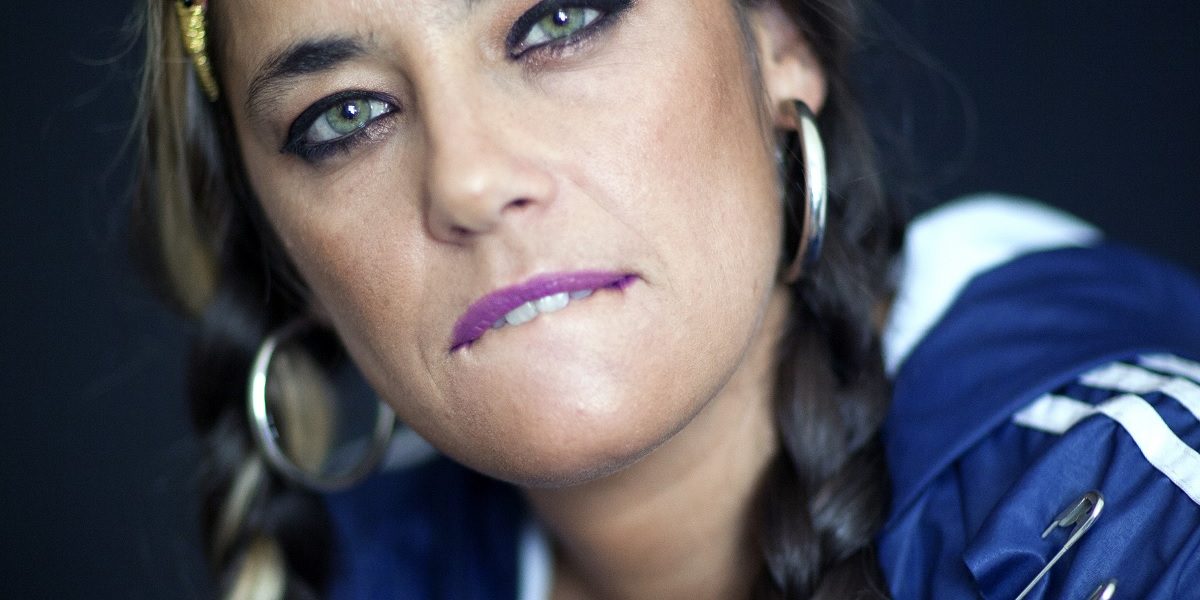
With fury, with a hip-hop cadence, Sara Hebe makes herself visible, wears the green scarf of legal abortion, waves the LGBTI pride flag, aims, shoots, sings. A defiant feminist, she has been making music for almost ten years, but perhaps she is best known for her song "El Marginal," the theme song of last year's hit TV show that won the Martín Fierro de Oro award and became one of Netflix's most popular series.

Share

By Daniela Pasik. With fury, with a hip-hop cadence, Sara Hebe makes herself visible, wears the green scarf of legal abortion, waves the LGBTI pride flag, aims, shoots, and sings. A feminist and activist, she has been making music for almost ten years, but achieved popularity with her song The MarginalTheme song from last year's hit TV show that won the Martín Fierro de Oro award and became one of the most popular series in Netflix. In all kinds of settings, in the underground or at festivals, touring Europe or playing in small Argentinian towns, the rapper from Trelew hurls her rhymed daggers at the things that many refuse to see. “The National Women's Meeting "It's the real thing, the anti-capitalist event. Everything else is just survival. I've never been to one before; this will be my first. I'm not going with a musical idea or to play; I want to go as an apprentice, to do workshops. I'm excited; it's a unique political event that doesn't happen anywhere else," he says. -Your lyrics are militant. Is that where lesbian visibility became a theme? Lesbian visibility became an issue because of the fact that I like girls, and then it became activism. Not the other way around. And it became activism because we live in a social context with marriage equality and the gender identity law, but also one of great danger. There's still so much to make visible. That's why the personal becomes political as well. While there are more advertisements featuring same-sex couples, or a novel where some girls are in love, in reality something else is happening. A repressive, fascist, and lesbophobic offensive is being launched in response to, or reaction to, the advances in visibility. It's much harder to kiss your girlfriend in public if you're a woman because you might get arrested, or some creep might say something to you, or people might stare, and that's something you feel and it's horrible. There you feel like an object, the object they want us to be. If you see two girls from the neighborhood, and one doesn't conform to the beauty standards and codes established by heterocapitalism and patriarchy, she's thrown in jail. But if she's thin, pretty, on TV, in a soap opera, then she's accepted. There's an organized, repressive system that wants to demonstrate to us, more forcefully than ever, that they have the power. Women and transvestites are always objects for capitalism, and if we do not fit the norm that sells, we are stopped and blamed. Much can be done to raise awareness and break down stereotypes. Above all, we need to rethink our perspectives, examine our mental binaries, read authors—and there are many who have thought and written about these issues—and listen to younger generations, who bring more information and fewer prejudices. -You record independently, you play in small venues, no matter the size, but also at Lollapalooza. Is it difficult to maintain your stance, principles and ideals in places that might not seem suitable at first glance? "It's not hard for me to maintain my principles anywhere. Unfavorable places? The world isn't favorable. Within the market, there are no spaces left where we aren't expected to talk about such and such. It even suits them, because that's how capitalism absorbs things. Lollapalooza doesn't give a damn what I say. They want me, like market fodder. And I sell myself, I'm working. It would be nice if I finally got up the nerve to drop a bomb on stage, but I don't want to kill any fans either, haha." -You started composing on your own and now you're considered the best female rapper in Argentina. What guided you to find yourself in that space? The "best female rapper" thing is someone's opinion, someone who wrote an article about it at the time, but I'm not comfortable with that definition because "best" has to do with the fierce competition we're immersed in within this savage capitalism, where women are more prey to this competition than men. Nobody is "the best." Everyone does their best at what they do. Every single person on this planet is irreplaceable. I got here guided by music, by listening to rap and all kinds of things. Hip hop, Beastie Boys, Mala Rodríguez, Todos Tus Muertos, Actitud María Marta, lots of things. One of the places where I started to gain confidence to compose songs was in theater classes with my teacher Mirta Bogdasarian, who encouraged me, told me that what I wrote was good. There wasn't one step or one leap to making music and sharing it with the public. There were thousands. I imagined myself like this from a very young age, when I played at doing what I'm doing now. I said I was on tour, going from place to place, to locations completely different from each other, like Gaiman (a tiny town in Chubut) and Los Angeles. I'd get dressed up, convince my friends to be part of my show, try to get people together, and write songs. Just like now. -You're a solo artist, but you play with a band and have a partner in the studio and on stage. How do those musical partnerships work? -I started out alone, playing around with pre-recorded tracks. In 2009 I made my first album, The Madman's Daughter, which included productions by several people, among them Ramiro Jota, on two tracks, Historika and DesperateHe's a great producer, super original, and also a friend, a really good guy. Then in 2012 I made the second one. BridgeBy then, he had produced most of his own music and began performing live. The last one, Empty CollectiveIn 2015, we recorded it more as a duo creation. The team we make works really well. We're independent of each other; he has his own thing, but I love his production skills and his musical ear. They make me want to keep working together. And Edu Morote joined the band a while ago on drums; Fernanda Ron plays bass and guitar and alternates with Ramiro; and sometimes my sister, Arie, sings backing vocals. -What new projects do you have? -We brought up the topic very recently Violet DogThere's a video on YouTube, and I'm thinking about new things, very slowly, but there's no concrete plan for an album. We're playing shows. On Saturday, October 28th, we'll be at La Cortada in Hurlingham. There are other dates later in November in Temperley and Olavarría, and also in Córdoba, Santa Fe, Rosario, and Bahía Blanca. Sara Hebe continues playing on Friday 3/11 at Casa Babylon (City of Cordoba), on Saturday 4/11 at Calypso (Rio Cuarto), on Friday 17/11 at Sivendia (City of Santa Fe), on Saturday 18/11 at Asociación Japonesa (Rosario) and on Thursday 23/11 at Nueva Cruz (Bahía Blanca).]]>
We are present
We are committed to journalism that delves into the territories and conducts thorough investigations, combined with new technologies and narrative formats. We want the protagonists, their stories, and their struggles to be present.
SUPPORT US

FOLLOW US
Related notes


We are present
This and other stories are not usually on the media agenda. Together we can bring them to light.