

#Paraguay: The government has banned gender-related content in schools
The Paraguayan government this week banned the dissemination of content related to “gender theory and/or ideology” in public schools nationwide. Human rights and LGBTQ+ organizations say the measure is a setback for education and human rights. It is part of a regional “onslaught” by religious fundamentalists.

Share

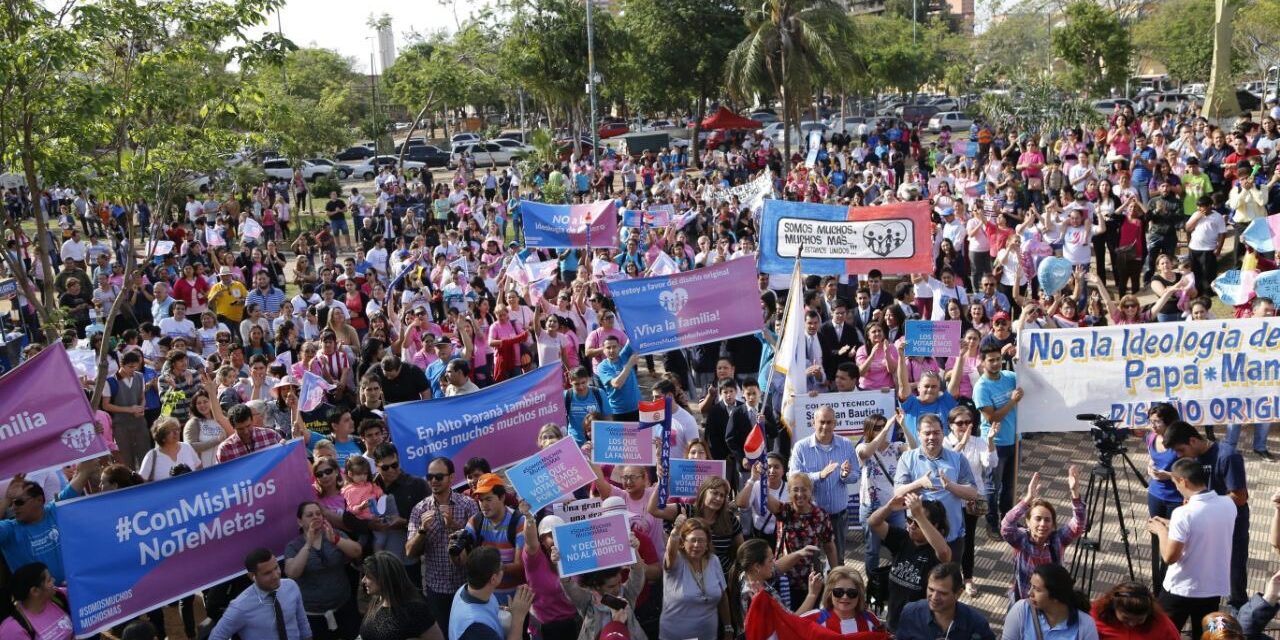
The Paraguayan government this week banned the dissemination of content related to “gender theory and/or ideology” in public schools nationwide. Human rights and LGBTQ+ organizations say the measure is a setback for education and human rights. It is part of a regional “onslaught” by religious fundamentalists. By María Sanz, from Asunción. Image: Twitter. A resolution from Paraguay's Ministry of Education and Science (MEC) on Tuesday prohibited the dissemination in schools of materials that refer to “gender theory and/or ideology.” The MEC also requested the supervision of all educational materials with references to gender within 60 days. The MEC resolution was released on Tuesday, but it was signed on October 5, after a public hearing in the Paraguayan Congress regarding the alleged dissemination of “gender” concepts in schools. At the hearing, Education Minister Enrique Riera asserted that the Paraguayan Constitution defines marriage as being between a man and a woman, and upholds traditional family values. He also offered to burn materials related to “gender ideology.” That same day, outside the Congress building, thousands of people demonstrated against what they call “gender ideology,” and in favor of the traditional family composed of a man and a woman.
"Eliminating education for equality is promoting violence."
Organizations such as Amnesty International (AI) described the Ministry of Education and Science's (MEC) resolution as a "serious setback" in human rights. They also pointed out that the decision contradicts Paraguay's international obligations regarding non-discrimination. "Women, and lesbian, gay, bisexual, transgender, and intersex (LGBTI) people, suffer constant discrimination and violence due to prejudices and stereotypes that persist in our societies. Removing education for equality from the curriculum is to promote this violence and discrimination from the State, with extremely serious consequences," they said. in a statement Erika Guevara Rosas, Americas Director at Amnesty International, and the Paraguayan branch of the Peace and Justice Service of Paraguay (Serpaj-Py), also rejected the measure. “The resolution could set a disturbing precedent by practically criminalizing a way of thinking about social reality,” she stated. in a statement. The WhatsApp audio that sparked the controversy The controversy surrounding the teaching of gender issues in schools began with a WhatsApp message. In mid-September, andIn an anonymous audio recording—whose origin was never verified—a supposed teacher lamented: “The word gender has now been detached from the word sex. Gender does not determine sex. Gender is constructed. And this ideology has already entered the upper elementary school curriculum. It has entered very strongly, the idea that gender is no longer simply male-female.” In another audio message, the same woman gave examples of how these ideas are expressed in the educational program: “For example, on Folklore Day, if a little boy says to you, ‘Teacher, I want to dance in a pollera, I want to dress as a Paraguayan woman,’ you have to let him, you shouldn’t stop him.” The audios did not go unnoticed by ultraconservative organizations and fundamentalist religious groups. The Movement for Life and Family denounced the content of some textbooks. References to sexual identity, to the different sexual orientationsQuestions about what the attitude should be toward sexual diversity were among the topics covered. Pro-life and pro-family groups were outraged.““Fundamentalist onslaught” at the regional level
Elba Núñez, a member of the Paraguayan delegation to the Latin American and Caribbean Committee for the Defense of Women's Rights (CLADEM), believes that both the demonstration and the public hearing—which she attended—were a show of force by conservative groups. “This fundamentalist onslaught is a regional trend. We have seen examples in Peru and Brazil, where religious instruction has been introduced into schools. There is a symbiosis between fundamentalist groups and state actors. The state ends up being complicit with a group that seeks to impose logics of intolerance, violates human rights, and even legitimizes aggression,” she stated. According to Núñez, the Ministry of Education's (MEC) prohibition on discussing “gender” in schools is an example of this symbiosis, which seeks to narrow the separation between church and state. She opined that this resolution could pose a “risk to the very lives” of people who defend LGBTQ+ rights and gender equality."A call for impunity, hatred and intolerance"
“It is a call for impunity, hatred and intolerance against all diverse thought, and in particular against sexual diversity. The State is sending the message that there will be no guarantees for exercising sexual and reproductive rights. This is about returning to heteronormative logic, with an absolute degree of risk for people who embrace their gender identity or sexual orientation. This disciplinary logic can entail risks for their lives,” Núñez warned. In the same week that gender ideology was being debated in Parliament, and ultraconservative groups took to the streets, two trans women were stabbed in Greater Asunción. The latter, Sheyla Brítez, was discharged from the hospital this Tuesday. Her economic situation is precarious, and she needs support to continue her recovery. another woman assaultedThe 28-year-old remains hospitalized, with a good prognosis.[READ MORE: Brutal attack on trans woman in Greater Asunción: the second in four days]
An educational “setback”
David González is an activist with Somos Pytyvohara (“companions” in Guarani), a network of teenagers and young adults demanding comprehensive sexuality education programs and public policies. He considers this an “educational setback.” “We never had real sexuality education in schools. But at least there was talk about the existence of LGBTQ+ people: in a crude, vague way, without delving into what that means, but there was talk. Now all this content is being removed from the curriculum, and the marginalization of LGBTQ+ people is returning, promoted by the State. This will have a negative impact on gay, lesbian, and bisexual children and teenagers. And especially on transgender children and teenagers, who were already excluded and marginalized,” he told Presentes. The activist believes the Ministry of Education and Culture's resolution is due to pressure from conservative groups with a strong message of hate against the LGBTQ+ community. “Political groups are trying to curry favor with these fundamentalist groups for electoral purposes,” he stated. Paraguay is currently in the pre-election period leading up to the primaries for each political party. From these will emerge the presidential candidates already seated in Congress.LGBTI people: a taboo in political campaigns
González insists that, to date, there are no concrete political proposals aimed at LGBTQ+ people in Paraguay from the major parties. However, opposition to LGBTQ+ people is being used to garner votes from the fundamentalist sector. An example of this is Tobías Wiens, the Colorado Party's candidate for Congress—whose campaign slogan is the classic fascist motto of "God, Fatherland, and Family." Wiens declared himself LGBTQ+ this week. against LGBTI organizations, already in favor of the family “in its original concept”. In July, she had already made her transphobic stance known with ua video from his Facebook profile. "If you have a penis and you want to enter the women's bathroom, I don't care how much of a woman you feel: you're entering through the wrong door, and I'm not going to leave my wife or my daughter there with a mentally unstable person," he said in the recording. Last week he questioned The possible congressional candidacy of trans activist Yren Rotela, representing the Kuña Pyrenda movement (“women’s platform” in Guarani), has been discussed. Wiens stated in the media that Rotela “was born male” and that if she were to win a seat, would be taking the place of “real women”. The more sensationalist media outlets in Paraguay also stirred controversy around Rotela's candidacy. The newspaper Popular dedicated its front page to him, with a headline that read “Women’s party proposes former muleteer as candidate”. “Conservative sectors are the electoral base of traditional political groups and parties, such as the Colorado Party, and a large part of the Liberal Party. And the LGBTI issue is always at stake, because these groups use fear as their main argument. Fear of the unknown spreads in a society with little education and little in-depth debate. And that's how we get results like the Ministry of Education's resolution,” feminist activist Lilian Soto told Presentes. In the 2013 elections, Soto was a presidential candidate for Paraguay with the Kuña Pyrenda party. She witnessed firsthand how LGBTI people become the target of the phobias of conservative sectors in Paraguay. “We could have a platform with 150 public policies, but the debate would focus on issues like abortion or same-sex marriage, because those are the ones that cause the most fear in people who aren't engaged in a debate about rights,” she stated. Faced with this fundamentalist offensive, Soto affirmed that those committed to human rights will continue to reaffirm their commitment to LGBTI rights. “We are firm enough in upholding our commitment to the rights of different groups through political candidacies, whether or not they have majority support. We have a commitment to groups that have historically been excluded,” he asserted.
We are present
We are committed to journalism that delves into the territories and conducts thorough investigations, combined with new technologies and narrative formats. We want the protagonists, their stories, and their struggles to be present.
SUPPORT US

FOLLOW US
Related notes
We are present
This and other stories are not usually on the media agenda. Together we can bring them to light.
1 Comment