

Two years without Diana Sacayán: “She continues to be our guiding light”
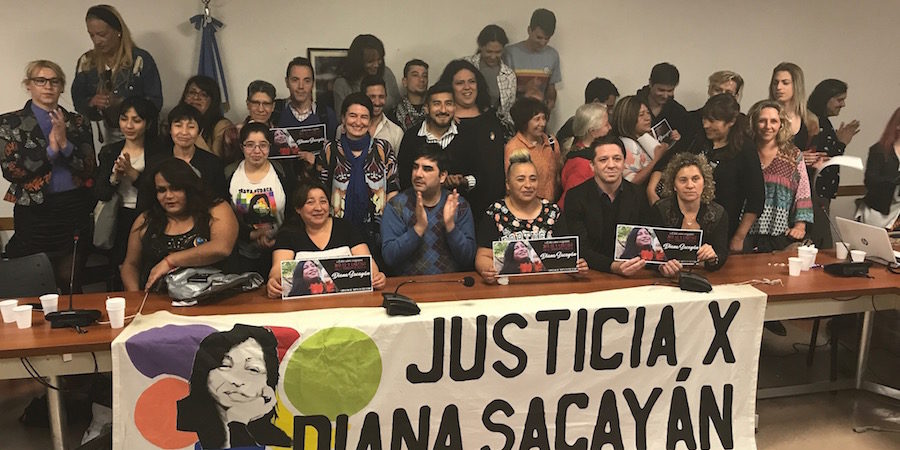
The contrast between the cold, public building room and the emotion of those paying tribute marked the atmosphere of the homage to Diana Sacayán in the Chamber of Deputies. Today marked two years since the murder of the Argentine trans activist, and her family, friends, and fellow activists gathered to remember her and demand justice for her transphobic murder.

Share

By Ana Fornaro
The cold, public building room contrasted sharply with the emotion of those who paid tribute to Diana Sacayán in the Chamber of Deputies. Today marked two years since the murder of the Argentine trans activist, and her family, friends, and fellow activists gathered to remember her and demand justice for her transphobic murder . She was 39 years old when she was found stabbed to death in her apartment.
There is still no date set for the trial, and the case had to be reopened thanks to the activism of the Commission headed by his brother, Sasha Sacayán. There are three suspects and one defendant in pretrial detention. National Deputy Diana Conti (Front for Victory) reiterated her commitment to a draft resolution demanding that the Justice system bring those responsible for the hate crime to trial and punish them.
"Diana fearlessly embraced rebellion," says @martincanevaro of @100_porciento during the tribute to #DianaSacayanPresente in the Chamber of Deputies pic.twitter.com/Ocqm9HYBBu
— Agencia Presentes (@PresentesLGBT) October 11, 2017
The tribute in the Chamber of Deputies is part of a political recognition of a woman who was a “true leader,” as her colleague Darío Arias, from the organization Conurbanos por la Diversidad (Suburbs for Diversity), called her. It is also a strategic location, given that there are several bills—and laws—that are essential for the trans and travesti community, a sector of the population that rarely surpasses the average life expectancy of 40 years in Argentina, where violence and police persecution have intensified.
[READ ALSO: Unpublished interview with Diana Sacayán: “I speak from the politicized transvestite core”]
After a video showcasing Diana's activism—featuring her in action at marches, at the Congress during the passage of the gender identity law, one of her key causes, and in television studios—more than a dozen people spoke in her memory. No one could speak without breaking down. That was the defining characteristic of this tribute, which was less formal and more a collective embrace.
"Diana was in herself a cry for justice," says Representative @knazabal during the tribute to #DianaSacayanPresente two years after her transphobic murder. pic.twitter.com/E18v9gZ7uT
— Agencia Presentes (@PresentesLGBT) October 11, 2017
Congresswoman Karina Nazabal (Front for Victory) announced that a project is underway to declare Sacayán a prominent figure of the Province of Buenos Aires, in addition to working on the repeal of Article 68 of the Provincial Code of Misdemeanors. This article allows the police to repress people engaged in prostitution, and transvestites and transgender people are the most targeted.
"She will always be a role model. This transphobic murder and the profound loss she leaves behind are directly related to the current lack of human rights," says Pedro Paradiso of CHA #DianaSacayanPresente pic.twitter.com/zpm4LbgSJf
— Agencia Presentes (@PresentesLGBT) October 11, 2017
Most of the speakers referred to the urgent need to implement the trans employment quota law "Recognizing is Repairing" bill , which seeks historical redress for transvestites and trans people who are victims of institutional violence.
“We take up Diana and Lohana’s banner of saying that prostitution is not work,” Nazabal said, eliciting applause. And that idea was echoed by other colleagues such as Flor Guimaraes and Representative Diana Conti.
“Their struggle changed my life”
Diana's struggle resonated in many lives that are now a legacy. To bear witness to this, Magalí and Ximena, two trans women from Mar del Plata who were able to escape homelessness and prostitution thanks to the employment quota program, shared their experiences. Accompanied by Claudia Vega from the LGBT association AMI, they recounted their stories.
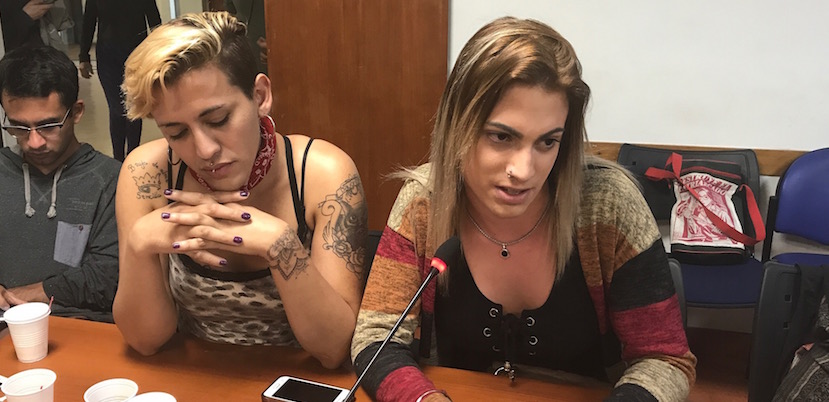
“I didn’t know her personally, but I remember her every day. Because her struggle changed my life. From 18 to 23, I was on the streets and I saw my friends die and I thought: I’m next,” said Ximena Lorenz.
[READ ALSO: Two trans workers selected for the University of Mar del Plata]
Among her family members, behind the flag, besides Sasha, were three of her sisters and her niece Milagros, who listened with tears in their eyes to every memory, anecdote and exhortation to follow Diana's paths while the screen continued to project her photos.
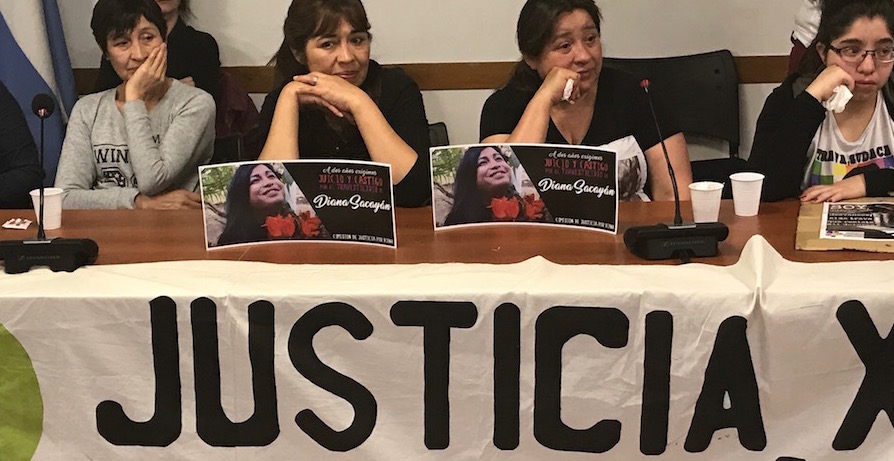
Diana's sisters and her niece Milagros
“I haven’t been able to speak for two years. She fought every single day of her life. If she had to go to the middle of the Ceamse landfill to protest that we were living on top of a garbage dump, she did it. She felt compelled to fight for every cause. She did what needed to be done,” said Martín Lanfranco, a friend and colleague from INADI and the organization MAL (Anti-Discrimination Liberation Movement) created by Sacayán.
Her friends remembered her as a warm whirlwind, a "storm that opened paths with joy," as Congresswoman Conti described her. These sentiments were echoed by the words written by trans activist Lohana Berkins (her close comrade in social activism, who died six months later) after Diana's murder. They were read by activist Alma Fernández, from the Mocha Celis Trans High School.
Let justice be done
The last to speak was Sasha. At times overcome by anguish—two years of sleeplessness, of having a lump in his throat—and at others by calm, his brother focused on the search for justice for his transphobic murder.

Sasha hugs her niece at the end of the tribute
“We mustn’t forget that Diana was a human rights activist, and it’s no coincidence that she was killed. Nothing is a coincidence. We don’t want punishment or prison for no reason. I want justice, even though I know nothing will bring my sister back. And how much we miss her.”
To conclude the tribute, the more than thirty people gathered for a group photo where they shouted once again: Diana Sacayán, present, now and forever. Tomorrow they will meet again at the weekly march of the Mothers of Plaza de Mayo.
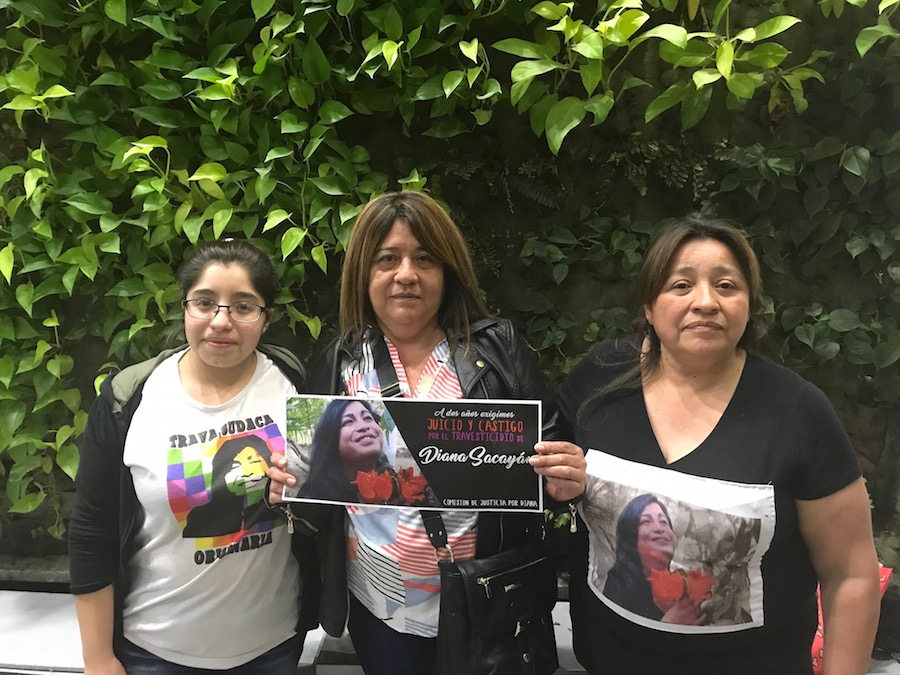
Milagro, Diana's niece, and the sisters Rosa and Gladis.
We are present
We are committed to journalism that delves into the territories and conducts thorough investigations, combined with new technologies and narrative formats. We want the protagonists, their stories, and their struggles to be present.
SUPPORT US

FOLLOW US
Related notes


We are present
This and other stories are not usually on the media agenda. Together we can bring them to light.