

Mariana Gómez testified before the court: "It was a case of lesbophobia."
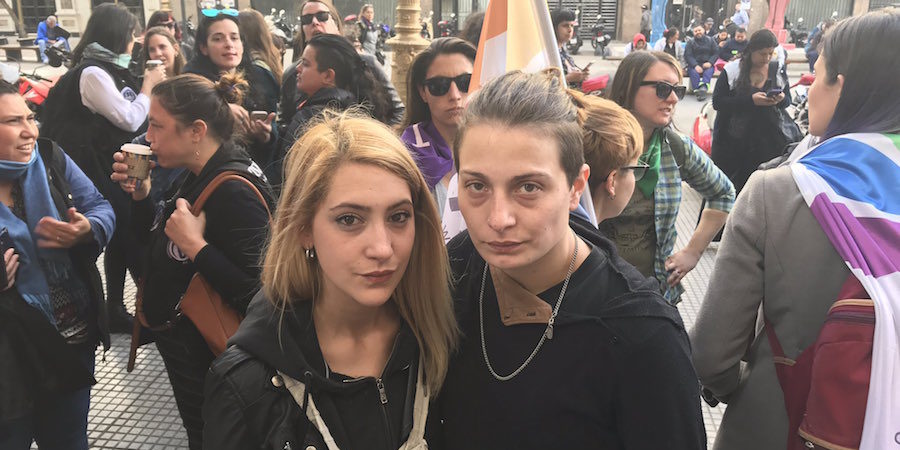
Mariana Gómez (24) and her wife Rocío Girat (23) arrived at the courthouse at 9:30 in the morning to testify in Criminal and Correctional Court No. 45. From early on, feminist and lesbian activists came to support the women.

Share

By Paula Bistagnino and Ana Fornaro. Mariana Gómez (24) and her wife Rocío Girat (23) arrived at the courthouse at 9:30 a.m. to testify in Criminal and Correctional Court No. 45, presided over by Judge María Dolores Fontbona De Pombo, two days after Mariana was assaulted and detained by police in the Constitución neighborhood. From early morning, feminist and lesbian activists gathered to support the women, who left the hearing after midday. Mariana is charged with " assault and resisting arrest, and causing bodily harm."
“They are very scared. From here, we are going to the National Ombudsman's Office's Institutional Violence Program to report the police actions. Their evidence consists of statements from a Metrovías employee and two police officers. We presented Mariana's statement as our initial evidence. They are waiting for the Metrovías security camera footage. The police claim there are no cameras in that area. We are going to collect a number of videos circulating on social media. Currently, there is a forensic medical report confirming Mariana's injuries and contradictory statements from a Metrovías employee and the two police officers who assaulted Mariana,” he told Present Mariana's lawyer, Lisandro Teszkiewicz.“Everyone was smoking at the station, but they only came looking for me.”
On Monday afternoon, Mariana went to accompany Rocío to catch the bus at Constitución station in downtown Buenos Aires. Just then, a storm of rain and hail began. The young women decided to take shelter in the entrance of the subway terminal there. They weren't alone: dozens of people were doing the same. There were also a few other couples who, like them, were laughing, touching each other, or kissing. Many were smoking, too, like Mariana. "But of all those smoking or kissing, we were the only lesbians," Mariana told Present. It all started when a Metrovías employee approached her and asked her to put out the cigarette they were smoking. “When he said that, I told him to show me where it said smoking was prohibited. Because there wasn't a sign. And I pointed out that there were a lot of people smoking there.” Then, according to Mariana's account, the employee went to find a City Police officer—later identified as Jonatan Rojo—with whom he had the same conversation about the cigarette and the lack of a sign. The woman finished her cigarette, put it out, and decided to leave. But as she headed for the exit, the metropolitan police officer stood in front of her, put a hand on her chest, and said, "Kid, stay here or you'll be arrested for disobeying authority."
[READ ALSO: Lesbian arrested and beaten for kissing his wife: police must be held accountable]
“They treated me like a man the whole time. Even though I told him I was a woman, he kept calling me 'kid.' And when he tried to grab me, I told him he couldn't touch me and that he should call a female officer if necessary,” Mariana emphasized. It was then that First Officer Karen Villarroel approached and told her directly to turn her back because she was going to handcuff her. Mariana told her no, that they couldn't arrest her because she hadn't done anything, and she tried to leave. That's when another struggle began, this time between the two metropolitan police officers and the young woman. “We struggled until the female officer grabbed me by the neck—I still have the marks—and the male officer used his arm as a lever and threw me to the ground. Then they both got on top of me: the male officer was pressing his knees against my head and neck and twisting my arms with his hands. And she was squeezing my legs with her knees so I couldn't move.” The sequence was recorded by at least five people who witnessed the entire scene and pleaded with the police to let them go, saying they weren't doing anything wrong. “The police officer told them it was because I was smoking, and those same people replied, 'That's a lie. If I'm smoking too, you're not taking me. Why aren't you taking me, since I'm smoking?'” Despite this, the Metropolitan Police officers continued, handcuffed her, and took her away.
[READ ALSO: #8M Lesbians were repressed and arrested: “it was a police hunt”]
While Mariana lay with her head pinned to the ground, Rocío had a nervous breakdown, seeing that there was no way to stop the police. “She wet herself out of fear and anguish,” Mariana recounted. She added that the people filming were telling her, “Don’t let them take her. Don’t leave her side, or she’ll become another Maldonado” (referring to the young man who disappeared two months ago in Patagonia after a Gendarmerie operation).“I have no doubt that this is a case of lesbophobia.”
Mariana is convinced it was an attack because they are lesbians. “I have no doubt that it’s a case of lesbophobia and that they were looking for an excuse to attack us. That was clear from all the mistreatment we received at every moment,” the young woman said. Besides being addressed with male pronouns the entire time, another act of violence Mariana denounces is that her wife, Rocío, was not allowed to accompany her during the arrest. “When they handcuffed me, she started asking where they were taking me and said she was my wife. Then they asked for her information and marital status. And she said 'married,' but they wrote down 'single' and wouldn’t let her come in the patrol car.” All Rocío was told was that they were taking her to the Metropolitan Police station in the Boedo neighborhood. So, as soon as Mariana was put in the patrol car, Rocío went there to wait for her. An hour and a half later, she still hadn't arrived, and no one was telling her where they were holding her. Meanwhile, Mariana was still in Constitución inside the patrol car with the two police officers who had assaulted her. It wasn't until two hours later, around 5 p.m., that they finally transferred her to the Boedo station.
“I felt violated again”
“After booking me, two female police officers made me undress and squat naked more than three times to check if I had drugs in my vagina… I felt raped again. That’s how we both felt. Me, while they threw me to the ground and stepped on my head, when they undressed me and made me squat. And Rocío, when she saw what they were doing to me and when I told her what they did to me later at the police station,” the young woman recalled, her voice breaking. Both Mariana and Rocío were victims of abuse in their adolescence. Rocío is the daughter of naval petty officer Marcelo Girat, and in 2011 she reported her father to the courts for abusing her during her adolescence, both at home and at the Naval Base. Mariana Gómez was abused by her stepfather, Guillermo Sosa, and by his father, her step-grandfather, Osvaldo Víctor Sosa. Both were convicted by the Oral Criminal Court of Azul No. 1.[READ ALSO: Lesbian activists arrested ahead of #8M, closer to going to trial]
Meanwhile, thanks to the initial publicity given to the case by passersby who witnessed the arrest in Constitución, and later to calls from Mariana's mother, activists from various organizations gathered at the entrance of the place where she was being held to demand her release. “I think it was thanks to the speed of the response that they released me quickly, because first they told my mother and Rocío that they were going to keep me for 15 hours. And then they threatened me that if I didn't calm things down outside, they were going to keep me there all night… And I was in a cell.” Finally, around 9 p.m., she was released.
“Let’s not be afraid to be lesbians”
Rocío, Mariana's wife, also spoke with Presentes to recount her experience: “They targeted her under the pretext that she was smoking, but it's very clear that wasn't the reason. They treated her violently the entire time and repeatedly emphasized, without explicitly saying so, that the problem is that we are women and lesbians,” Rocío said. She detailed how, when she began arguing with the police officer about the absence of a “No Smoking” sign, Officer Rojo replied, “Who do you think you are? That you have all the rights just because you're a woman?” “It’s clear that what bothered them was that we were kissing, touching, and hugging. Because there’s no explanation for that violence, for that arrest, for this treatment. They treated me like a friend, even though I told them I’m his wife, and they wouldn’t take that down. They treated her like a kid. They want us to be afraid to kiss, to hide. Let’s not be afraid to be lesbians: we have to express ourselves as we are and be proud of who we are. We are free, and we are not alone. Let’s not be afraid. Let’s not give them that satisfaction.”The defense of the City Police
Following the media and social outcry over the arrest of Mariana Gómez, especially with the release of several videos showing City Police officers forcing her face to the ground, the institution issued a statement. In it, they explained that «The woman, who refused to put out her cigarette, began throwing punches at the male police officer for no reason (…) He tried to flee the scene, losing his balance after a few meters and falling to the ground. Following this, the female police officer approached, at which point the aggressor grabbed her hair violently. The male officer intervened and managed to subdue the woman, who was visibly agitated and had clear intentions of attacking them. The statement concludes by saying thatThe police managed to control the situation between the two, due to the woman's resistance, and were able to handcuff her. It was only at that moment that they proceeded with the consultation with the secretary of Criminal and Correctional Court No. 45, who authorized the arrest for Assault and Resisting Authority with Bodily Harm. Presentes contacted the City Police, but they stated they would not comment or provide any information beyond what was contained in the official statement, adding that the case against Mariana Gómez is proceeding through the courts. Furthermore, they emphasized that "it cannot be said in any way that the institution harbors any discriminatory attitude toward the LGBT community, and that there are same-sex marriages and transgender individuals within the force," and that they have not yet received any formal complaint against her.]]>
We are present
We are committed to journalism that delves into the territories and conducts thorough investigations, combined with new technologies and narrative formats. We want the protagonists, their stories, and their struggles to be present.
SUPPORT US

FOLLOW US
Related notes
We are present
This and other stories are not usually on the media agenda. Together we can bring them to light.