

The story of Farah, mother of Cuban transvestites: #GaboAward for best text
For this work entitled History of an Outcast, Jorge Carrasco received the Gabriel García Márquez Journalism Award in the text category.


Share

winners for the best Ibero-American productions in text, image, coverage, and innovation were announced
Farah's story was published in El Estornudo , an independent narrative journalism magazine, "made from inside Cuba, from outside Cuba and, incidentally, about Cuba"
By Jorge Carrasco Photos: JC, Almudena Toral and Farah's album The Sneeze Magazine Since Farah likes bad boys, it will surprise no one to learn that both her husbands were released from Combinado del Este prison on the same day. Under the pardon granted by the Cuban government to more than 3,500 prisoners for Pope Francis's visit to Cuba in September 2015, Amed Negro Trujillo and Andrés Bravo Cardenal were acquitted. A few hours after their husbands—as most Cuban trans women tend to call their partners in an emancipatory gesture—were acquitted, Andrés showed up at the San Leopoldo compound where Farah lives. Farah the incontinent, Farah the sex addict. Farah, who is anything but a woman of romanticism and tender fidelity, lay enraptured in the arms of Minguito, one of her passing lovers. Andrés broke down the door. He beat her and he beat Minguito. –They both got tangled up with me, and I ran to the police station shouting “Help!” and “Help!” The people from the neighborhood were shouting at me, “Farah! Stay strong! Keep them both: one for a little while and the other for a little while!”***
Long before she owned sixty wigs, before she became prison fodder, before the man who made her happiest had a knife plunged into her groin, long before she was called Lulu and Farah María, Raúl Pulido Peñalver was born in San Antonio de los Baños—a municipality in what is now Artemisa province—on August 24, 1965. His mother, a beautiful mulatto woman named Ana Julia Peñalver, died of leukemia when Raúl was six. He and his nine-year-old brother, Efrén, were then taken in by their father, Rubén Pulido. A man who was too strict but had flexible morals, he was already carrying on a love affair in Havana while his wife was on her deathbed. When Raúl's mother died, there were no longer any obstacles preventing Rubén Pulido from moving to the capital with his lover, Haydée. He took Raúl with him. Efrén was raised by his maternal grandparents in San Antonio. In the new house – an apartment located on the fifth floor of a building on San Nicolás Street, Old Havana – Raúl grew up like a outsiderHaydée, his stepmother, had three children with Rubén Pulido: Isabel, Iván, and Alexis, all contemporaries of Raúl, whose existence constantly reminded Haydée of the bitter time she had been the second wife of the man she loved. “Sometimes I would take out photos of my mother to remember her, and that woman would have a breakdown.” In second grade, Raúl Pulido received a scholarship to a special education primary school for children with behavioral disorders, where social cases abounded, mostly children orphaned of both parents. The school was located on the outskirts of the city, near Lenin Park, remote enough for Haydée and her family to remain unaffected by the troubled boy's problems. He was only allowed out on weekends. His father didn't pick him up most of the time, and often a teacher would take pity on him and take Raúl home. Other times he would run away to the woods with the boys they also didn't come to pick up, and he'd spend the weekend messing around in the fields on the outskirts of town. Although his grades were excellent, the teachers emphasized certain gestures, certain inflections in his voice, certain worrying traits in a young boy. In a school where every student was special, Raúl Pulido was already the center of gravity of his little world. The school, you could say, orbited around him, and in the middle of it all was him, seven, eight, nine, ten, eleven years old, a boy who danced femininely, who was a show-off, who gestured everything a little boy wasn't supposed to gesture. "The teachers would scold me, and I'd tell them, 'Don't tell me not to gesture anymore. I'm nine years old, but I'm already gay. And I'm going to be gay until the last day of my life.'" On weekends when Raúl was brought over, Haydée, a sort of building manager, received constant complaints from the neighbors, who hung their sheets and towels out to dry on the roof. White sheets and towels. Clean sheets and towels that the mischievous Raúl Pulido would take down from the clotheslines to wear as dresses, to invent wigs, and to parade provocatively on the same roof, leaning out over the street to blow kisses and wave to his imaginary audience, a group of neighbors below who, scandalized and red with fury, watched their belongings flapping in the air. Raúl Pulido finished elementary school amidst the stains on his record—where wise teachers wrote altruistic and admonitory paragraphs that future teachers would read about the wayward boy's twisted behavior—and the beatings from his father, who could no longer tolerate the rebellion of his son, who was beginning to tarnish his family's image. “My dad used to beat me so much for those pranks that one day I climbed onto the roof of the building and almost jumped. The police came, everyone came, and I was screaming that I was going to jump. My brother Iván was the one who managed to get me down.” At twelve years old, when Raúl Pulido started high school at a vocational school on Manrique Street in Old Havana, his situation at home had become intolerable for Rubén and Haydée. In addition to his pranks in the building, Raúl began dancing in the street to the latest songs, running errands for neighbors, and cleaning houses to earn his own money. He slept away from home regularly, started hanging out with other gay men, and—most seriously—one day he showed up at high school in a girl's uniform. A classmate lent him a skirt and a blouse. Raúl parted his hair into two daring bobs and showed up like that for the morning assembly. “Imagine,” he said, “me in the girls' line and everything.” A huge rumor and scandal erupted. They took me to the principal's office and sent for my father. Not only my childhood, but also my adolescence, were spent away from home, going from one reform school to another. Since insubordination has never been rewarded with applause, from the age of twelve, Raúl never slept inside the house again. The "venting room" was the most drastic punishment. More drastic than the beatings with the slipper and the belt, because those blows hurt, but they didn't last long. In the hallway, next to the apartment where the family still lived, Raúl Pulido, the wayward puppy, was locked in at night. Inside there was a sofa, a sink, a toilet, and a shower that he used to bathe. He began to suffer asthma attacks because of the dampness of the place, and some concerned neighbors advised Rubén and Haydée to take the boy out of there.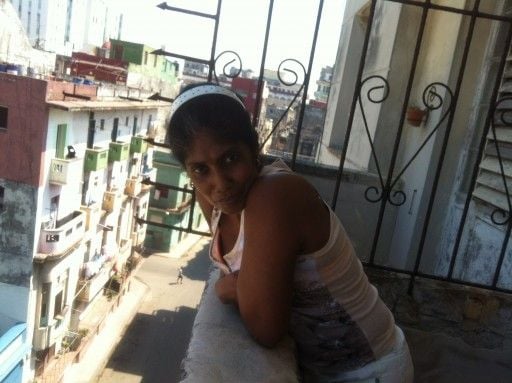
Isabel Pulido, Farah's sister / Photo: Jorge Carrasco
***
Jorge “La Reglana” was a fat, Black man with a glass eye and a dreadful reputation. Homosexual. Santero. Son of Yemayá. Addicted to drugs like Dexactedron and Parkinsonil, Jorge “La Reglana” crossed paths with Raúl Pulido at a critical moment. He dried his tears, and the rest happened quickly: Jorge, who had no children and lived alone on Lagunas Street, just six blocks from the Pulidos, agreed to take custody of Raúl if his father allowed it. The father said yes, of course. He removed him from the ration book and felt relieved. Haydée would die a couple of years later. Jorge was like water in the desert. He gave Raúl a roof over his head. He tried, unsuccessfully, to change his last name. He called him “son,” just as Raúl called him “father.” But Jorge didn't work; he lived off his business, selling hallucinogenic pills to the desperate souls of Central Havana, and Raúl had to start dancing in the streets again, cleaning houses, running errands for the neighbors in the new neighborhood. "Was Jorge good to you?" "So-so." "Why?" "Because he was a very strong homosexual." "Did he hit you?" "He only slapped me once, because I disrespected him. I was very outspoken. He didn't hit me, but he was a very strong man, and he didn't like me doing bad things. He was good and he was bad. Sometimes he kicked me out of the house, and I had to go out on my own. Then he'd take me back." Teresa, a neighbor who has lived for more than ten years upstairs in the house at "La Reglana," Raúl's new home, remembers: "Jorge wouldn't move from his chair, and yet he never lacked food or cigarettes." When the boy didn't bring money or things home, he mistreated him quite badly. He used him, as many still do. But he was the one who raised him, who took him in when he was rejected at home. Around that time, the late seventies, Raúl Pulido left the house for the first time completely dressed as a woman. "I went out onto the streets in a quinceañera dress someone had lent me. People were scandalized. You know how people were back then." After that step, there was no reason for Raúl to continue using his real name. He thought it was better to forget his own name, to wall up that part of the dark pit that was his short past, and start over. When the streets of Central Havana began to feel too small for him, people started calling him Farah María, after a Cuban singer who became popular for her flirtatious verse, "I don't swim in the Malecón, because there's a shark in the water." Singing that little song earned Raúl a few pesos on the streets of Havana, and one day he decided he had to get rid of Raúl. Farah, on the other hand, was a divine name.***
Farah, in a treacherous whisper. In a voluptuous brush of upper teeth against lower lip. FARAH—with its sophisticated H at the end—was the very name of success. Nothing bad could happen to someone named Farah.***
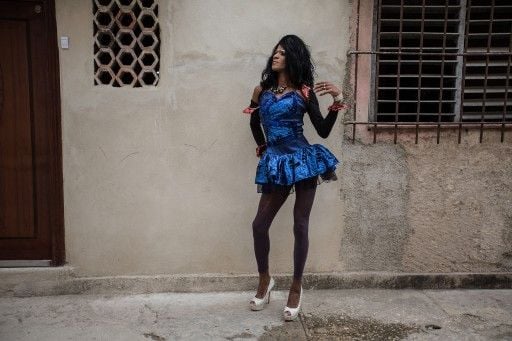
Photo: Almudena Toral
***
In the mid-2000s his record Her criminal record was clean. As far as possible, Farah was happy. She had gone almost ten years without being arrested. The police no longer worried about her as they once had. Eusebio Leal, the Historian of Havana and something of a lenient guardian of the city's historic center, issued a document around 2005 prohibiting the authorities from arresting Farah for dancing publicly and flaunting her homosexuality in the city's tourist district. Eusebio Leal made her untouchable. In the document, he calls her a "local character." Farah had transitioned, through constant taxation, from social pariah to picturesque character with legal safe passage.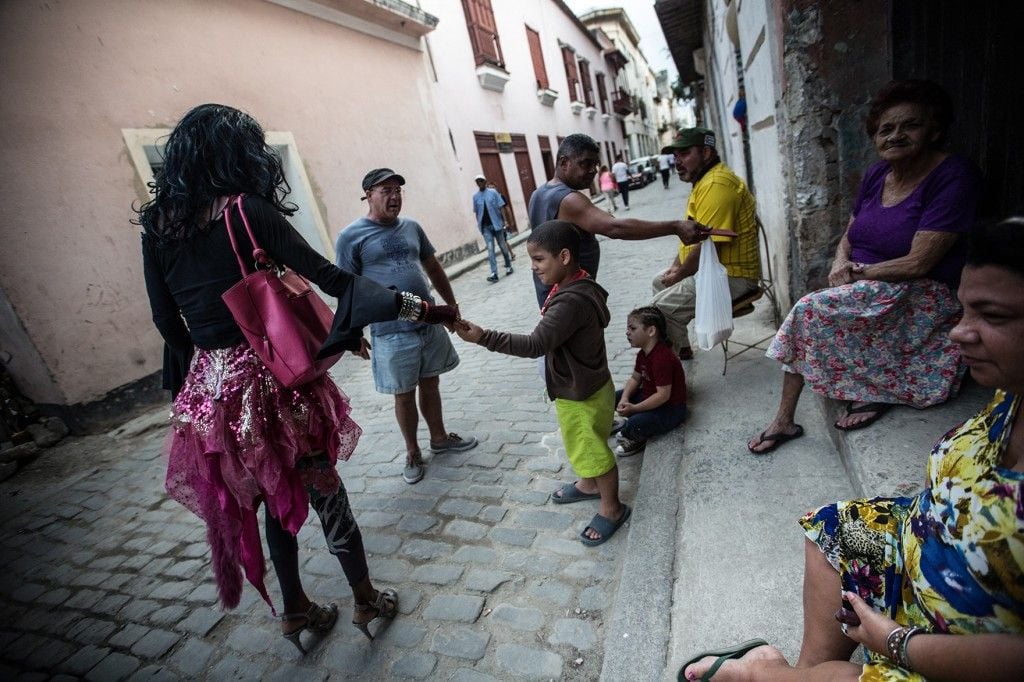
Photo: Almudena Toral
***
On December 29, 2008, as dusk fell and Farah was out hustling for money on the streets of Havana, Santiago was cooking a pot of black beans. Sandro, Jorge's partner at the time, added a ladleful to the pot, which Santiago didn't like. Santiago and Sandro came to blows, and in a matter of seconds, Sandro had plunged a knife into his opponent's groin. Teresa heard Jorge shouting, "You killed him! You killed him!" The whole neighborhood erupted in the brawl. Minutes later, Farah arrived home from the street, made up and happy about the good day she'd had.***
Five years of relationship cut short in one fell swoop. The end of Santiago Sánchez López. The end of the story.***
Two years later, in 2010, Jorge died from cirrhosis of the liver due to the abuse of the medications he was taking. “I took care of him until the end. After dancing in the street and hustling for money, I would buy food, cook it, and take it to him at the hospital. The day he died, I was at home resting. I had just finished bathing him at the hospital. Three days before he died, we talked, and I forgave him for all the hardship he had inflicted on me. Alone again. I rarely saw his father, and when they did cross paths in the neighborhood, each acted as if the other wasn't there. I hardly ever saw his brothers. Iván had been in prison for some time in Orlando, Florida, for drug trafficking. He sent me two hundred dollars once. The house had been reduced to a small room for rent, after Jorge gradually subdivided it into smaller rooms that he sold to immigrants and other marginalized people.” “I became very depressed after Santiago and Jorge died, and I started to avoid the room. I began spending more time on the street looking for a partner.” Elio Medina is a gay Santería priest who lives in another neighborhood a couple of blocks from Farah. He met her when Jorge was still alive, grew fond of her, and became a kind of friend and spiritual guide. Elio recounts: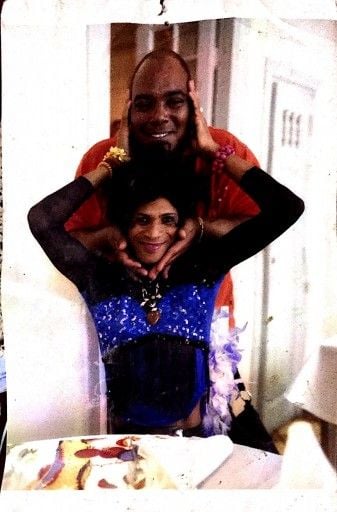
Farah with Elio Medina / Photo: Courtesy of Farah
***
From Santiago Sánchez López to the present day, several pimps have vied for custody of Farah, a kind of golden goose. Consumed by her need for affection and her low self-esteem, Farah is capable of enduring almost anything—from humiliation to beatings—just to avoid spending the night alone. As you might expect, anyone who wants something from her—a roof over their head for the night or for a while, a plate of food—only needs to be moderately cunning to tell her what she wants to hear. Farah turns a blind eye, deceives herself, and tries to deceive the few who care about her, claiming that at fifty years old she has young men eating out of her hand, until the lies come to light and the relationships—if we can call them that—become untenable. The most significant of the last ten years, in particular, began with Vladimir, nicknamed "Death," a fumigator by trade. "Why did they call him Death?" "Kid, because he was a gorgeous little white boy with blue eyes. The best." But as beautiful as he was, he was poison inside. He was like Chucky, the killer doll. Farah went to live with Vladimir “La Muerte” in a makeshift room they rented on the outskirts of San Miguel del Padrón. She adapted to the isolation of the periphery. She quickly became the place's servant. She scrubbed, cleaned, tidied, and danced in the neighborhood to earn money to buy food. “Everything was rosy until he started stealing my money. When I tried to leave him, he would beat me and threaten me.” To get away from Vladimir “La Muerte,” Farah found another pimp. She would be with Amed Negro Trujillo for five years. They met one night in Fraternity Park. Amed asked her if she was Farah, the famous one. She said yes. That day, after playing hard to get—she claims—they went together to the room in San Leopoldo. “I made him a ‘whore's meal’: plantains, tomatoes, rice, and a fried egg. We had sex.” We got along well, and so on and so forth. Amed was epileptic and a pill addict. When the two were on, Farah had to run far away, because a beating was guaranteed. He was arrested several times for hitting his adoptive grandmother, for disorderly conduct, and for threatening with a knife. Farah herself would sometimes report him for theft or physical assault, only to withdraw the complaint a few hours later. Every time Amed was arrested, Farah would go—sparkly heels, a gaudy dress, scooters—laden with bags of food, to see her husband in prison. When Amed was released on furlough, he stayed at her house. And she provided for him. On one of her visits to Amed, another prisoner started keeping tabs on her. Andrés Bravo Cardenal, alias “El Diente” (The Tooth), who was in jail for robbery, was released on furlough one day and bumped into Farah at a fried food stand. “It was cold.” I was eating a sandwich and he asked me to buy him one. I did. We started talking and I told him I was tired of Amed, that he beat me a lot. He wanted to walk me back to the neighborhood, he was going to drop me off at the corner, because Amed was at my house, also on a day pass. The end of the story is that Andrés ended up coming into the house. I said he was my cousin. And Amed said, "What cousin? He's in prison with me!" So I declared, "Well, from now on he's my husband." Man, it was five in the morning and they started fighting over me. The police had to come.
Initials of Andrés, one of her husbands / Photo: Jorge Carrasco
***
“I’m the kind of gay man who likes to attract attention. The more extravagantly I dress, the more confident I am. When people shout ‘Farah, bitch, tough, diva, you’re the one!’ at me in the street, I feel fulfilled. A magazine said I had real balls for going out into the streets dressed as a woman without a care in the world. When I was young, I was a gorgeous gay man. Look, I’m fifty years old now, and I still look stunning.”
Photo: Almudena Toral
***
In March 2016, Farah's home is the same four-by-four-meter box she inherited from Jorge "La Reglana" in the San Leopoldo neighborhood. The smell, as soon as you cross the threshold, connects you to the misery and marginalization in which her life unfolds. The nauseating stench of a poorly ventilated place that is cleaned infrequently and with little care. Photo: Almudena Toral
-
Photo: Almudena Toral
-
Photo: Almudena Toral


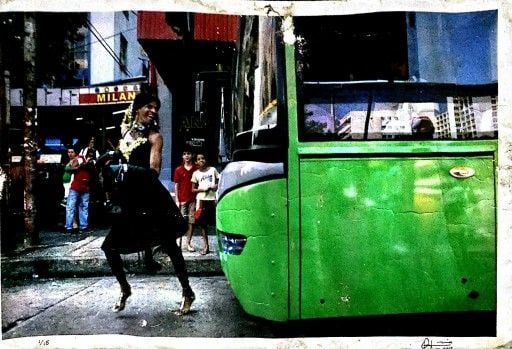
Photo: Courtesy of Farah
***
Elio Medina has an interesting theory. And according to this theory, Farah is protected by something supernatural. –It's not normal that she's still alive with everything that's happened to her"She says. In matters of faith, Farah follows the pattern of convenience. If Jehovah's Witnesses are making donations, she becomes a follower of Jehovah's Witnesses. If Seventh-day Adventists give her a pamphlet explaining the historical evidence that Jesus existed, she might become one of them. If she's in dire straits, she asks Elio to intercede for her with Oggún or Elegguá, and then entrusts herself to the deities of the Yoruba religion. In the same year, she was stabbed twice (it was in the 2000s, but she doesn't remember the exact date, and neither does anyone close to her). The first time was during a fight in a bar on Águila Street, from which she emerged with an awl stuck in her stomach. Surgeons had to cut her open like a pig to make sure the weapon hadn't damaged any organs. There are several versions of the second stabbing." According to Farah, it was an accidental cut, sustained in another fight between homophobic youths who had attacked gay men gathered in Fraternity Park with knives. According to Elio Medina, she was in Chinatown and was cut for intervening in a fight. According to Isabel Pulido, the cut was inflicted by a man with whom she had made unwanted advances. Whatever the true story, all versions end with the same scene: Farah, with the edge of a machete embedded in her neck. Farah's body, locked away in the morgue of the Carlos III emergency hospital.***
They presumed her dead. At the funeral home on Zanja Street, her neighbors and friends (never her family) awaited the body, the place filled with wreaths made of cloying gladioli, wrapped in paper bands that read things like “Rest in peace, Farah.” Upon arriving at the hospital with her throat slashed, Farah suffered catalepsy (a condition that would accompany her for the rest of her life), which consists of the temporary loss of vital signs, to such an extent that doctors assume the patient is dead. Scientific investigations such as the one published in the British Journal of Medicine In 1876, catalepsy was defined as a “neurological episode associated with patients suffering from schizophrenia, hysteria, and even melancholy.” Edgar Allan Poe's story Premature burial (The Premature Burial), reviews apparent cases of catalepsy in people who were buried alive. Locked away in the morgue, Farah lay with a tag tied to her big toe. The tag read Raúl Pulido PeñalverSince Farah's sanity exists primarily within her own imagination, stories like this need to be corroborated. Elio Medina confirms his friend's account: "The funeral home was packed. She showed up with a bandage around her neck, an IV in her hand, and wearing a hospital gown. When she arrived, people started screaming and fainting." She tells it much better: "The cold air from the refrigerators woke me up. I made such a racket that they came to drag me out. There was a huge commotion. They told me that the funeral home in Zanja was waiting for my body. I threw a rag over my head and escaped. I ran out into the street, and a young man took me to the funeral home in a bicycle taxi. I arrived and started screaming, 'I'm not dead. What is this?!' I ripped the wreaths off the walls and threw them on the floor. Then they took me back to the hospital." Some claim that the doctor who removed her from the morgue had been under psychiatric treatment for several years.***
Someone who hasn't lived in Havana might think that the neighborhood has accepted Farah naturally, that the neighbors are friendly, that everyone loves her, and certainly Farah does nothing but leave the tenement and everyone who crosses paths with her shouts phrases that she greatly appreciates, such as: "You're the only one!", "You look splendid today!", etc., etc.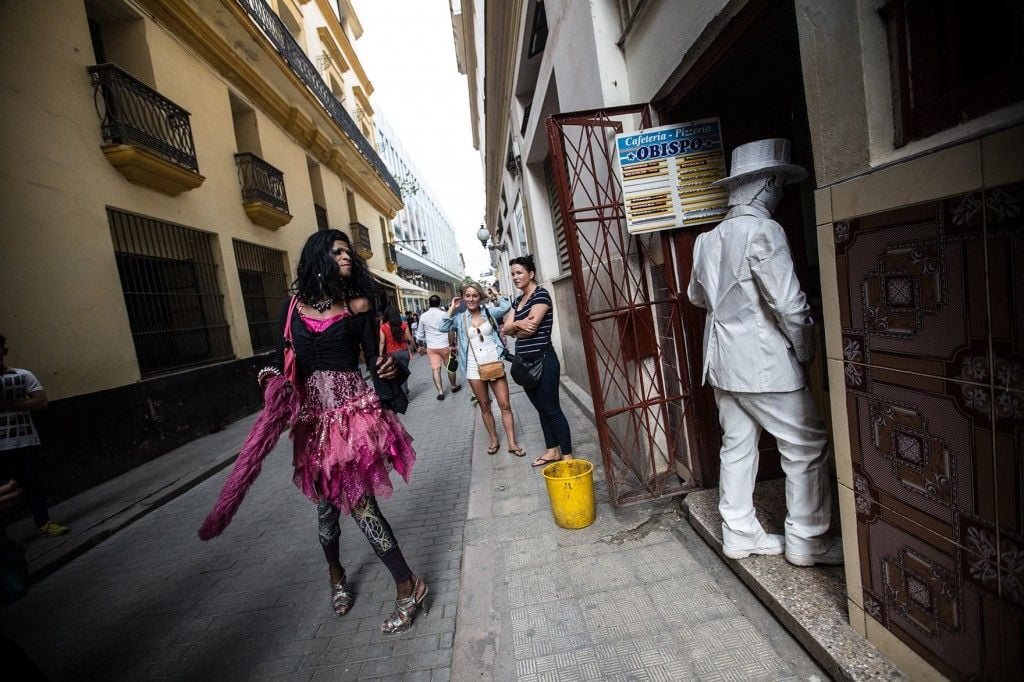
Photo: Almudena Toral
***
The last time Farah saw her father, she had gone to the building on San Nicolás Street to visit some neighbors. “He said to me, ‘What are you doing here?’ I told him he wasn’t the owner of the building. It was awful. Now he’s sick with blood pressure or heart problems. I don’t know. I walk past him and it’s like he doesn’t exist. Legally, I have a right to that house, but I don’t want anything to do with it.” “What would you do if your father needed you someday?” Farah shakes her head to say NO, without having to open her mouth. “When I was stabbed and almost died, he never came to see me. I have no feelings for him.”***
On Tuesday, March 1st, at noon, Teresa's phone rang on Lagunas Street in the San Leopoldo neighborhood. Someone answered. "Hello Teresa, Farah gave me this number in case I needed to reach her. Would it be possible to speak with her?" "Farah has been hospitalized since January 12th at the AIDS Sanatorium in Santiago de las Vegas."***

Farah at the sanatorium / Photo: Jorge Carrasco
***
Friday, March 11, 2016. Second visit. Farah received a call from Teresa and had to leave the previous weekend, from Saturday to Tuesday. Amed, one of her exes, kept the key to the house and, upon learning that she was in the Sanatorium, took the liberty of renting it to a group of gay men who caused a stir in the neighborhood for a few days. “When I arrived at the house, it was a brothel. Amed had a bunch of gay men crammed in there, having sex all day long and shouting. A neighbor went to tell them off, and they threatened to throw boiling water on him. In the end, we called the police and were able to get them out.” Farah packed up her few belongings and stored them with the neighbors because Amed, lacking anything valuable to steal, had sold her two mannequins she kept as decorations in the living room. After putting a padlock on the door and barricading it with a couple of wooden slats, she checked back into the Sanatorium on Tuesday the 8th. Back in prison, depression set in. While on leave, she met another young man in Old Havana. “I have great luck with men. I was on a roll this weekend. I ran into this gorgeous mulatto, and he asked for my address. I told him I was in jail and had just been released. ‘I’m in jail because I assaulted a guy and stabbed him,’ I told him. ‘You know I’m quick-witted.’” During a short walk through the Sanatorium, she tells several patients she’s connected with who came to see her from the streets, “What’s tough is tough.”***
Tuesday, March 15, 2016. Third visit. Fed up again. She insists her life is on the street, dancing. That she's had enough, that they've finished the penicillin and the syphilis has cleared up. "I packed two suitcases with all my things and I'm leaving tonight. I'm taking my partner home with me. We're leaving this horrible place together."***
A week after having him live in the house, the twenty-something who infected her with syphilis at the Sanatorium began to reject Farah's caresses. At this point in her life, so tired of begging for affection, she didn't insist. She was fed up with him, packed up his belongings, and threw him out onto the street. "After all, I can afford to choose, because I'm the artist." In March 2016, Farah's main phobias continued to be heights and loneliness. She had a dog named Miseria, a loyal dog who died under the wheels of some truck. Miseria was replaced by Canelo, just as emaciated, because Farah wanted them for company but rarely gave them a plate of food. "They have to learn to fight on the streets. If I do it, how can they not?" In March 2016, Farah weighed fifty kilos distributed across a body that stood over six feet tall. Thin and long like a broomstick. Arachnid. A fake mole tattooed between her eyebrows. In her mouth, only two teeth are hers: two half-closed hooves clinging to her lower jaw. On top, the aligned, fake pieces of a prosthesis. In her fantasy of glamour and stardom, a diva with only two teeth is still a diva. [READ MORE: Being trans and living on the street: Yhajaira's story]Share
We are present
We are committed to journalism that delves into the territories and conducts thorough investigations, combined with new technologies and narrative formats. We want the protagonists, their stories, and their struggles to be present.
SUPPORT US

FOLLOW US
Related notes



We are present
This and other stories are not usually on the media agenda. Together we can bring them to light.