

Pride, pain and demands on the State at the 14th LGBTI march in Paraguay
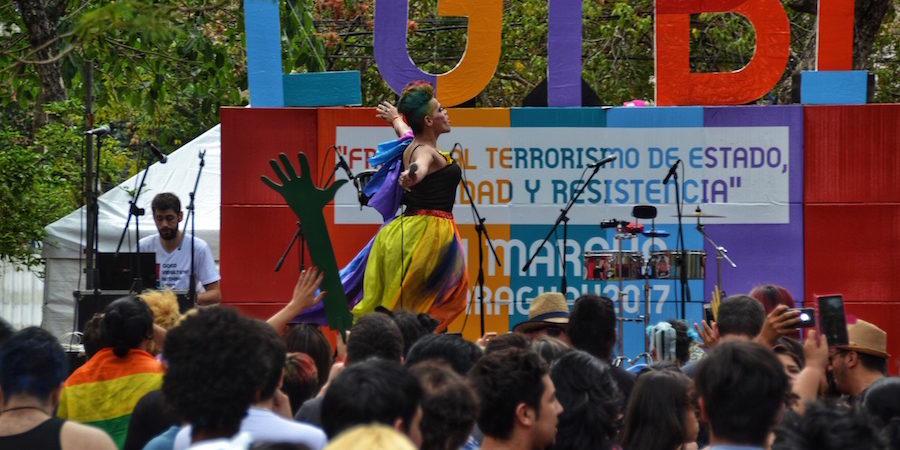
This year's mobilization took place in a context of growing hatred in the country against what conservative sectors call "gender ideology," and today's slogan was "against state terrorism towards LGBTI people."

Share

By María Sanz Domínguez, from Asunción.
Photos: Jess Insfrán Pérez. The 14th march for LGBTI rights was held today in Asunción with a large and diverse turnout. It was joined not only by sexual diversity organizations, but also by student groups, feminists, and human rights defenders. From the Antequera Steps, an emblematic site of trans resistance, to the central Plaza O'Leary, hundreds of people marched this afternoon amidst chants, drumming, and artistic performances. This year's mobilization takes place against a backdrop of growing hatred in the country against what conservative sectors call "gender ideology," and today's slogan was "against state terrorism towards LGBTI people." Amidst dancing, testimonies, joy at taking to the streets, and sorrow for an unjust past and present, the nearly 60 murders of transgender people in Paraguay since 1989 that have gone uninvestigated . Mention was also made of the prohibition against incarcerated lesbian women receiving visits from their partners in prisons. And one of the most resonant issues was the arbitrary arrests of transgender women and gay and lesbian couples.
[READ ALSO: She is trans and was tortured in a police station: after filing a complaint she was released]
“We receive reports of arbitrary arrests all the time. They are couples of boys or girls walking down the street holding hands, and they are arrested and taken to police stations,” he told Present Carolina Robledo, from the organization Aireana - Group for the rights of lesbians.A date and a number
For the past fourteen years, every September 30th, dozens of LGBTQ+ organizations have chosen this day to celebrate diversity. The chosen date coincides with "Letter from an Immoral Man," an anonymous document defending sexual diversity published by a Paraguayan newspaper in 1959. That letter was written two weeks after mass arrests of people “suspected of being homosexual.” In fact, that same newspaper had headlined an article saying that “108 people of dubious moral character” had been arrested in connection with one of the cases. Satirical media outlets of the time began playing with the number 108, and that's how the number began to be used as a pejorative synonym for homosexual. Today, the number is a symbol of pride. But not all organizations marched today. Somosgay and Lesvos joined the march in early July. the international call for Gay Pride, which recalls the riots at the Stonewall Inn in New York - which occurred in 1969, ten years after the publication of the "Letter of an Immoral Man" in Paraguay.
An offensive from the Government
“We are fed up with the hypocrisy and moralistic discourse of a sector of society that condemns other ways of existing that do not conform to the heteronormative, conservative model, and that does not question the existing violence against groups made vulnerable by discrimination and social stigma,” Aireana added. In recent weeks, several television personalities and organizations Ultraconservative groups in Paraguay issued hate messages against the LGBTI population. This followed the dissemination of a WhatsApp audio message that discussed the alleged "imposition of gender ideology" on students in schools. In response to the controversy, The Paraguayan Ministry of Education itself ordered the removal the content related to “gender” in the curriculum. The organizations also criticized the fact that high-ranking officials in the Paraguayan government are “brought in directly from the Stroessner dictatorship.” They highlighted the case of dForeign Minister Eladio Loizaga, who says that There is no homophobia in Paraguay."and openly leads international spaces where members of the LGBTI community do not have rights," the groups stated in their manifesto.
 Chiara, a trans woman from the city of Coronel Oviedo (about 140 kilometers east of Asunción), agreed with González. She marched, for the third year in a row, wearing a striped dress, mimicking a prison uniform, and adorned with chains and padlocks. “We trans people feel like prisoners because our rights are denied. I think the law against all types of discrimination, and the law on gender identity for trans people, must be passed,” she told Present.
[READ ALSO: Paraguay assumed an active role against LGBTI rights at the OAS Assembly]
Humberto, a transgender man, echoed these same legal demands, lamenting the lack of visibility of trans men in these demonstrations. “Trans men tend to go a little more unnoticed (than trans women). That's why we have the advantage of not being bothered, and of living as a 'genderless' person, in quotes. And there are many young men with their heads down, afraid to show themselves, afraid to say that they are young men fighting for their rights. We are few who make ourselves visible, but we are here,” he affirmed. Another group that also demanded greater visibility was that of bisexual people. “Sometimes we don't feel as much discrimination or we go more unnoticed. But often, when you have a partner of the opposite sex at a certain point, you are no longer considered part of the LGBTQ+ community,” emphasized Alejandra Sosa, a bisexual woman and activist with an organization for sexual and reproductive rights. And Cesia Benítez, a representative of the high school students and also bisexual, added: “We are an important force within the LGBTI community.”
The main demands
At the end of the march, the organizations summarized their main demands in a joint manifesto: -Approval of the “Julio Fretes” law against all forms of discrimination. Paraguay is one of the few countries in South America that lacks this type of legislation. despite international recommendations. At the end of 2014, the bill was rejected in Parliament due to the fears of conservative lawmakers that it would legalize same-sex marriage, which is not permitted in the country. -Study and urgent approval of a gender identity law. This is yet another debt Paraguay owes to transgender people. Currently, only one person, activist Yren Rotela, has managed to have her chosen name recognized on official documents, in accordance with an article of the Paraguayan Constitution regarding the right to identity. However, The prosecution appealed this court ruling. -Declaration of September 30 as National Day for LGBTI Rights, in memory of all the LGTBI people persecuted during the Strom dictatorship. –Legal recognition of sex work exercised by adults who do so voluntarily. -Compliance with Regulations for private visits in prisons across the country, which makes no distinction based on the sex or gender of the person. Aireana reports that this regulation is not being followed. In the case of lesbian women incarcerated in the Buen Pastor prison, who are not allowed to receive private visits from their partners.Stop the violence and the fear against LGBTI people in Paraguay.]]>
We are present
We are committed to journalism that delves into the territories and conducts thorough investigations, combined with new technologies and narrative formats. We want the protagonists, their stories, and their struggles to be present.
SUPPORT US

FOLLOW US
Related notes

We are present
This and other stories are not usually on the media agenda. Together we can bring them to light.