

There is a lesbian in my campaign for legal abortion
"It is necessary that the activism for the right to free, safe, and legal abortion begins to be a place where lesbians and trans people are welcomed, valued, and empowered," says lawyer and activist Luciana Sánchez.

Share

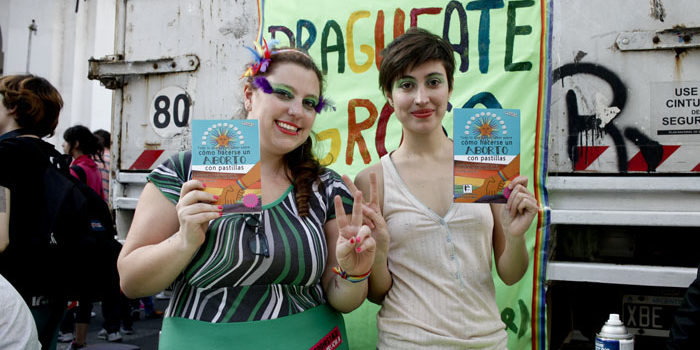
By Luciana Sánchez* Photo: Gisela Volá, Cooperativa. For lesbians and feminists for the decriminalization of abortion, 2012. Many feminist activists cling to abortion as if it were the last bastion of heterosexuality within the women's movement. And they exclaim, when they see us arrive: But HOW! Here TOO? And yes, lesbians are everywhere. There's a lesbian in my Campaign for abortion rights. And even more: there are lesbians outside the campaign for abortion rights, and we still advocate for abortion rights. Lesbians face many risks in our lives, every day. We earn less money; we have less access to formal employment—especially sex workers; Young lesbians are pathologized by their families and social circles as if they were going through “a phase.” Lesbian couples are constantly harassed in the street, in places of entertainment, and at marches. In 2017, at three marches—March 7th, March 8th, and the Jones Huala release march—the police fabricated charges against some thirty lesbians in Buenos Aires alone. It wasn't a “witch hunt against women.” It was a “witch hunt against lesbians.”
Deleted from the campaigns
Lesbians are at greater risk of experiencing obstetric violence, and medical violence in general. If we are trans lesbians, the risk increases much, much more. In popular culture, lesbians are constantly confused with and juxtaposed to bisexual women (Flozmin being the most recent example). However, lesbians are erased from feminist campaigns and actions against street harassment, for equal pay, workplace inclusion, institutional violence, and sexual and reproductive rights. We are required to be feminist activists with apologies, apologies, and thanks. In eight years of lesbian and feminist activism for the decriminalization of abortion, I have heard various pretexts for this exclusion: "What do lesbians have to do with abortion?" “Lesbians in favor of abortion is obvious; Catholics for abortion seem much more radical…” “Abortion, lesbians, and decriminalization—all ugly words in the same sentence… they’re not going to get anywhere…” Any excuse will do, ultimately, to question the association, the link, between something as popular and widespread as abortion, and something as popular and widespread within feminism as lesbianism. The objective of this visibly excluding lesbians from feminism and from “lesbian issues” as frontline causes to fight for is to accommodate the movement so that men—cis, bi, straight, gay—can feel comfortable within it. The comfort of trans men doesn’t seem to be of great importance either. Here, it’s worth considering how cis lesbians contribute to the reification of heterosexuality within feminism through transphobia.Subjects who “do not have abortions”
The field of activism for legal, safe, and free abortion proves fertile ground for transphobic practices, marginalizing the contributions of those who embody subjects who supposedly “do not have abortions.” Likewise, many cisgender lesbians are willing to uphold transphobia within the feminist movement, and particularly within the fight for abortion rights. It would be worthwhile, as a collective practice, for us to work systematically and in an organized manner on these practices and the prejudiced constructs upon which they are based and reproduced. The objective of transphobia is to adapt the feminist movement to the gender binary, entrenched in the structure of political representation and the exercise of power. When we practice transphobia, lesbians are profoundly functional to the heterosexist patriarchy we claim to combat, in addition to perpetuating and reinforcing negative stereotypes about lesbians. Perhaps some feel more like lesbians for “hating” transvestite and trans sisters, particularly in the face of cisgender women who are the object of their cisgender desire.How to end the hunt
But certainly, framing the struggle around the dogma that “the lives and existence of lesbians are endangered by transvestite and trans women” is as absurd and grotesque as saying that feminism and the right to abortion lose momentum and popularity if they also prioritize the participation of lesbians. Transphobia doesn't come only from lesbians, and lesbophobia doesn't come only from men. In 1969, Betty Friedan coined the term “violet menace” to designate lesbians within feminism and exclude them for their “manly behavior,” “hatred of men,” and “being distracted from the struggle by thinking about sex.” Betty died in 2006, and the vast majority of the lesbian feminist colleagues she excluded outlived her and are successful writers and screenwriters in Hollywood—all white, it should be noted. But the hunt for lesbians, in particular the hunt for trans women, is not yet over. Heterosexual feminists and cis lesbians must ask themselves why they are determined to continue with this witch hunt, and stop thinking primarily about how to "not scare" cis men and cis women into feminism. It is necessary that the activism for the right to free, safe, and legal abortion begins to be a place where we are welcomed, valued, and empowered to challenge this lesbotransphobia.. *Lesbian and feminist lawyer. Abortion hotline: more information, fewer risks: (11) 6664-7070- ]]>We are present
We are committed to journalism that delves into the territories and conducts thorough investigations, combined with new technologies and narrative formats. We want the protagonists, their stories, and their struggles to be present.
SUPPORT US

FOLLOW US
Related notes
We are present
This and other stories are not usually on the media agenda. Together we can bring them to light.