

Susy Shock: “All failures are due to clinging to the binary.”
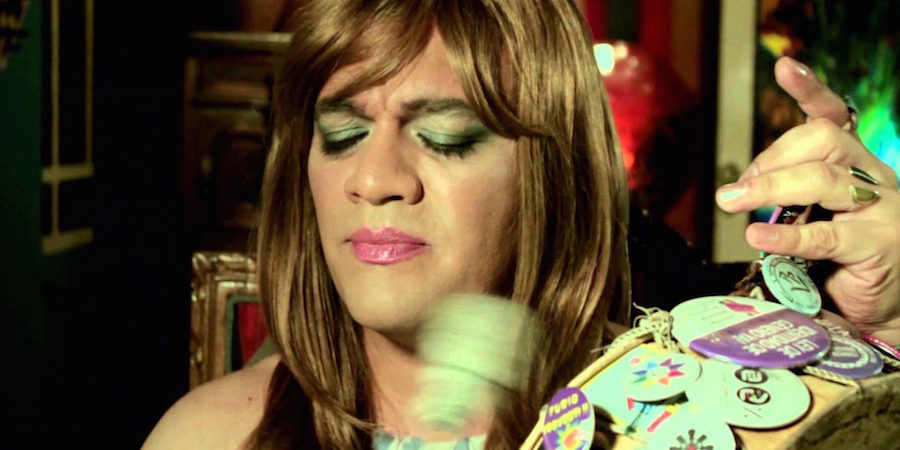
A trans South American artist and hummingbird, poet, folk singer, performer, teacher, activist. Her phrase “I claim my right to be a monster! Let others be normal!” has become a banner, a t-shirt, and even a quote from the American queer theorist Judith Butler.

Share

A trans South American artist and hummingbird, poet, folk singer, performer, teacher, activist. Her phrase “I claim my right to be a monster! Let others be normal!” has become a banner, a t-shirt, and even a quote from the American queer theorist Judith Butler. By Paula Bistagnino
I reclaim my right to be a monster
neither male nor female
neither XXI nor H2O
I, monster of my desire
flesh of each of my brushstrokes
blue canvas of my body
painter of my journey
I don't want any more titles to load.
I don't want any more positions or boxes to fit into.
nor the right name that any Science reserves for me (…)
Excerpt from "My Monster" (Trans Pirado Poetry Collection, 2011)
-South American trans artist, hummingbird, monster, neither male nor female, neither XXY nor H2O… How did you become Susy Shock?
I am a construct that continues my own story: the story of the embrace. Because I was raised embraced by my mother and father, and that's something that sets me apart from my own community, which is expelled in childhood, which experiences violence in its own home as a first step. And that embrace I received meant, means, and will continue to mean that one can build oneself up for oneself, taking the time one needs. Unlike that other construction that you do quickly, because you have to survive and you need a certain body to negotiate with this adult world and survive. And it is from that privileged position that I stand to discuss this world we are creating: to discuss the hegemonic system we are building, which expels us, denigrates us, violates us, and kills us. So I continue to build myself. Because, as Marlene Wayar would say, I am a gerund. I am not a finished product. And I didn't become Susy Shock. I continue to build myself in Susy, from Susy, towards Susy.
-What came first: art or trans identity?
-In my case, art came to me through theater when I was 14. I had an adolescence in which I entered that world… especially a sector of theater, which is independent and activist theater, militant, very political and very dreamy. And that was also a privilege, because as a teenager I was in a world of adults who seriously believed that rehearsing a play for a year was the possibility of changing the world, of revolutionizing it. And growing up in that environment gave me the advantage of understanding that art is a giant, potent, powerful weapon. Not only for communion but for transformation. And there, too, I am a gerund between art and trans identity.-Last year you published Crianzas , a book of stories that was defined as an attempt to establish a transvestite pedagogy while denouncing violence against trans children. How did it come about and what is its purpose?
It's not a book specifically about trans children. But it is a book that attempts to address that hegemonic world and the violence it produces: how, when it encounters difference, it violates, disciplines, and punishes it. And in that sense, it speaks more to all childhoods, to all upbringings. Because I believe no one can grow up without an embrace. Which means not only being kept warm and fed so you don't starve, but also being given the freedom to live your own adventure. Because every little boy and girl is the possibility of a new adventure. Don't let them clip your wings, as Pedro Lemebel would say, before you become an adult. With trans activist Marlene Wayar
-You're on tour, you've released another book, you have a movie and an album... What's your life like today?
My life is about continuing to walk, like the ancient messengers of the indigenous peoples, who went from village to village carrying news. I feel incredibly fortunate that my art is seen, welcomed, celebrated, and sought after in different parts of the country and across the continent. And I travel, but traveling is above all about forging connections and becoming part of a tribe that has no limits imposed by geography. That we can be in distant places but share thoughts, desires, dreams, and struggles. Embracing young people, especially young people, who are the ones who guide me and welcome me, and who are perhaps the only thing I can believe in at this point in my life.
-Your activism isn't just about diversity: in 2001 you were already out on picket lines and in factories.
–Activism and theater went hand in hand during my adolescence, because that's how it was. Especially in that decade of impunity in the 90s, we were in massive street protests fighting for what needed to be fought for: against the pardons, against the Due Obedience Law, but also for the National Theater Law, which was a decades-long struggle that we finally achieved in the 90s through a lot of street protests and organizing. So there's a continuity there too, because it's about challenging power and seeing how we can secure rights and opportunities to improve our lives. And today's struggle, for a few of us, is about holding on through failure to challenge all the hegemonic powers, their many oversights, their many missteps. It's about feeling that we're not on the country's emotional agenda, and I'm not just talking about (President Mauricio) Macri. Feeling that we, too, have to deconstruct a path: to understand that we have nothing and that, to find what we need, we have to reinvent ourselves within a logic that, in general, all the hegemonic forces don't try to pursue. We have activists who are not very creative, predictable, and very egocentric—they're killing us—and we have the challenge of first building a connection among ourselves. Which isn't so easy, which isn't always achieved, and which isn't always possible. Because we are far apart and because we are structurally impoverished, making it difficult to come together as much as necessary and be close to each other. The struggle is for us to move further and further away from the binary. All the failures of this world are due to continuing to uphold the binary. This world is over. So one goes around looking at what's happening with parenting, what's happening with art, what's happening with young people. Because the rest is more pathetic than inspiring. On Friday, October 6th, as on the first Friday of every month for the past eight years, Susy Shock and her group "Susy Shock and the Hummingbird Flock" will perform at Casa Brandon at 9:30 PM. Luis María Drago 236 / 4858 0610 / info@brandon.org.ar]]>We are present
We are committed to journalism that delves into the territories and conducts thorough investigations, combined with new technologies and narrative formats. We want the protagonists, their stories, and their struggles to be present.
SUPPORT US

FOLLOW US
Related notes
We are present
This and other stories are not usually on the media agenda. Together we can bring them to light.