

A trans activist was acquitted: "It was another case fabricated by the police."
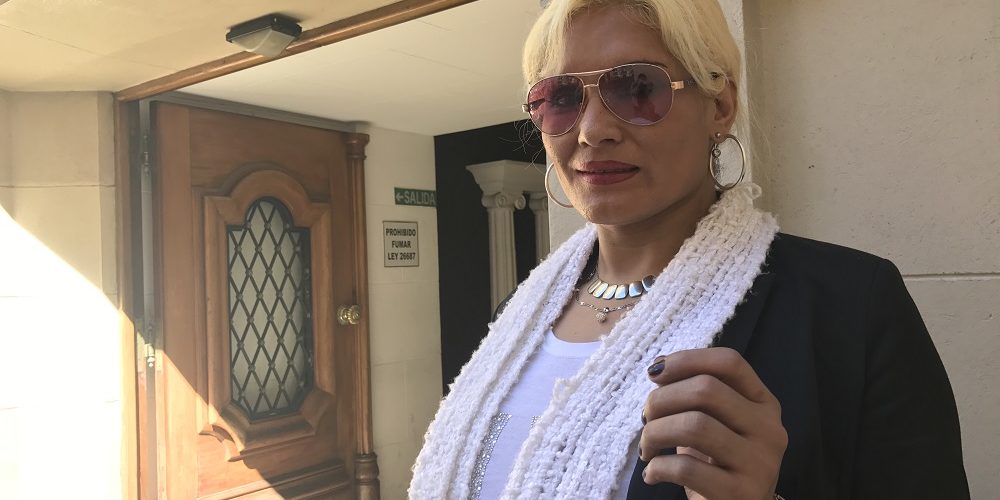
Dalma Emilce Lobo is a 39-year-old trans activist: a survivor in Latin America, where trans people have a life expectancy of 35. This week she was tried for attempted robbery. "It was a fabricated case," she has repeated since October 23, 2014.

Share

By María Eugenia Ludueña
Dalma Emilce Lobo is a 39-year-old Argentine trans activist: a survivor in Latin America, where trans people have a life expectancy of 35. This week she was tried for attempted robbery. "It was a fabricated case," she has repeated since October 23, 2014. That day, police officers from the 18th precinct in Buenos Aires—notorious for its high number of arrests of trans people—accused her of attempted robbery. Emilce ended up beaten and woke up unconscious in Ramos Mejía Hospital. Monday wasn't the first time she had been tried. But it was the first time the courts acquitted her.
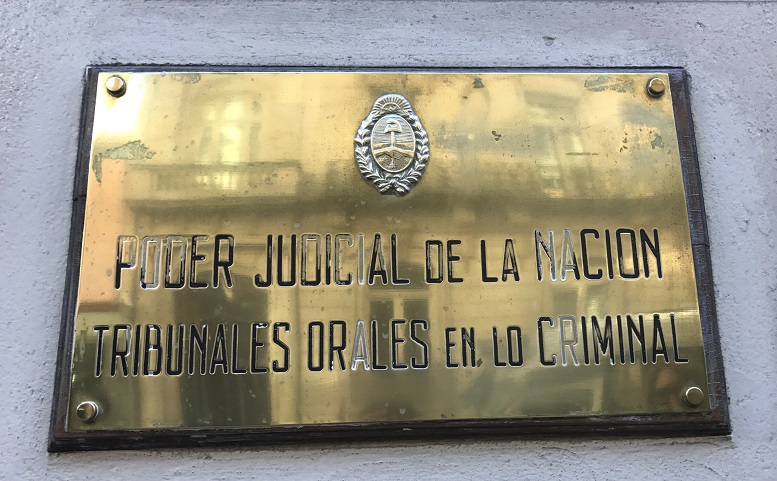
On September 18, Emilce arrived at the courthouse on Paraguay Street with the thought that she could end up, once again, in Ezeiza prison. The same prison where, while serving another sentence, she was almost set on fire.
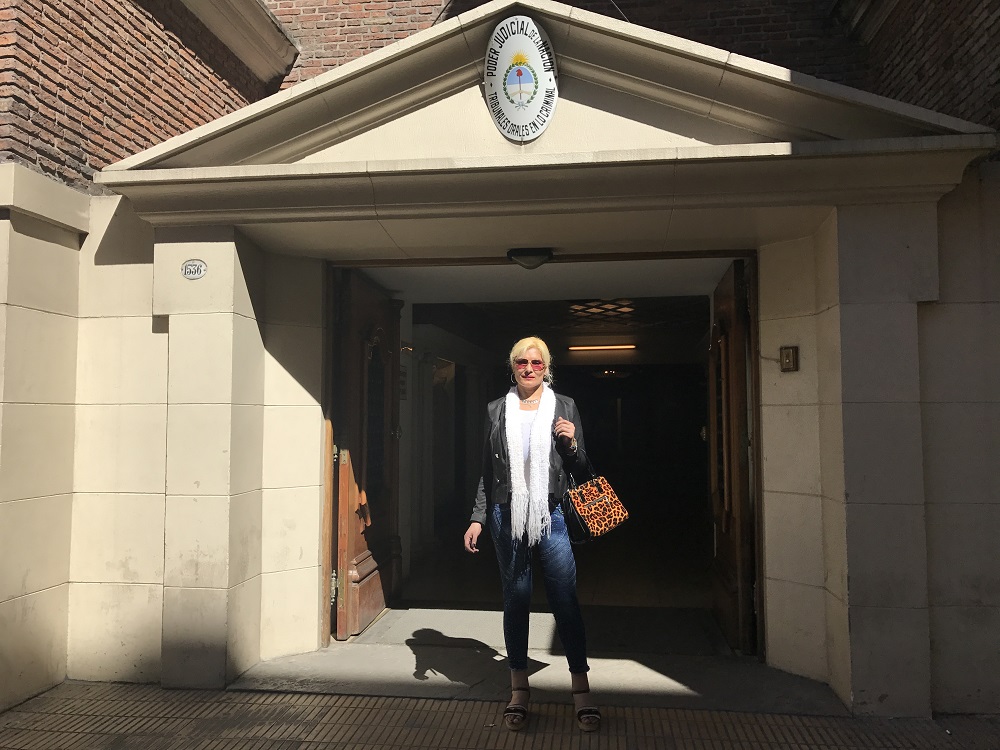
The trial for attempted robbery lasted five hours in the Oral Criminal and Correctional Court No. 24 of the City of Buenos Aires. The courtroom, with its large bench and red carpets, seemed either too big or too empty. There were no more than ten people: Judge María Cecilia Maiza; Prosecutor Ariel Yapur; Emilce's defense attorney, Marcela Piñeyro; the court clerk and an employee; Emilce's partner; a law student; and a police officer.
Emilce sat next to her defender and remained silent most of the time. Every now and then she moved her red lips in a sign of disapproval.
The judge checked her personal information. Emilce was born on August 6, 1978, in Burruyacú, Tucumán. She is married and unemployed. She is living with HIV and has a lung nodule. "I am undergoing treatment in infectious diseases and immunology at the Muñiz Hospital. I am also receiving psychological and psychiatric treatment."
“All three were armed causes”
Emilce was accused in court three times. “All three cases were fabricated by the 18th police station,” she told Presentes . The first time was in 2000. “I was in Devoto prison accused of attempted robbery. They ruled there was insufficient evidence against me. I spent eight months in jail.” Years later, she was accused of homicide. She was sentenced to 12 years in prison.
“At the end of 2007, I was detained in Marcos Paz. They put me in a cellblock with people accused of rape and indecent assault. There were ten of us trans women, and we suffered various rapes. That's where I contracted this disease. We were like that for a year until I decided to report it. My reports are with the UFI (Specialized Prosecutor's Office) in Morón.”
Emilce was one of the pioneers in demanding that trans people be housed in specific pavilions. “In the end, we managed to get transferred to Ezeiza and housed in pavilions divided by gender. We won another step against the system.”
Later, a criminal enforcement judge determined that there were no guarantees for Emilce's safety in Ezeiza prison. She was granted house arrest.
She was serving her sentence under house arrest in Buenos Aires when the police accused her of attempted robbery. Emilce was allowed to leave to go to Muñiz Hospital or run authorized errands. On the morning of October 23, 2014, she was heading to an office of the Ministry of Social Development. Emilce claims she was walking along Saénz Peña Street, between San José and Pavón, when a young man punched her. She woke up in Ramos Mejía Hospital at three in the afternoon. Her purse, her folder with documents, and her jacket were gone.
Emilce says the signatures on the arrest report aren't hers. And that many false things were said that day, for example, that she was drunk. "Because of my medical condition, I don't drink."
The police version
In the attempted robbery trial, three witnesses testified. The first was Sergeant Elizabeth Maidana, who will retire from the force next week. She worked for seven years at the 18th precinct. "It's been a long time," she excused herself more than once, unable to recall details.
"I think it was past noon. I was walking along Sáenz Peña when I heard the sound of shattering glass. I went over and saw someone with half their body inside a van. I yelled 'Stop!' and they threw a light switch cover at me. Being a woman, I asked for backup. I tried to subdue them with as little force as possible until my colleagues arrived very quickly. The girl had a cut above her eyebrow. She was disheveled. She took her purse with her in the ambulance."
The second witness was MC, an employee of a cable video company. He was working a few meters away when he heard something, went outside to see what was happening, and found a person lying on the ground surrounded by police officers. They asked him if he could be a witness.
A biography of institutional violence
Called by the defense, Luciana Sánchez, a lawyer and member of the organization COPADI (Collective for Diversity), testified. Sánchez said she met Emilce six years ago. "My relationship with her is that of a fellow activist. And I was her lawyer in several very serious cases of institutional violence of which she was a victim. I met her because of one of these incidents at the Ezeiza prison, where she was tortured," she said.
Because of this attempted robbery charge, Emilce was taken by ambulance to the hospital, then to police station number 18, and from there to Ezeiza prison. She was sent to the same cellblock where she had been assaulted earlier. At that time, Sánchez filed a writ of habeas corpus, and Emilce was granted house arrest.
Police stations 16 and 18 are targeting transvestites
Colectivo para la Diversidad is an association of lawyers with over 10 years of experience working on institutional violence in the Constitución neighborhood. "We have documented numerous complaints against the Buenos Aires city government for institutional violence in the neighborhood. Police stations 16 and 18 use discriminatory profiling against trans and gender-diverse people engaged in prostitution in that area," Sánchez told Presentes.
Before the judge, she cited reports and statistics from the Public Defender's Office of the City of Buenos Aires showing that in Commune 1 (Constitución), there is discriminatory profiling of transgender people by the police. "It is a practice of the security forces and the judiciary," Sánchez said in court.
He recalled that the Inter-American Commission on Human Rights (IACHR) condemned the State of Brazil for the murder of Wallace de Almeida, a young Afro-Brazilian man who was a victim of targeted police violence in 1998.
“Following this case, the IACHR, the UN, and the European Commission established indicators to identify discriminatory profiling, both group and individual. They determined that the State has a duty of due diligence in vulnerable communities (such as transvestites and transgender people, and their representatives). In this case, we are talking about a discriminatory context in Constitución, reflected in statistics. More than anywhere else in the city, police stations 18 and 16 target transvestites. This has been happening for the last 10 years,” said Sánchez. She then provided the 2015 report.
Armed causes
“Criminalizing a leader sends a message of impunity to the entire community,” the lawyer warned. She then compared the arrests in Constitución and Flores. “While anyone can commit the crime of soliciting sex in public (Article 81), in Constitución this type of offense is applied almost exclusively to trans women. In Flores, it is non-trans women who are persecuted. This makes sense. Statistically, there are more non-trans women in prostitution.”
According to that report, in Constitución, 77.7% of those arrested under Article 81 are transvestites, and 8% are non-transgender women.
The COPADI lawyer recalled that Emilce Lobo reported police violence, and that no investigation was ever pursued. "Another activist, Yhajaira Falcón, was accused by the 18th police station in a case similar to this one," Sánchez said. Yhajaira spent four months in pretrial detention in Ezeiza. The Public Prosecutor's Office then dropped the charges. "She was granted her freedom from the courtroom, something uncommon. The fabrication of that case was so scandalous," Sánchez said. Furthermore, Yhajaira filed a complaint against her lawyer for referring to her as a man. The National Public Defender's Office issued a resolution requiring all lawyers to uphold and respect the Gender Identity Law in court.
Emilce's lawyer also pointed out: "It's striking that this minor case is proceeding, while the other cases where she suffered terrible things aren't being investigated." She emphasized the unanswered questions: If it was a busy area, why isn't there a single witness to incriminate her, or anyone who saw the arrest besides the police? How could they have left her purse if detainees' belongings are confiscated? Why wasn't her blood drawn if they said she was intoxicated? Why are there so many irregularities in the police action? "There is no other option but acquittal," the lawyer stated.
According to prosecutor Yapur, Emilce's attempted robbery was proven, but he described it as "minor." He requested that the exclusion of transgender women be considered a mitigating factor.
"Today a little justice was done."
In the end, the judge decided to acquit her. The grounds for the decision will be released on September 25. “The acquittal is an implicit acknowledgment that this was a case fabricated by the 18th police station,” said Luciana Sánchez. “We need to see the grounds for the decision. I would hope that the judge took into account the gender stereotypes in the testimony of the only witness against Emilce: a police officer from the 18th police station.”
Now the Public Prosecutor's Office can appeal the acquittal or drop the charges against Emilce. "What should happen is that they stop persecuting trans women and start investigating their complaints of harassment and police persecution," said Sánchez. This already happened with another activist, Mama Jems, a leader of Otrans in Buenos Aires, for drug trafficking. Judge Di Giorgi dismissed the case against her. Now Judge Daniel Rafecas and Prosecutor Paloma Ochoa are investigating the complaint she filed.
“This is the first time I’ve been acquitted, a real achievement,” Lobo told Presentes . “My rights have been violated in every way. But my complaints are always pending. Today, a little bit of justice was served.”
We are present
We are committed to journalism that delves into the territories and conducts thorough investigations, combined with new technologies and narrative formats. We want the protagonists, their stories, and their struggles to be present.
SUPPORT US

FOLLOW US
Related notes

We are present
This and other stories are not usually on the media agenda. Together we can bring them to light.