

Luis Larraín: "I want to be the first gay activist to reach Congress"
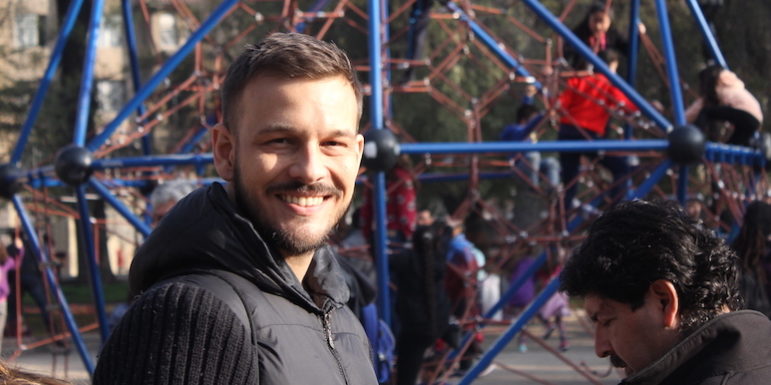
Women tell him he looks like Ricky Martin. He came out at 23 and rose to fame as a model in a campaign for Sebastián Piñera, a politician he criticizes whenever he can. Born into a conservative and traditional Chilean family, he lives with kidney disease, which has led him to clash with the pharmaceutical industry on several occasions. He has been an activist for sexual diversity for five years and wants to be the first LGBTQ+ person elected to Congress. Today he is an independent candidate for deputy.

Share

By Airam Fernández, from Santiago, Chile
Luis Larraín Stieb became a media figure in Chile after a controversial incident with former president Sebastián Piñera. In 2009, he was the face of Piñera's presidential campaign to support the civil union agreement, which at the time remained just a promise. The most memorable part of that campaign ad is the image of two smiling young men holding hands, one of them Larraín, who hugs the candidate and says, "You will be our voice." It caused a scandal. Not only because it was the public coming out of the son of Luis Larraín Arroyo, a man of the traditional Chilean right and founder of the Liberty and Development Institute, but also because it provoked divisions and reactions in the country's most conservative sectors. It was the first time a right-wing candidate had incorporated gay issues into a political campaign ad.
Larraín has had several facets. While at university, he was a model and dabbled in acting. After graduating as a civil engineer, he held a government position. He then became deeply involved in LGBTQ+ rights activism and founded Iguales, along with writer Pablo Simonetti. In December 2016, after nearly four years with the foundation, he announced his departure. Now he wants to become one of the eight representatives for the coveted District 10 of the Metropolitan Region. The district encompasses the municipalities of Ñuñoa, Providencia, Macul, San Joaquín, La Granja, and Santiago, where the seat of government is located.

From his office in Providencia, a mansion he converted into his campaign headquarters, Larraín spoke with Presentes about his life, his leap into politics, and his enthusiasm for becoming the first gay activist elected to Congress. He also discussed the issues he considers most urgent for legislation regarding LGBTI rights in Chile.
In the presidential and parliamentary elections on November 19, Larraín will run as an independent candidate on the Evópoli ticket, a party that supports him “unconditionally,” as he says. Evópoli is part of the coalition currently seeking Piñera's return to La Moneda. Larraín criticizes Piñera whenever he can. Perhaps that's why he frowned when asked if he believes the former president was his springboard: “I don't know if I'd call it that. Because yes, I entered public activism without seeking it. But even before coming out, I was already a kind of mini-activist in the small circles I moved in.”
-First you were a model, then you created a foundation and became an activist. What was that process like?
"I was always interested in raising awareness for the gay cause. But I never thought I'd have to be one of the leaders. It never occurred to me to see it as a source of income, but perhaps as a hobby. But actually, everything I did before and what I do now is connected, albeit quite by chance. When I was a model, I did a lot of scenes with women as my partners. I remember one for Valentine's Day, where I had to kiss one of them, and I felt a bit fake. At that moment, I mentioned that I'd like to do something like that but with a man. Several years later, a film director I'd met while doing commercials called me and told me he was directing the TV ad for Sebastián Piñera's campaign. At the same time, I started working in that government, in the General Secretariat of the Presidency, but not on issues related to sexual diversity. The minister I worked with was extremely conservative, and although he wasn't my direct supervisor, he didn't want any progress on these issues. So I ended up resigning."
-Did you feel used?
No, because in a way I feel I also used them. I mean, in politics there's always a bit of exploitation. Generally, conviction is mixed with electoral calculation, which is always going to exist in a campaign. So I don't feel used because, despite the little progress made, I think it was very good because it opened up the discussion of sexual diversity issues in this country. That same year, when I left the government, I criticized Piñera very harshly, saying that he was beholden to the parties in his coalition and hadn't taken a stand. I still criticize him to this day. At that time, he tried to counter my position by introducing a bill. But doing that and then not prioritizing it is just a media stunt that doesn't reveal a genuine desire to legislate. The issue remained, though, and it ceased to be a niche discussion, becoming a discussion for all of society, and in the end, civil unions were approved by the following government. But it was precisely with this conflict that I realized what I really wanted to do with my life and what I wanted to dedicate myself to.
-What has your relationship with your parents been like? What was it like coming out in such a traditional family?
I think at first my parents suffered a bit like I did, because of the culture of taboo, of secrecy surrounding these issues. Back then, the world was different. Sexual diversity wasn't talked about, or at least not in my world, not among people my age, and certainly not among my parents' age. So I knew they weren't going to understand it so easily. Before my parents even knew, all my friends, my school, and my university already knew because someone had seen me kissing another boy and told everyone. Suddenly, I started getting tons of emails and messages from people asking for advice, telling me they were in a similar situation, asking for help, inviting me for coffee to talk. That's why I always say that even before coming out, I was already a kind of mini-activist in the circles I moved in; that prepared me for the family context. My dad never expected it. The only one who expected it or had any suspicions was my mom, but she was in denial and didn't want to accept it. My psychologist also made things easier with them, because together we designed the plan to tell them. In fact, he was the one who told them, not me, because he thought it was a better strategy to have a specialist somehow "validate" everything, to explain that being gay was normal, that it wasn't a problem or an illness. And that's what happened; I just prepared myself to answer questions. But yes, the first year was very hard.

-How do you see the possibility of becoming the first sexual diversity activist to reach Congress?
“ I want to be the first gay activist elected to Congress, to be part of the group that makes decisions on issues of sexual diversity in my country and in many other areas as well. I see it as a natural process. The idea of a more diverse Congress than the one we have today is an added value. I would love for all groups and all forms of diversity to be included and feel that they have a representative, unlike today, where there is a very hegemonic bias. It is also an honor and a tremendous responsibility, because I would have many eyes on me. The ultra-conservative religious groups will probably be watching everything I say or do, interpreting it as a demonic act. Then there are those who support me, because they will probably be watching closely and will demand that I do things right because they gave me their vote and because they trusted me. There will also be a group of more critical, more dissenting activists. They will basically find fault with everything I do or say; of that I am certain.”
-Are you referring to those who have previously labeled you a "posh activist"?
Yes, in Chile there are many more established activists, longer-standing activists, who have been fighting for this cause for many more years than I have. But they have a very short-sighted and authoritarian view of this issue. Many are left-leaning and don't share the approach we took with Iguales, because I have liberal ideas. But in general, their criticisms have always seemed quite clumsy to me.
-Because?
A long time ago, an activist told me she couldn't work with me simply because her ancestors were my ancestors' nannies. I still can't understand that attitude, although I know it's perfectly possible, because I don't deny history, but it's something I can't take responsibility for; those are decisions I didn't make. I think it's good news that coming from opposite worlds, with different political views, there's a possibility of working toward a common goal, but this more dissenting perspective sees things the other way around. I'm not trying to play the victim here, but I must say that it's a kind of reverse classism, which is much less harmful than the traditional kind—the kind that deprives non-hegemonic groups of opportunities, rights, and dignity—but in the end, it's just as damaging because it perpetuates hatred and generates disunity. When you really want something to move forward, in this case, issues of sexual diversity, the right strategy is to want as many people as possible to join the cause, not to criticize in order to divide. And within activism and politics, that happens a lot; sometimes it's hard to reach an agreement, or very old grudges come to light.
-How do you see Chile in LGBTI issues compared to the rest of the region?
"We're way behind. Same-sex marriage already exists in Argentina, Uruguay, Brazil, Colombia, and Mexico, but not here, although we've been working very hard on it lately. It's an issue that also has a lot of public support, and I think it will be very important in the next Congress. I would love for it to finally be approved during this administration, but I see it as very difficult because there's hardly any time left; we'll have to push it through next year. But it will depend a lot on who the next president is. If it's Sebastián Piñera, he clearly won't prioritize it. On the other hand, there's also the gender identity bill. It's been delayed for four years, and when it was finally approved by the Senate, it happened without some of the gains we had achieved. People under 18 weren't included, among other things. Another issue is that they introduced psychiatric exams as a requirement for legally changing one's name and gender, which I consider pathologizing. It puts a person's identity in the hands of a third party, something only that person knows. We hope to reverse that."
-What things would you like to see replicated here?
If we're talking about copying good practices or figures, I'd love to see a centrist liberal candidate with a modern vision in these presidential elections, but the truth is, I don't see it happening. There's no Justin Trudeau, like in Canada, or a Macron, like in France. That would be a dream. But we're in Chile, and unfortunately, we're not headed in that direction.
-You're on Instagram almost every weekend broadcasting from some vegetable market and always talking to a lot of older people, how do they receive you?
The fun part about going to the fair is that I meet people with a very different profile than what I was used to during my days of intense activism. It's an audience that mostly doesn't know me, or isn't familiar with me, and doesn't know I'm gay. Sometimes they just don't care much about the gay issue, but I always try to find something to engage them with. Lately, women have been telling me I look like Ricky Martin, which makes me laugh, but it's a good way to connect, gauge opinions, and the conversation usually ends up being positive. When I meet evangelicals, it's different because I don't have as much time to focus on trying to open their minds, like I did before when I was with Iguales. Now, the priority is getting votes, and unfortunately, I can't spend much time with them because I've realized that nothing will change those religious groups' minds or make them more tolerant. If their pastor tells them that someone like me is the devil, there's nothing I can do because the campaign doesn't give me the time.

-Are you putting activism on hold?
No, it's just about using the best strategies at the time. I will always be an activist and work for inclusion.
-Besides the cause of sexual diversity, what are your other causes?
"At the Congress, I want to broaden the topics and talk about inclusion in general, including discrimination against women, children, the elderly, and migrants. But for now, I want to focus much more on the issue of health, which has been a kind of mini-activism for me and is very close to my heart. I suffer from a genetic kidney disease that has required me to have two transplants. I'm constantly complaining about pharmacies, private health insurance companies (Isapres), and Fonasa, the public health insurance system here in Chile. I've met with many people from patient organizations, doctors, and foundations, who have shared their experiences with me. Together, we see that many things are very poorly functioning. Other issues that are characteristic of me, and which perhaps aren't as public, are urban issues, because I'm a pedestrian, I travel by subway, bus, or bicycle, and I think there's a lot of room for improvement in that area as well."
-Your brother is training to be a priest and was one of your donors, what is your relationship like?
"My family is very close. It was very hard for everyone when I came out, but that was almost 13 years ago, when I was 23. There's no drama anymore. Luckily, my brother Pedro has been quite open as a seminarian on some issues, and not on others. He's quite critical of the Church, and I think that's to be expected because, as an institution, it has performed rather poorly lately. I like that he's as questioning as I am and not just a sheep following the crowd, although obviously we each have our own reasons and convictions. Even though we think differently and have arguments, like in any family, I will always be eternally grateful to him for donating a kidney to me."
-What do you consider the most urgent issue to address in LGBTI policies in Chile?
-The gender identity law, without a doubt. Trans people are the most discriminated against, have the fewest job opportunities, the least education, and the lowest life expectancy and quality of life. Therefore, that is the most urgent issue, much more so than marriage equality. This is not to belittle the cause, because I know there are same-sex couples with children who are also in a very vulnerable situation. I believe we must move forward in parallel, but the trans community is a much more battered and mistreated community. I believe that the priority right now is them, for their right to live and exist.
]]>We are present
We are committed to journalism that delves into the territories and conducts thorough investigations, combined with new technologies and narrative formats. We want the protagonists, their stories, and their struggles to be present.
SUPPORT US

FOLLOW US
Related notes
We are present
This and other stories are not usually on the media agenda. Together we can bring them to light.
Classist queue! You fight for the privileges of your class. If you weren't Larraín, nobody would take you seriously. You're part of one of the most powerful families in Chile! You're the right wing's puppet, pretending to make progress on minority issues, when in reality they only denigrate and mistreat us! You're a charlatan! Go get married alone, you crazy woman!