

Peter Pank: “Sexist attitudes exist in all musical genres”
Wearing a black bodysuit, lace stockings, and Mickey Mouse ears, Peter Pank flaunts his sculpted physique and sings, “I want to be a girl.” Below the stage, a party of young people dances with eyeliner. The scene seems straight out of the Parakultural of the 80s. But no, it was just a few weeks ago that he and his synthpop-dark-techno band, “Los chicos perdidos” (The Lost Boys), celebrated their first 10 years together.


Share

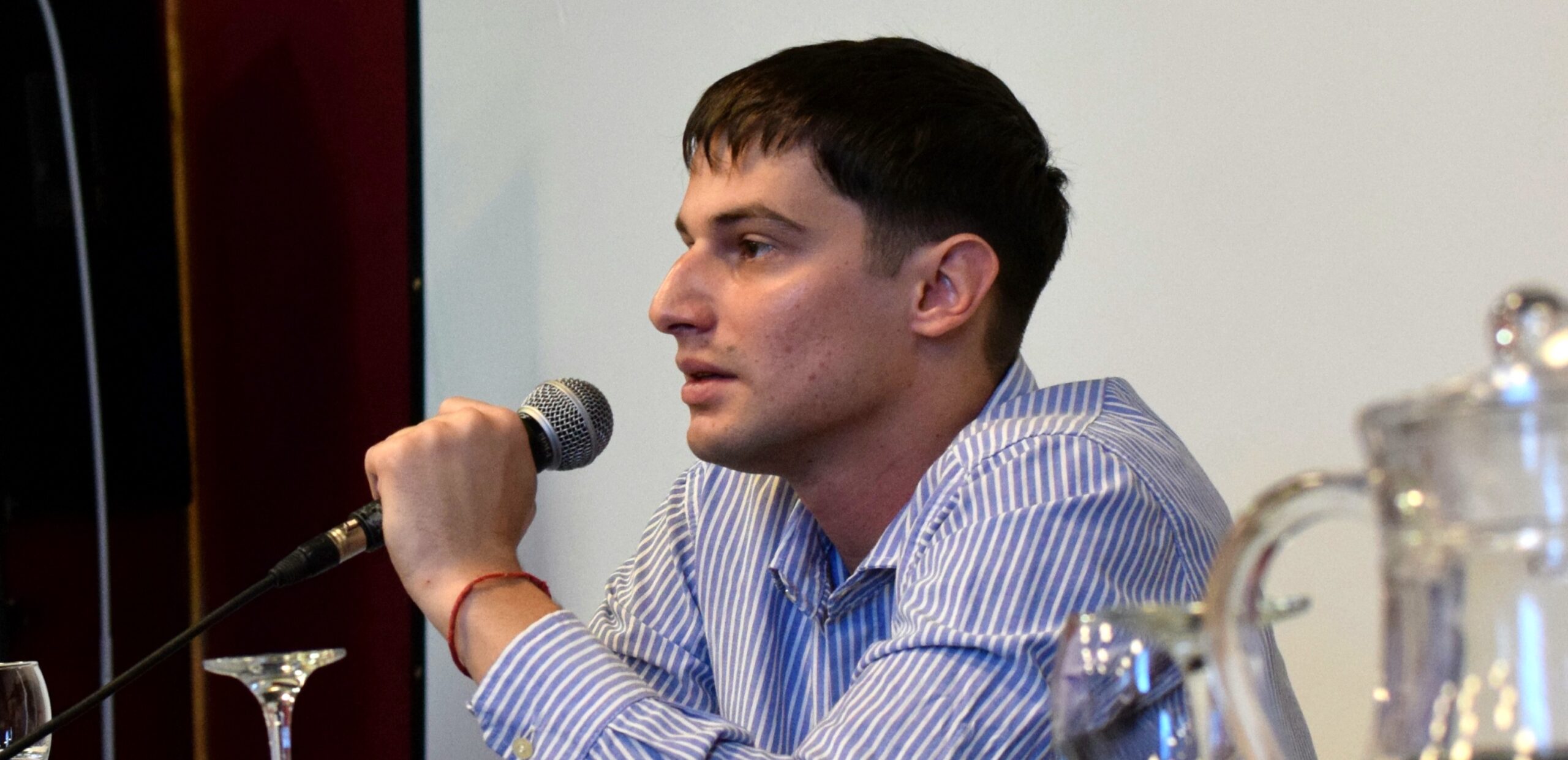
By Luciana Caminos Photos: M. Villagarcía Wearing a black bodysuit, lace stockings, and Mickey Mouse ears, Peter Pank displays his sculpted physique and sings, “I want to be a girl.” Below the stage, a party of young people dances with eyeliner. The scene seems straight out of the Parakultural scene of the 80s. But no, it was a few weeks ago at his latest concert, where he and his synthpop-dark-techno band, “ Los Chicos Perdidos” (The Lost Boys), celebrated their first 10 years. During that time, they have played as the opening act for Boom Boom Kid, La Prohibida (Spain), Dani Umpi, Gaby Bex, Adicta, and Cumbia Queers, among other artists. Peter Pank identifies as queer, genderfluid, or neutral. He recounts that one day he saw the video for Culture Club's song “Do You Really Want to Hurt Me?” and was fascinated by Boy George's androgyny. “Through him I discovered David Bowie and realized that was what I wanted to be: androgynous, neither masculine nor feminine, yet both at the same time. Artists like Michael Jackson and Annie Lennox were a great source of inspiration. I learned to do my own makeup, copying Boy George. I always liked walking that tightrope, without falling to one side or the other. Over the years I've had more feminine and more masculine phases. It's all a construct. I find it very difficult to pigeonhole myself into a gender and answer the typical question of 'Are you macho or feminine? Are you trans?' I am me. I am Peter Pank,” he says. Singer, actor, writer, and performer, Peter Pank was born in Campana, Buenos Aires province, but moved to the capital city as soon as he finished high school. Before dedicating himself to music, he worked in the off-Broadway and underground theater scene in Buenos Aires. He worked in plays by José María Muscari, among other directors, and performed with the legendary Mosquito Sancineto in Ave Porco and El Dorado. He is also a filmmaker: he directed several short films and co-directed, with Goyo Anchou, the feature-length documentary "La peli de Batato" about Batato Barrea, the legendary clown of the Buenos Aires avant-garde of the 1980s. This year he published his novel Tarzán Boy (Milena Caserola publishing house).
-There's a song of yours called "Homophobia" and it says "I'm no worse than you"...
– When I composed it and we recorded it, it seemed anachronistic to me. I thought, "Am I talking about this now, when there are laws and things are changing?" Last year, I experienced a homophobic incident at the gym where I went; I was kicked out based on a false accusation from the instructor. I realized that the song's lyrics are still relevant and valuable, especially with everything that's happening: the attack on the kids in La Plata, what's happening in Chile… While society is becoming more inclusive, these kinds of things from the past still exist. Sometimes I think many people aren't ready to realize that we all have the same rights, that no one is doing anything wrong, or is different, better, or worse than anyone else.
-How did you create Peter Pank?
I've been using the name Peter Pank since I moved to Buenos Aires. I used to hang out at Parakultural and Cemento at night and was heavily influenced by punk and goth aesthetics. I had spiky hair, lots of makeup, and I already dressed in black. Disney's Peter Pan had always been my favorite childhood movie. I never identified with the princesses, but with that boy who didn't want to, and couldn't, grow up—a kind of gift and a curse at the same time. I'd gotten hold of the original novel by J.M. Barrie and was obsessed; I read it and underlined passages as if it were a rite of passage. I always carried that book in my Cure backpack. One night at a lesbian pub I frequented, a girl took my backpack to see what I had. When she found the book, she started making fun of me, relating it to my look and calling me "Peter Pank." It was a nickname that suited me so well that everyone started calling me that, half-jokingly, until I decided to adopt it and began signing the short films I made at the Avellaneda Film School as Peter Pank. I am Peter Pank, that is my name and my identity; what my ID says no longer matters. I built my own identity.-How did you meet Batato and why did you decide to make a film about him?
I met Batato Barea one night at Cemento. Although I'd been a fan of his for a while, we'd never spoken. He was doing a performance where he'd pull you under a sheet and tell your fortune. That's when he gave me a little card with a quote from Alejandra Pizarnik and his phone number. I called him the next day to talk about Alejandra, about the books he had and the ones I had (her work hadn't been republished yet, and they were hard to find). I started bringing him photocopies to his shows, and we became friends. When I had to film my documentary thesis for the Avellaneda Film School, I decided to portray him. I filmed a short called Batato in 1991, which consisted of me going to his house for tea, and we talking about anything and everything. The camera would "get bored" and wander into the bedroom, the bathroom, the kitchen. An experiment. My professors didn't like it at all and told me to redo it or I'd fail the course. So I went back to his house with a film crew made up of a group of colleagues, and we recorded an almost two-hour interview where he told me everything. When I started editing, Batato died. It was a shock. I finished a short film called “14 Peacocks” with that footage, which helped me pass my degree and won awards at festivals. Overnight, Batato had given me a name and a career. That's when I decided I wanted to forge my own path and left film to dedicate myself to performance art and theater. Then, in 2001, I met Goyo Anchou, who called me to act in a remake of Sappho. He kept insisting that I had to salvage all the footage that had been left out of “14,” which was a lot, and only I had it. I didn't want to go back. My goal was music, to become a singer. Then, seeing the film Tarnation at BAFICI, I realized the importance and value of those recordings, and as I left the theater in tears, I called Goyo to ask him to help me make Batato's film a reality.-What has changed in the LGBT community from Batato's time to today?
Everything changed so much. Batato was a revolutionary, among other things, for getting breast implants and maintaining a neutral gender. Back then, there were no laws to protect you from anything, and police raids still existed even in a democracy, sanctioned by police edicts. I spent entire weekends in a police station where they applied edicts 2°F or 2°H to me for wearing makeup and dressing outside the "norms." I was almost imprisoned and had a very long trial before they acquitted me. Soon after, things started to change, and much later came the Equal Marriage and Gender Identity laws. The underground scene can't be the same in the '80s as it is now because it's a countercultural reflection of the society we live in, and society changes, evolves, or devolves. A couple of weekends ago, I participated in the Travesía Travesti show, brought by some women from Chile, which addressed topics such as femicides, transphobic murders, abortion, migration, and animal rights, among other things. Societies will never be perfect utopias, and the role of underground art is to point out what still needs to be done and what the media hides or sanitizes in a conformist way.-Do you think there are patriarchal genres within music?
Patriarchy, sexism, heteronormativity, and homophobia are present in all musical genres because music is made by people, and each person reflects their thoughts in their compositions. Luckily, there are other kinds of artists in every genre who share their dissenting experiences through their songs. Perhaps we won't become popular because there's still so much prejudice. There's always been a huge prejudice against pop, for example, as if all pop music were frivolous, effeminate, prefabricated, and elitist. That's a prejudice. I make synthpop, and I'm very proud of the music I make and the influences that have inspired me throughout my life. Bands like Bronski Beat, Communards, and Dead or Alive made synthpop and were much more political than other bands of that same era. You can see Peter on September 21st in Ferbast, at Espacio Cultural Mi Casa Agüero 787 22 hs. Saturday 16/9 with Los Chicos Perdidos at Karen Bennett's 50th birthday, 9pm Cultural Matienzo, Pringles 241. https://peterpankloschicosperdidos.bandcamp.com/ https://www.youtube.com/user/PeterPankOficial https://www.facebook.com/Peter.Pank]]>We are present
We are committed to journalism that delves into the territories and conducts thorough investigations, combined with new technologies and narrative formats. We want the protagonists, their stories, and their struggles to be present.
SUPPORT US

FOLLOW US
Related notes
We are present
This and other stories are not usually on the media agenda. Together we can bring them to light.