

Politicians out of the closet: interview with Alberto de Belaunde
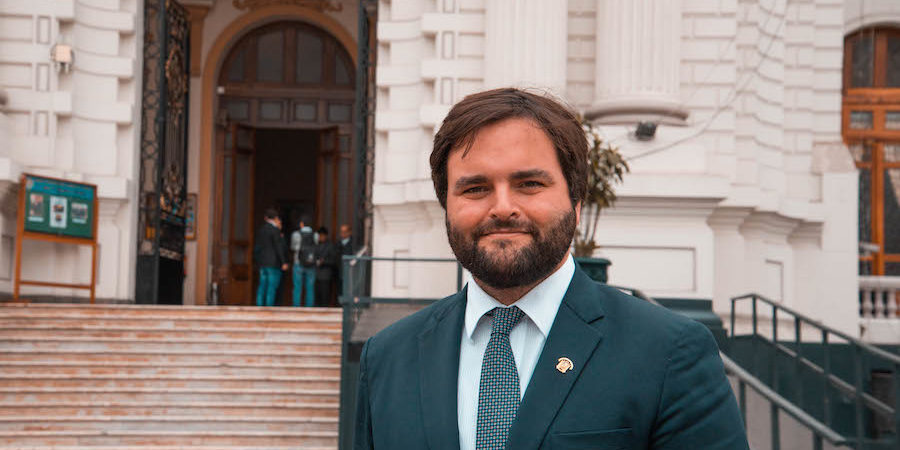
He is 31 years old, openly gay, and a congressman for Peruvians for Change. He has just published "Beyond the Rainbow," a book that compiles interviews with LGBT leaders from across Latin America. In this interview, Belaunde says that we are living through an unprecedented moment in the region, but, quoting Lemebel, he says: "It's not enough to be gay, you have to be gay and something more."

Share

He is 31 years old, openly gay, and a congressman for Peruvians for Change. He has just published "Beyond the Rainbow," a book that compiles interviews with LGBT leaders from across Latin America. In this interview, Belaunde says that we are living through an unprecedented moment in the region, but, quoting Lemebel, he says: "It's not enough to be gay, you have to be gay and something more."
By Esteban Marchand, from Lima
Photos: EM
Alberto de Belaunde was never asked on national television if he was gay when he was campaigning for Congress with the Peruvians for Change party. In July 2016, at just 30 years old, he was sworn in as a member of Congress, becoming the second openly gay member of parliament. He knew he couldn't be the only one, so he began to investigate. Not only in Peru, but also in Venezuela, Chile, Bolivia, Argentina, Uruguay, and Guatemala. This led to the creation of "Beyond the Rainbow," a publication that compiles interviews with LGBTQ+ leaders from those countries.
– Why did you decide to write this book?
The book's origins lie in an anecdotal way: in an interview, a group of students asked me what it felt like to be one of the first openly gay members of Congress in Latin America. I hadn't thought about it and wasn't even sure if the information was true. After the interview, I started researching and realized that we live in a rather unique moment in Latin America, where there are many openly LGBT leaders, not only in public office but also in democratically elected positions. I thought it would be interesting to document this unprecedented moment in the region's history.
– Did you cover all the ones in the region or did you miss some?
– No, due to logistical issues. I had identified 20, but the 13 interviewees provide a different perspective that greatly enriches the collective view of the book.
– Do you think being LGBTI is a guarantee of being a good politician?
No. There's a quote from Pedro Lemebel that I include in the book: "It's not enough to be gay, you have to be gay and something more." Something I was very careful about when selecting the 13 interviewees was that I wanted people who, beyond the common fact of being openly LGBT, had a consistent track record of public work and a commitment to the specific cause of human rights that is clearly reflected in other causes. It would have seemed very inconsistent to me to interview someone who is openly LGBT but votes against human rights issues or holds an anti-reproductive rights position for women.
– However, Luisa Revilla openly supported Keiko Fujimori in the campaign and is included in your book.
– I've focused a lot on seeing how Luisa has developed as an authority figure, and I've found a consistent thread and an attempt to connect with the more organized LGBT movements in her role as a councilwoman. In addition, the fact that she's the first trans official in a low-income district in a province of Peru makes her an interesting character.
– How do you explain this kind of double pressure to stand out while having “the burden” of being LGBT politicians?
– I think it really strengthens the idea of representation, and at the same time it forces you to strike a balance because ultimately it's not the only item on your agenda, but you always have to be aware that you're representing a particular population that has been excluded from formal spaces within the State for a long time. It's definitely a challenge.
– Which of the various agendas, many of which are not strictly related to human rights issues, surprised you the most?
– The example of Tamara Adrián (Venezuela) is super interesting because, being a reference on legal issues in hydrocarbons, she is seen as an authority on those issues, and in turn, that makes people listen to her on other issues.
– And his handling of the human rights agenda is impeccable.
– It's very broad and very rich. And the same is true for Manuel Canelas (Bolivia), because he also plays a pivotal role. He is absolutely committed to the Movement for Socialism (MAS), but because of his background , he engages in dialogue with opposition groups. The legitimacy he gains in these kinds of roles also gives him the legitimacy, space, and political breathing room to address issues like the gender identity law.
– Canelas mention that the issue of discrimination is understood when close situations such as discrimination against indigenous people are raised.
– I mentioned to him that they started with the most difficult issue, which is explaining gender issues to politicians. Civil unions or a hate crimes law are ultimately more relevant situations. I asked him: How did you manage to get a conservative Congress to understand this issue? He then spoke to me about the perspective of exclusion. That's a very interesting strategic option here in Peru.
“We are a deeply discriminatory society. Any type of discrimination is present in Peruvian society: sexism, racism, classism, xenophobia. We are not only a society that is a victim of discrimination, but the victims themselves are also perpetrators in other situations.”
– How do you think that connection could be made in a Congress like the one in Peru?
– This could be an opportunity to talk about this issue. We are a deeply discriminatory society. All kinds of discrimination are present in Peruvian society: sexism, racism, classism, xenophobia. We are not only a society that is a victim of discrimination, but the victims themselves are also perpetrators in other situations. It's a complex relationship of discrimination, and I think everyone in Peru has been discriminated against at some point. And everyone in Peru can talk about how they felt during that moment of discrimination. If we can build this bridge of empathy between how you felt when you were discriminated against and how the LGBT population feels, perhaps we can make greater progress.
– How could that bridge be achieved?
– From my experience this year in Congress, I would say that there is a sector very much against it; a smaller sector very much in favor; and in the middle there are people for whom the issue is not a priority, and that right now many of them are taking a position that they consider to be the majority position in society, but that by reflecting and discussing the issue they can take a militant and more moderate position on these issues.
– There's a question you ask most of your interviewees, and now I'm asking it to you. Have you ever felt questioned in Congress because of your sexual orientation?
– No, but there is an attempt to discredit me by saying I'm a one-issue congressman, and that I dedicate a good part of my book's introduction to defending myself against this attack. If that were true, fine, because I do fulfill a representative role, but it's not. What they're trying to do is pigeonhole me in order to caricature me, and by caricaturing me, you have an interlocutor you no longer have to respond to. That's the strategy we have to confront.
– Do you also believe that the absence of the State has helped the proliferation of the growth of conservative religious groups as Sandra Morán (Guatemala) suggests?
– I found it an interesting and thought-provoking hypothesis. If it's true that when one finds oneself in a situation of need, one turns to the social circle or group that can offer some kind of protection or certainty, then there may be a connection between the level of religiosity and the failures of the state. It would need to be studied further, but it doesn't seem like a far-fetched proposal to me.
– It applies perfectly in Peru.
– That's right, and generally, the more connected and developed a particular group in society is, the easier these issues are for them to understand. This isn't just true here, but in several countries.

– How did you react when several authorities asserted to you that the argument of 'gender ideology' is present throughout the region?
– On the one hand, you don't feel so alone. But on the other hand, what it shows us is that this isn't a phenomenon that's going away; on the contrary, it will continue to strengthen and become more organized over time. But I also have a reflection, which is an optimistic view, and that is that 20 years ago this movement wouldn't have been necessary because it was the status quo. There was no need to defend themselves because nobody questioned it. Now they feel threatened, and that's very good news.
“When you see the trans population and the place given to their agenda in the discussions we have in different gay or lesbian spaces, it makes you wonder, "Are we really a community?"
– Do you think we are an LGBT community or just an LGBT population as Jaime Parada mentions?
– I feel that he may be right. When you see the trans population and the space given to their agenda in the discussions we have in different gay or lesbian spaces, it makes you wonder, are we really a community? Have we truly embraced the situation of absolute vulnerability that the trans population faces? Or does everyone maintain their own perspective on the issue?
– And even within white gays, cholos, poor and rich…
And that's why it makes me a little uncomfortable when a journalist asks me if I've suffered any kind of discrimination in my life. Any openly gay person can point out that they've felt discriminated against at some point, and that makes them a kind of poster boy for discrimination. But it's not the same to be a gay congressman from Miraflores, with all that implies in our country, as it is to have been born in a poor area, be gay, and Black. The situations of discrimination are not comparable. Discrimination is intersectional.
– After hearing the opinions of the authorities you interviewed, what did the debates on LGBT issues in Latin American countries manage to contribute?
– What I get from the book is that it's clearly an unstoppable process. We're on the right side of history, and the question isn't whether these changes will happen, but when. And let's hope it's as soon as possible.
– Does sexism still proliferate in the political sector despite there being fewer lesbian and trans women in public office?
– I asked a couple of interviewees that because I noticed it from the beginning. I was aware that it wouldn't end up being a book by a gay man interviewing a bunch of gay men, making the rest of the community invisible. But the truth is, there's a much larger group, and that's undoubtedly explained by the fact that situations of discrimination aren't just one thing. And opportunities for political participation are tied to the education and political training each person has received.
There is a group that doesn't have any political representation that I've been able to identify, and that's the transgender community. There are more transgender women than transgender men as representatives, and I don't have an explanation for that, but I thought it was worth noting.
“It’s not the same to be a gay congressman from Miraflores, with all that that implies in our country, as it is to have been born in a poor area, be gay, and be Black. The situations of discrimination are not comparable. Discrimination is intersectional.”
Finally, do you think good times are coming for the Justice Commission?
– We will try, without a doubt. Not only for the LGBT community, but also for people with disabilities who have long awaited reform of the civil code regarding legal capacity. Better times are also coming for the protection of women's rights. And in general, for something I believe benefits all vulnerable populations in the country: the reform of the justice system.
We are present
We are committed to journalism that delves into the territories and conducts thorough investigations, combined with new technologies and narrative formats. We want the protagonists, their stories, and their struggles to be present.
SUPPORT US

FOLLOW US
Related notes
We are present
This and other stories are not usually on the media agenda. Together we can bring them to light.