

Public consultation: How to guarantee the rights of LGBTI people in Mercosur?
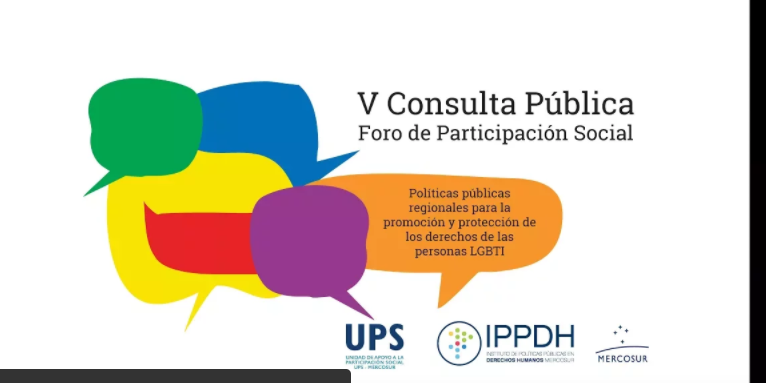
Civil society organizations and social movements are invited to the 5th Public Consultation of the Social Participation Forum, taking place on August 17th in Buenos Aires. This initiative of the Institute of Public Policies on Human Rights (IPPDH) of MERCOSUR will be held at its headquarters, the Memory and Human Rights Space (ExESMA). Live online participation is also possible. Here is the book that compiles good government practices from the region.

Share

Civil society organizations and social movements are invited to the 5th Public Consultation of the Social Participation Forum, taking place on August 17th in Buenos Aires. This initiative of the MERCOSUR Institute of Public Policies on Human Rights (IPPDH) will be held at its headquarters, the Memory and Human Rights Space (ExESMA). Live online participation is also possible. Here is the book that compiles good government practices from the region. What are the most urgent regional challenges regarding the rights of LGBTI people? What responses are organizations demanding from the States of the region? What policies and strategies are lacking to achieve the promotion and protection of the rights of LGBTI people? These are some of the topics that will be addressed at the 5th Public Consultation of the Social Participation Forum, taking place on August 17th in the City of Buenos Aires. The meeting, convened by the MERCOSUR Institute of Public Policies (IPPDH), is a space for exchange and listening among civil society organizations and groups. It will be held at the Institute's headquarters, in the Memory and Human Rights Space (ExESMA: Av. del Libertador 8151). The meeting is open to those who live far from the headquarters, as the consultation will be broadcast live (streamed via YouTube by clicking on this link):
What is a public consultation and what is its purpose?
The MERCOSUR Institute for Public Policies on Human Rights (IPPDH) was established in 2009 by the Common Market Council (CMC). Its functions include technical cooperation with member states, research, training, and support in coordinating regional human rights policies. The IPPDH's Social Participation Forum began with its first Public Consultation in 2015. Since then, it has addressed various topics, including memory, truth, and justice; the rights of victims of trafficking; and education and culture in human rights. This time, the focus is on the rights of LGBTI people. Throughout the day – from 9 a.m. to 5 p.m. – the Consultation proposes an initial debate on the current situation and the assessment of progress and challenges in national and regional policies. Afterwards, a round of proposals is opened, which are developed in groups and documented in a regional social agenda.[PROGRAM AND AGENDA OF THE CONSULTATION ON LGBTI RIGHTS]
“The Fifth Consultation is simultaneously a space to analyze proposals from organizations and social movements for the agenda and the new work plan of the Permanent LGBTI Commission of the Meeting of High Authorities on Human Rights (RAADH) of MERCOSUR,” reported the Communication and Culture Department of the IPPDH. It is also a place for “exchange and analysis of the current situation: local, national, and regional initiatives, practices, and policies regarding the rights of LGBTI people.”BOOK: Good Government Practices (free download)
 Are there good government practices for protecting LGBTI rights? An IPPDH publication compiled some in the book LGBTI: Regional Compendium of Good Government Practices for Guaranteeing and Protecting Rights. It can be downloaded for free by clicking here .
It was presented on May 31, 2017, at the XXIX Meeting of High Authorities on Human Rights and Foreign Ministries of MERCOSUR and Associated States (RAADH). Experts participated in the meeting, working in coordination with the States and incorporating contributions from international organizations such as the Inter-American Commission on Human Rights. Francisco Eguiguren, the IACHR Rapporteur born in Peru, wrote the introduction, outlining a regional human rights landscape. “Lesbian, gay, bisexual, trans, and intersex (LGBTI) people in the Americas face high levels of discrimination, exclusion, and violence due to their sexual orientation, gender identity, gender expression, and/or bodily diversity. These situations of discrimination and exclusion could be defined as a problem of structural discrimination against LGBTI people, since the legal systems and frameworks of the countries in the region are not fully adapted to protect and include LGBTI people in various aspects of life,” Eguiguren wrote. The publication traces the progress made by States, and without overlooking the serious problems that remain, is structured around three main axes: a first part with a focus on rights and international standards, a second part with governmental experiences from Argentina (focusing on transgender children); Bolivia, Brazil and their national public policy conferences; Ecuador, Paraguay, and Uruguay; and finally, concluding remarks for building an agenda of equality and rights. Among these, it states: “The production of information by the State is a fundamental condition for the design, implementation, and evaluation of public policies aimed at eradicating situations of discrimination and promoting conditions of substantive equality among the different social groups that make up a community. Guaranteeing the right to equality and non-discrimination demands, as a starting point, the implementation of public policies aimed at giving visibility to groups in vulnerable situations.”
Are there good government practices for protecting LGBTI rights? An IPPDH publication compiled some in the book LGBTI: Regional Compendium of Good Government Practices for Guaranteeing and Protecting Rights. It can be downloaded for free by clicking here .
It was presented on May 31, 2017, at the XXIX Meeting of High Authorities on Human Rights and Foreign Ministries of MERCOSUR and Associated States (RAADH). Experts participated in the meeting, working in coordination with the States and incorporating contributions from international organizations such as the Inter-American Commission on Human Rights. Francisco Eguiguren, the IACHR Rapporteur born in Peru, wrote the introduction, outlining a regional human rights landscape. “Lesbian, gay, bisexual, trans, and intersex (LGBTI) people in the Americas face high levels of discrimination, exclusion, and violence due to their sexual orientation, gender identity, gender expression, and/or bodily diversity. These situations of discrimination and exclusion could be defined as a problem of structural discrimination against LGBTI people, since the legal systems and frameworks of the countries in the region are not fully adapted to protect and include LGBTI people in various aspects of life,” Eguiguren wrote. The publication traces the progress made by States, and without overlooking the serious problems that remain, is structured around three main axes: a first part with a focus on rights and international standards, a second part with governmental experiences from Argentina (focusing on transgender children); Bolivia, Brazil and their national public policy conferences; Ecuador, Paraguay, and Uruguay; and finally, concluding remarks for building an agenda of equality and rights. Among these, it states: “The production of information by the State is a fundamental condition for the design, implementation, and evaluation of public policies aimed at eradicating situations of discrimination and promoting conditions of substantive equality among the different social groups that make up a community. Guaranteeing the right to equality and non-discrimination demands, as a starting point, the implementation of public policies aimed at giving visibility to groups in vulnerable situations.”
We are present
We are committed to journalism that delves into the territories and conducts thorough investigations, combined with new technologies and narrative formats. We want the protagonists, their stories, and their struggles to be present.
SUPPORT US

FOLLOW US
Related notes
We are present
This and other stories are not usually on the media agenda. Together we can bring them to light.