

Evita, a transvestite, and the body as the center in two of Copi's works
Until September, the production that brings together two works by the Argentine writer, cartoonist, and playwright Copi can be seen in Buenos Aires. “Eva Perón” and “The Homosexual or the Difficulty of Expressing Oneself” revisit – sometimes with excessive solemnity – two works where body and word resonate around power, confinement, and trans identity.

Share

Until September, a production combining two works by the Argentine writer, cartoonist, and playwright Copi can be seen in Buenos Aires. “Eva Perón” and “The Homosexual, or the Difficulty of Expressing Oneself” revisit—sometimes with excessive solemnity—two works where body and word resonate around power, confinement, and trans identity. By Gabriela Borrelli Azara. Photos: Mauricio Cáceres. “We can say whatever we want, words don’t change the world .” A rather Buenos Aires idiom for a statement made in the frozen steppes of Siberia. All of Copi’s theater could be interpreted in this light: distance, coldness, the unexpected, the intimacy of a way of speaking that becomes irreverent, and the politically incorrect pronouncement. “ The Homosexual, or the Difficulty of Expressing Oneself” is one of two Copi plays showing at the Teatro Nacional Cervantes this season, directed by Marcial Di Fonzo Bo, in a double bill that it shares with his no-longer-so-controversial “ Eva Perón .” Di Fonzo Bo himself played Evita in his time, and now he chose television celebrity Benjamín Vicuña for the role, a move that monopolized the discussion about the production. When the play began circulating in the 1970s, many saw in its writing a lack of respect or an unforgivable irreverence toward the mythical figure of Eva. That's no longer the debate. It's Vicuña. And that could be a sign of our times: it's not so much what is said that matters, but who says it. In this case, a media personality, who struggles with the tone of Copi's Eva. His plays only need good actors who understand the irreverence of acting, or of living, or of being gay, or of being Evita. Vicuña is not one of those actors.

Anticipatory transvestism
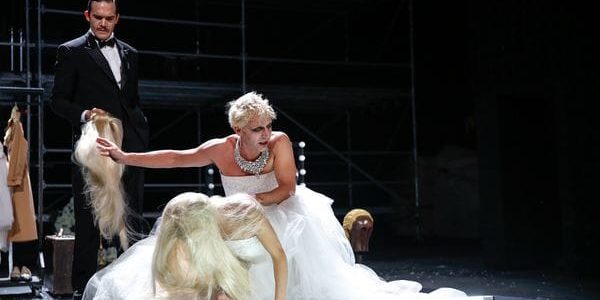
“Homosexuality or the difficulty of expressing oneself” It has everything that the following production lacks. That carnivalesque nightmare, as Eva Perón was once described, is present in the preceding work. The macabre peeks out from under the humor, that blurred line between laughter and horror, and the physical rapture. The acting trio in this play—Mother (Juan Gil Navarro), Irina (Rosario Varela), and Garbo (a brilliant Hernán Franco)—constructs the transvestite and whore-like masquerade that the other trio, Eva (Vicuña), Eva's Mother (Carlos Defeo), and Ibiza (again, Gil Navarro), fails to achieve. A pre-Almodóvar-esque transvestism with a post-war cabaret atmosphere, three trans people who have sex with words or are possessed by them are the protagonists of “The homosexual….” Scene from "The Homosexual..."
In one of the most remarkable moments of Hernán Franco's performance (the great discovery, the one who truly deserves all the applause) his body melts with joy as he repeats, like an orgasmic karma, the question:Why did you have the surgery? Did you want a woman's genitals and not a man's? Why did you have the surgery? Was it before you met Mrs. Simpson?And so it happened several times, in a tangle of words and body. The difficulty of modifying a body alongside the impossibility of changing a word or of that word changing the world.
Scene from "The Homosexual..."
In one of the most remarkable moments of Hernán Franco's performance (the great discovery, the one who truly deserves all the applause) his body melts with joy as he repeats, like an orgasmic karma, the question:Why did you have the surgery? Did you want a woman's genitals and not a man's? Why did you have the surgery? Was it before you met Mrs. Simpson?And so it happened several times, in a tangle of words and body. The difficulty of modifying a body alongside the impossibility of changing a word or of that word changing the world.
Copy-and-paste
Copi's works are displaced; he himself lived displaced. Displaced from a language, a homeland, a family also displaced. Copi is the nickname that the writer, playwright, and anarchist Salvadora Medina Onrubia (wife of Natalio Botana, the legendary founder of the newspaper Crítica) gave to her grandson. Raúl Damonte Botana, his real name, was the son of Georgina, daughter of Onrubia and Botana, and of Raúl Damonte Taborda, deputy and director of the newspaper Popular TribuneA life divided between exile and the search. His early years in Montevideo and then to France. When Eva Perón died, Copi was 12 years old. In 1970, the vigor of his own language, fractured by the political events of his homeland, produced in Copi that Eva PerónDeranged, transvestite, a foreigner in her own home, struggling with her physicality, haunted by power or drugs, consumed by rage. Evita is tormented, driven mad by the prospect of dying young or by the fear of not dying at all. All this that the text conveys is not delivered by the actors or the staging, which seems disorganized not because of height and overlapping spaces, but because of an irreverence that doesn't manifest in the actors' bodies. A solemnity that I don't know where they got it from, but certainly not from Copi's text.
Solemn
The two plays are separated by an intermission where Gustavo Liza speaks to Copi. He seems uncomfortable most of the time with Copi's words in the first person, reproducing fragments of a 1970 interview. At times, he becomes explanatory, as if he needs to justify why we're seeing Copi on one of the biggest stages in Argentine theater. Moreover, the entire intermission ends with a phrase from Copi celebrating national theater. Unnecessary. Gustavo Liza shines more in his other appearances within the plays than in this intermission, which tries to be relaxed but falls short. I'll return to comments from the lobby after the minor stir caused by his plays: can you imagine an Eva Perón played by Hernán Franco? Yes, that's what many of us hoped for—that all the irreverence and power of that performance would be embodied in Eva. We haven't lost hope, because the theater continues to give us Copi. That is to say, irreverence and controversy. The exhibition can be seen until September 9, 2017. From Thursday to Sunday at 8pm. Venue: Cervantes Theatre, Libertad 815 CABA Tickets: $120 / $90 at alternativateatral or at the theater box office.]]>We are present
We are committed to journalism that delves into the territories and conducts thorough investigations, combined with new technologies and narrative formats. We want the protagonists, their stories, and their struggles to be present.
SUPPORT US

FOLLOW US
Related notes

We are present
This and other stories are not usually on the media agenda. Together we can bring them to light.