

Córdoba marched for the first time to say #StopTransvesticide
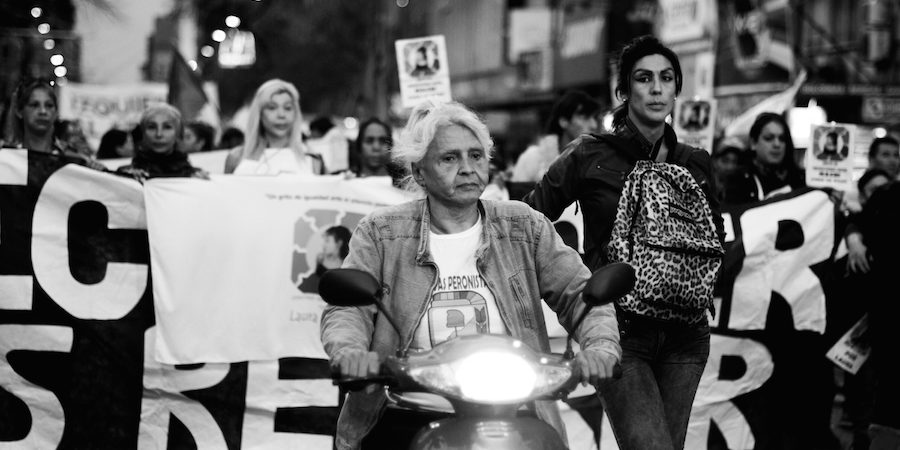
Two years after the murder of Laura Moyano, hundreds of people marched yesterday in downtown Córdoba to demand justice for Laura and to say #StopTheMurderingOfTransPeople: the State is responsible. LGBTQ+ activists, along with family members and neighbors, marched in the afternoon to the Patio de Olmos, where they read a jointly drafted statement, which we reproduce below.

Share

Two years after the transphobic murder of Laura Moyano, hundreds of people mobilized yesterday in downtown Córdoba to demand justice for Laura and to say #StopTransphobicMurders: the State is responsible. LGBTQ+ activists, along with family members and neighbors, marched in the afternoon to the Patio de Olmos, where a jointly drafted statement was read, which we reproduce below. Towards the end, the names of trans leaders and comrades who have died and been murdered were mentioned: Maite Amaya, Lohana Berkins, Diana Sacayán, Claudia Pía Baudraco, Vanesa Ledesma, Estrella Belén Sanchez, Marcela Chocobar, Cindy Arias, Laura Pileri, and Vanesa Zabala. Photos: Courtesy of MedioNegro. Text: Statement from the mobilization. Laura Moyano was a 35-year-old trans woman. She lived in the 9 de Julio neighborhood of Córdoba. She was actively involved in her community and was well-loved by her neighbors. She volunteered in community tasks and was part of the Women's group at Health Center No. 34. She was also attending adult primary school at the community center. She was the breadwinner for her family. During the day, she did all sorts of informal odd jobs, mainly domestic work, and at night she was a sex worker, since, like most trans people, she was excluded from access to the formal labor market.
[READ ALSO: Córdoba prepares to march against transphobic murders]
On July 25, 2015, Laura was found murdered in an abandoned lot in Villa Allende Parque; her body had been brutally beaten. Nearly two years after her murder, those responsible have still not been found. Laura's case adds to a long list of transvesticide and transfemicide that have affected the transvestite and trans population for decades and which, sadly, have increased alarmingly in the last two years. One of the nine cases that Amnesty International considers emblematic of human rights violations and torture worldwide occurred in Córdoba, during José Manuel de la Sota's first term as governor. It is the case of Vanesa Ledesma, a trans woman tortured and murdered by the Córdoba police. Vanesa, an activist with the United Transvestites Association of Córdoba (ATUC), was arrested on February 11, 2000, in a bar during a fight, accused of damaging the establishment. She died five days later in the 18th police station in the city of Córdoba.
Police and three closed judicial investigations indicated that Vanesa died of a heart attack. They also stated that she had AIDS, used drugs, and had a congenital malformation. However, an initial autopsy, the results of which were leaked to the Córdoba press, concluded that Vanesa had “died from blows.”
One of the nine cases that Amnesty International considers emblematic of human rights violations and torture worldwide occurred in Córdoba, during José Manuel de la Sota's first term as governor. It is the case of Vanesa Ledesma, a trans woman tortured and murdered by the Córdoba police. Vanesa, an activist with the United Transvestites Association of Córdoba (ATUC), was arrested on February 11, 2000, in a bar during a fight, accused of damaging the establishment. She died five days later in the 18th police station in the city of Córdoba.
Police and three closed judicial investigations indicated that Vanesa died of a heart attack. They also stated that she had AIDS, used drugs, and had a congenital malformation. However, an initial autopsy, the results of which were leaked to the Córdoba press, concluded that Vanesa had “died from blows.”
[READ ALSO: Córdoba: A trans woman was attacked and the video was uploaded to social media]
Vanesa's body was delivered in a closed coffin. When her companions bravely opened the coffin, they were able to see the marks of torture all over her body. More recently, on November 16, 2016, Estrella Belén Sánchez died in the Emergency Hospital as a result of multiple injuries. All these cases in Córdoba, like almost all transfemicides and travesticides in the country, remain unsolved. This demonstrates that for this cis-hetero-patriarchal justice system, some bodies and lives are more important than others, and as our dear Maite Amaya said, “some of them are worth less to the justice system and the police than the bullet that kills them.” That is why today we denounce and demand: Stop the travesticides and transfemicides! Stop the impunity! The State is responsible! Stop the sexist and patriarchal justice system! We denounce the ineffectiveness of prosecutor Liliana Copel in the Laura Moyano case. We demand progress in the investigation, the clarification of the facts, and that those responsible be found! Justice for Laura Moyano and all the murdered trans and travesti sisters!
 In May 2012, Law 26.743, known as the Gender Identity Law, was enacted, allowing transgender people (including transvestites, transsexuals, and gender non-binary individuals) to legally change their name and gender identity on their national identity documents (DNI). Furthermore, it mandates that all medical treatments related to gender affirmation be included in the Mandatory Medical Program, guaranteeing coverage for these procedures throughout the public and private healthcare system. It is the only gender identity law in the world that, in line with current trends in this area, does not pathologize the transgender condition.
 However, the effective implementation of this law remains elusive. There are no official figures on the number of deaths—not homicides—of trans women in the country. It is known, based on estimates, that the life expectancy for the trans population is 35 years. Romina, Tania, Ana Laura, Cindy, and Karla died due to the absence of public policies that would guarantee them dignified living conditions and access to the healthcare system. They were activists; they knew their rights, they knew they were being denied, and they fought for them. They were transvestites and trans women. They died within a six-day period, between June 25 and July 1 of this year, in the cities of Buenos Aires, González Catán, Mendoza, La Plata, and Reconquista, due to a lack of access to these services.
 The austerity policies and, above all, the feminization of poverty imposed by these ultraliberal, patriarchal, heteronormative, and colonialist governments profoundly affect the trans community, which is structurally poor. We denounce the cuts in medication for people living with HIV and other sexually transmitted infections, the closure of training programs for trans and travesti women, and the elimination of pensions for women with STIs. Therefore, we demand: the immediate implementation of the Gender Identity Law, which guarantees access to healthcare, education, and decent housing for trans and travesti people.
[READ ALSO: Maite Amaya: farewell to the libertarian warrior]
In Argentina, according to official figures, 30% of the population lives below the poverty line. These figures double when it comes to young people between 18 and 29 years old, where 2 out of 10 are unemployed. In the trans community, this figure is even worse: 9 out of 10 young trans people, simply because of their gender identity, do not have access to the labor market, leaving them with sex work as their only option for survival. Transvestite and trans women continue to demand, in the province of Buenos Aires, the implementation of the Diana Sacayán Transvestite-Trans Employment Quota Law, which was approved on September 17, 2015, and remains unregulated. In Córdoba, several bills have been introduced but have not received any attention from the legislature. We understand work as an essential human right for the development of life, therefore we demand: Labor inclusion for trans and travesti people! Trans children free from discrimination and violence! Lohana Berkins wrote: “The control of some populations, including travesti people, is carried out by the State through police edicts, contravention codes, codes of misdemeanors, all these unconstitutional regulations that serve for the police persecution of specific social groups. In this way, our presence and movement in public spaces are restricted, and in the case of travesti people, this limitation of public life is especially serious.” because the street is one of the few resources we have as a collective(…)
 There is an aspect of this attempt to expel certain individuals from public space that has not been widely discussed, and I would like to mention it. It is the role of the street as a stage for the construction of identities. (...) I believe that behind the ongoing efforts to regulate practices that take place in public space—such as prostitution, street vending, and political demonstrations—what we can find is a process of imposing moral values. (...) We trans women do not intend to impose our values and perspectives, but rather we demand the freedom and material conditions to live fulfilling lives with full rights. Because our desire is not to achieve respectability, but to demolish the hierarchies that order identities and subjects, recognizing ourselves as black, whores, Palestinians, revolutionaries, indigenous, fat, prisoners, drug addicts, exhibitionists, picketers, slum dwellers, lesbians, women and trans women, who although we may not have the capacity to give birth to a child, we do have the necessary courage to engender another history.”
[READ ALSO: Laura Moyano Trans Center: “A cry for equality in the face of silence”]
That's why we say: Enough with trigger-happy police and repression! Down with the Code of Conduct! The National Congress is preparing to debate and approve a new law on “religious freedom.” On the surface, this new law reaffirms freedom of worship. But in reality, it expands the privileges of the Catholic Church and extends them to other religions. The bill was presented by the Secretary of Religious Affairs, Santiago de Estrada, a former official of the dictatorship and the Menem administration. It is supported by the Pope, the Argentine Episcopal Conference, the Consultative Board of Federations of Evangelical Churches, the Islamic Center, Orthodox Christians, Mormons, and the Jewish organizations DAIA and AMIA. Instead of moving toward the separation of Church and State and, therefore, a secular state, the new law attempts to equate public morality with religion and represents several setbacks: It reaffirms Churches as public legal entities. State financial support for bishops, priests, and seminarians is maintained. This year, the national government will contribute approximately 32 billion pesos to support the Catholic Church. It allows for individual and institutional conscientious objection. This would enable them to refuse to perform legal abortions and provide contraceptives, or to disregard the Comprehensive Sex Education Law (ESI) and refuse to teach the theory of evolution in religious schools. It protects against sexual crimes and corruption; for example, a priest who knows about abuse can refuse to testify before the courts, invoking the supposed "ministerial secrecy." While respecting all religious beliefs, even those we do not share, today we demand: Total separation of the Catholic Church and the State. A secular state now! No to the Religious Identity Law. Cancellation of all state subsidies to the Church and all religious and private education, to allocate those funds to public education. Abolition of all religious education and prayer in public schools.
This year marks the 11th anniversary of the approval of the Comprehensive Sex Education (CSE) Law. This was a victory for various sectors that mobilized to ensure that sexuality is discussed in public education from a gender perspective and integrated across all subjects. However, this law has still not been implemented in all schools, and the program continues to suffer from defunding by the national government.
State financial support for bishops, priests, and seminarians is maintained. This year, the national government will contribute approximately 32 billion pesos to support the Catholic Church. It allows for individual and institutional conscientious objection. This would enable them to refuse to perform legal abortions and provide contraceptives, or to disregard the Comprehensive Sex Education Law (ESI) and refuse to teach the theory of evolution in religious schools. It protects against sexual crimes and corruption; for example, a priest who knows about abuse can refuse to testify before the courts, invoking the supposed "ministerial secrecy." While respecting all religious beliefs, even those we do not share, today we demand: Total separation of the Catholic Church and the State. A secular state now! No to the Religious Identity Law. Cancellation of all state subsidies to the Church and all religious and private education, to allocate those funds to public education. Abolition of all religious education and prayer in public schools.
This year marks the 11th anniversary of the approval of the Comprehensive Sex Education (CSE) Law. This was a victory for various sectors that mobilized to ensure that sexuality is discussed in public education from a gender perspective and integrated across all subjects. However, this law has still not been implemented in all schools, and the program continues to suffer from defunding by the national government.
 Therefore: We demand the immediate implementation of Comprehensive Sex Education (CSE) in all schools and educational levels! For all the above reasons, and because, as the beloved Lohana Berkins said, “we will never go back to jail,” the time for revolution is now! Today we take to the streets once again to shout with all our indignation and trans fury: Stop the murders of transvestites and transfemicides! Stop the impunity! The State is responsible! Stop the sexist and patriarchal justice system! We denounce the ineffectiveness of prosecutor Liliana Copel in the Laura Moyano case.
We demand progress in the investigation, the clarification of the facts, and that those responsible be found. Justice for Laura Moyano and all the trans and travesti sisters who have been murdered! We demand the immediate implementation of the Gender Identity Law, which guarantees access to health, education, and decent housing for trans and travesti people.
Workplace inclusion for trans and transvestite people. Trans children without discrimination and violence. Mandatory cis-heterosexuality is killing us. Stop trigger-happy police and repression. Down with the Code of Conduct. Secular State Now. No to the Law of Religious Freedom. Immediate implementation of Comprehensive Sex Education (CSE). Mandatory cis-heterosexuality is killing us. Maite Amaya, Lohana Berkins, Diana Sacayán, Claudia Pía Baudraco, Vanesa Ledesma, Estrella Belén Sanchez, Marcela Chocobar, Cindy Arias, Laura Pileri, Vanesa Zabala, Laura Moyano… PRESENT NOW AND FOREVER.
]]>
Therefore: We demand the immediate implementation of Comprehensive Sex Education (CSE) in all schools and educational levels! For all the above reasons, and because, as the beloved Lohana Berkins said, “we will never go back to jail,” the time for revolution is now! Today we take to the streets once again to shout with all our indignation and trans fury: Stop the murders of transvestites and transfemicides! Stop the impunity! The State is responsible! Stop the sexist and patriarchal justice system! We denounce the ineffectiveness of prosecutor Liliana Copel in the Laura Moyano case.
We demand progress in the investigation, the clarification of the facts, and that those responsible be found. Justice for Laura Moyano and all the trans and travesti sisters who have been murdered! We demand the immediate implementation of the Gender Identity Law, which guarantees access to health, education, and decent housing for trans and travesti people.
Workplace inclusion for trans and transvestite people. Trans children without discrimination and violence. Mandatory cis-heterosexuality is killing us. Stop trigger-happy police and repression. Down with the Code of Conduct. Secular State Now. No to the Law of Religious Freedom. Immediate implementation of Comprehensive Sex Education (CSE). Mandatory cis-heterosexuality is killing us. Maite Amaya, Lohana Berkins, Diana Sacayán, Claudia Pía Baudraco, Vanesa Ledesma, Estrella Belén Sanchez, Marcela Chocobar, Cindy Arias, Laura Pileri, Vanesa Zabala, Laura Moyano… PRESENT NOW AND FOREVER.
]]>
We are present
We are committed to journalism that delves into the territories and conducts thorough investigations, combined with new technologies and narrative formats. We want the protagonists, their stories, and their struggles to be present.
SUPPORT US

FOLLOW US
Related notes



We are present
This and other stories are not usually on the media agenda. Together we can bring them to light.