

“We need to ask television to reflect diversity.”
An actress for two decades, Marina Castillo Blanco has forged a path that has taken her from journalism to acting, and from off-Broadway theater to prime-time television in Argentina. Born in Algarrobo, a town of just two thousand inhabitants in the province of Buenos Aires, it was during this same journey that she discovered her sexual identity.

Share

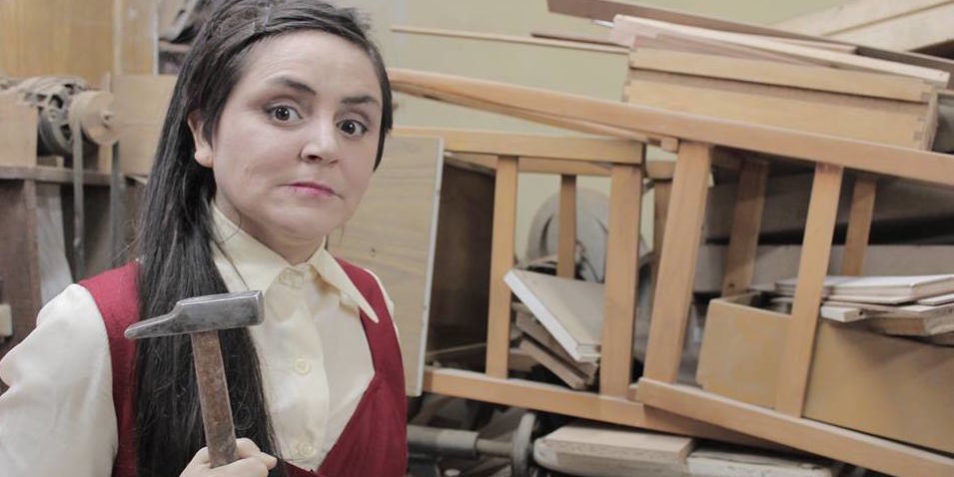
An actress for two decades, Marina Castillo Blanco forged a path that led from journalism to acting, and from off-Broadway theater to prime-time television in Argentina. Born in Algarrobo, a town of just two thousand inhabitants in the province of Buenos Aires, it was during this same journey that she discovered her sexual orientation and identity. By Paula Bistagnino. Like Inés, the carpenter from a small town who wrote and performs in her one-woman show, A Nail in the Heart, Marina Castillo Blanco had to break with societal norms and expectations to build herself. Born in Algarrobo, a town near Bahía Blanca that then had 2,000 inhabitants, it wasn't until she was 18, when she moved to La Plata to study Journalism, that she discovered her true calling was acting. And it was also during this transition that she discovered she was a lesbian. Trained by Cristina Banegas and Norman and Mariana Briski in Buenos Aires, and with Erik De Bont in Spain, her theater career bears the hallmark of the Buenos Aires off-Broadway scene: she has performed in more than 10 plays, including * Lo sé todo *, *Cómicas *, * Las lágrimas que me tragué *, * Animales* , and *Un clavo en el corazón* —the last three of which she co-wrote. In 2008, she began working in television with sketches and comedic characters on comedy programs, and in 2016 she achieved popularity with the character of Perla in * Educando a Nina* . This year, she is part of the cast of the series *Fanny La Fan * on Telefé, where she plays Marilyn.

-You had a late discovery of your vocation and sexual identity… Did they have anything to do with it?
-Clearly, one thing led to the other. As a child, I was always acting, but when I was 18 or 19, I started theater in La Plata. I had a director with a very open mind and a very daring approach to teaching, to the exercises he had us do… For me, coming from a small town, that was a revelation. My classmates, too, came from different places. That diversity, not just sexual, opened my mind to understand other stories, other ways of seeing, other ways of living. Theater had a lot to do with being able to talk about it, but also with being able to see it, to realize it, to take responsibility for it…-Didn't you have to leave your town to come out of the closet?
-In a way, leaving my small town and going to the theater were part of it. But it's not like I was suffering there… I hadn't realized it before. I lived in a town where homosexuality didn't exist. I mean, it didn't exist in the sense that it was seen or talked about. I hadn't even thought about it before. And art gave me freedom. That freedom and many others. I began that process in which I discovered everything all at once, and it wasn't until I was 21 or 22 that I said, felt, knew: I'm a lesbian.
-“ A Nail …” tells a heterosexual love story, but one in which a lesbian grandmother sneaks in. Is identity always present in the creative process?
-There's a look there. A nail in the heart It has two basic themes: one is a love story, and the other is family expectations and vocation. This woman, Inés, the carpenter, is heavily influenced by her mother and grandmother, and her mother by her mother and grandmother, and her grandmother likewise, and so on. And what we wanted to convey with the gay grandmother is that even when everything seems so closed off, there's always someone in the family who escapes that imposed expectation, someone who can help us break with those structures, or who dared to do so. There's a lineage of strong women, a secondary role for the men, almost absent. It's not a straightforward narrative, but of course there's a perspective that I share, as I'm the co-writer with Ezequiel Matzkin, the director.-LGBTI themes are appearing more and more, but always from a stereotypical perspective. Isn't there any other place for diversity?
-There isn't much. I don't see many places where the gay world is portrayed in a simple way and without resorting to stereotypes. It's only been happening and being shown for a few years now. I've been working on series for Underground, and I think they paved the way and are doing it differently. In fact, now in Fanny La Fan There's a trans girl (Julieta Díaz) and a lesbian (Verónica Llinás). And I think it's great that love stories can be told from all perspectives, from diverse backgrounds. I think they're the ones who are opening up that possibility on Argentine television today.
-Almost all LGBTQ+ representation on television is from a heterosexual male perspective: whether it's the effeminate gay man who likes fuchsia or lesbians as a fantasy for men. Do we have to point this out to television and demand something different?
Yes, we have to ask for that and much more: television is so powerful, it shapes so much of the social imaginary, that we can't give up on ensuring diversity is fully represented there. More stories need to be told, all stories, and with equal prominence. We're working on it: until very recently there was absolutely nothing, and it's still opening up, and stereotypes still exist. All of that is true, but that's why we have to keep asking for it and also support and celebrate the producers who are taking the risk to pave the way.A Nail in the Heart, every Saturday in July at 9pm at La Gloria Espacio Teatral (Yatay 890 / Tel: 1135274420)
]]>We are present
We are committed to journalism that delves into the territories and conducts thorough investigations, combined with new technologies and narrative formats. We want the protagonists, their stories, and their struggles to be present.
SUPPORT US

FOLLOW US
Related notes
We are present
This and other stories are not usually on the media agenda. Together we can bring them to light.